
Volkswagen's Taos appears set to move to a new architecture for 2028, with multiple reports suggesting a switch to the MQB Evo platform and the adoption of a self-charging hybrid powertrain.
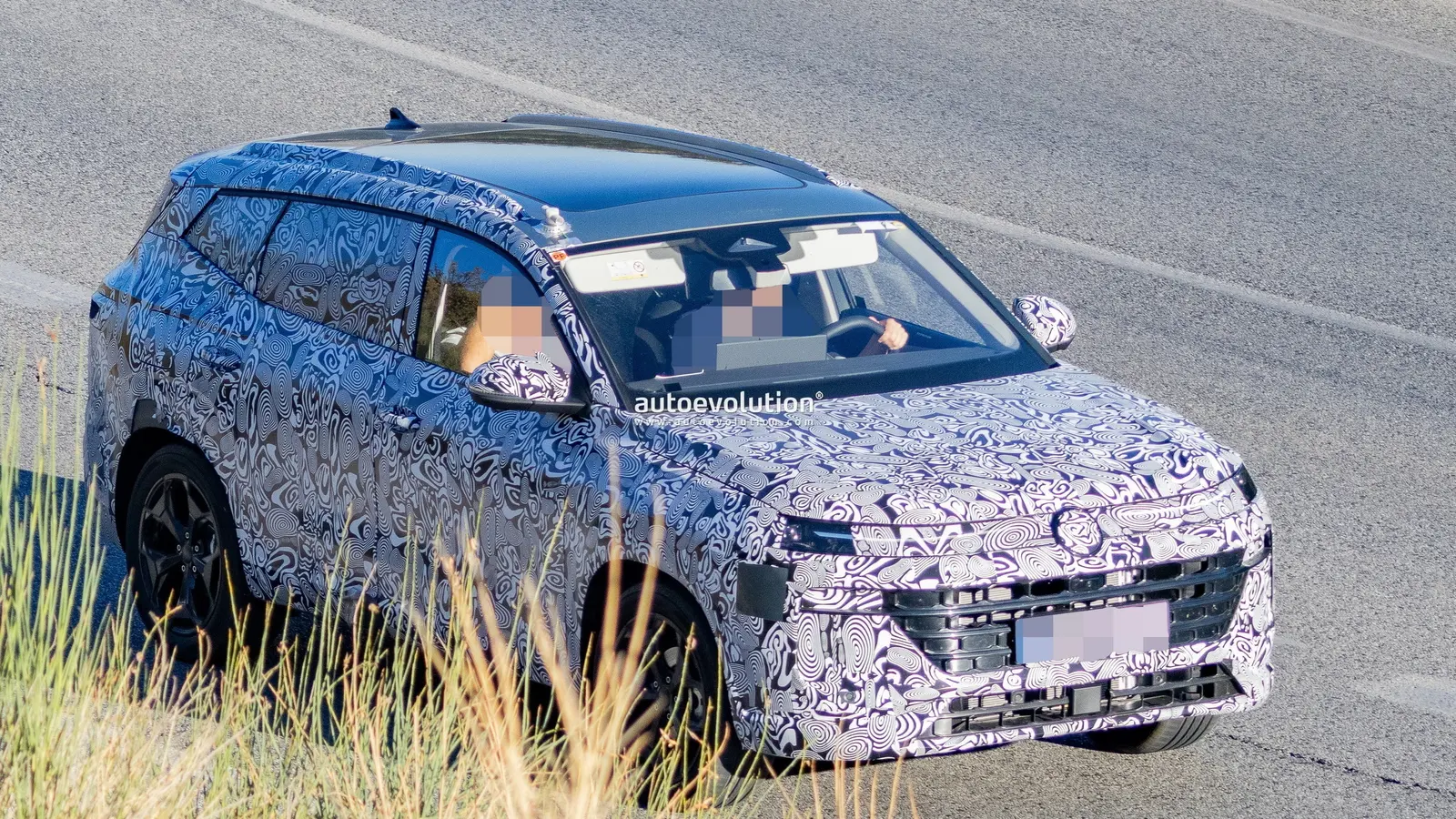
The central development: a full second-generation Taos prototype was spied testing in Spain, wearing heavy camouflage except for a large panoramic roof. The images, captured by SH Proshots, show a comprehensively revised exterior and confirm that Volkswagen is preparing an all-new model expected to reach showrooms as a 2028 model.
Design and exterior changes
The prototype reveals an entirely new front end with a slightly flatter nose, much slimmer headlights linked by a thin light strip that appears interrupted in the centre by the corporate badge, which may be illuminated. The lower grille has been raised and is separated from the bumper by a horizontal slat below the license-plate area. New side vents and a thicker lower bumper splitter are visible as well.
From the side the silhouette remains familiar, though Volkswagen has replaced doors, windows, pillars and other body panels for this new generation. Traditional door handles remain. At the rear, the Taos adopts slimmer taillights connected by a light strip and a centrally mounted tailgate badge; the license-plate recess has been moved to the bumper, leaving the tailgate visually cleaner.
Interior, platform and powertrain
Interior details remain largely concealed, but close-up images show a notably larger tablet-style infotainment screen. Expect a new digital instrument cluster, revised centre console, updated switchgear and steering wheel, and fresh upholstery and trim alongside typical tech and safety updates.
Volkswagen is expected to offer the new Taos on the MQB Evo architecture and to introduce a self-charging hybrid option, according to reports; neither the platform change nor any hybrid specifications have been confirmed by the company.
The current Taos is built on the Volkswagen Group's MQB A1 platform, shared with earlier versions of the T-Roc, SEAT Ateca, Skoda Karoq and Audi Q2. Reports tie the MQB Evo layout to a wide range of Group models, including Golf Mk8, Tiguan Mk2, Tayron Mk2, T-Roc Mk2, Atlas/Teramont Mk2, Skoda Kodiak Mk2, Octavia Mk4, Superb Mk4, SEAT Leon Mk4, Cupra Formentor, Terramar, Audi Q3 Mk4, Q3 Mk3 and Q6 among others, which would expand the Taos' access to different powertrains and technologies if confirmed.
Volkswagen explicitly has not announced an EV version of the Taos; the spy-car’s styling cues may look electric-inspired, but the manufacturer and observers indicate the new Taos will remain a combustion-focused model family with probable hybridisation rather than a pure battery electric vehicle.
Production history and context: the Taos entered production in 2018 in China and began assembly in Mexico for the Americas in 2020. Assembly previously took place in Russia and Argentina but ended in 2022 and 2025, respectively. The current model received a North American mid-cycle refresh for the 2025 model year featuring a revised front fascia, updated lighting, a larger infotainment screen and a retuned 1.5-litre turbocharged engine.
For now Volkswagen is expected to launch the new Taos as a 2028 model, with an official unveiling likely in 2027. In the meantime the outgoing Taos remains on sale in the United States in S, Sport, SE, SE Black and SEL trims. U.S. pricing for the 2027 Taos starts at $26,500 for the entry-level grade and is listed at $27,400 for the Sport, $29,290 for the SE, $31,540 for the SE Black and $35,900 for the SEL. All current versions use the same 1.5-litre four-cylinder engine rated at 158 horsepower; all-wheel drive is optional across the range except on the SEL, where it is standard.


“I cover automotive innovation, electric vehicles, and the future of mobility — where technology meets sustainability.”

Discussion
Leave a Comment
Comments
No comments yet. Be the first.