
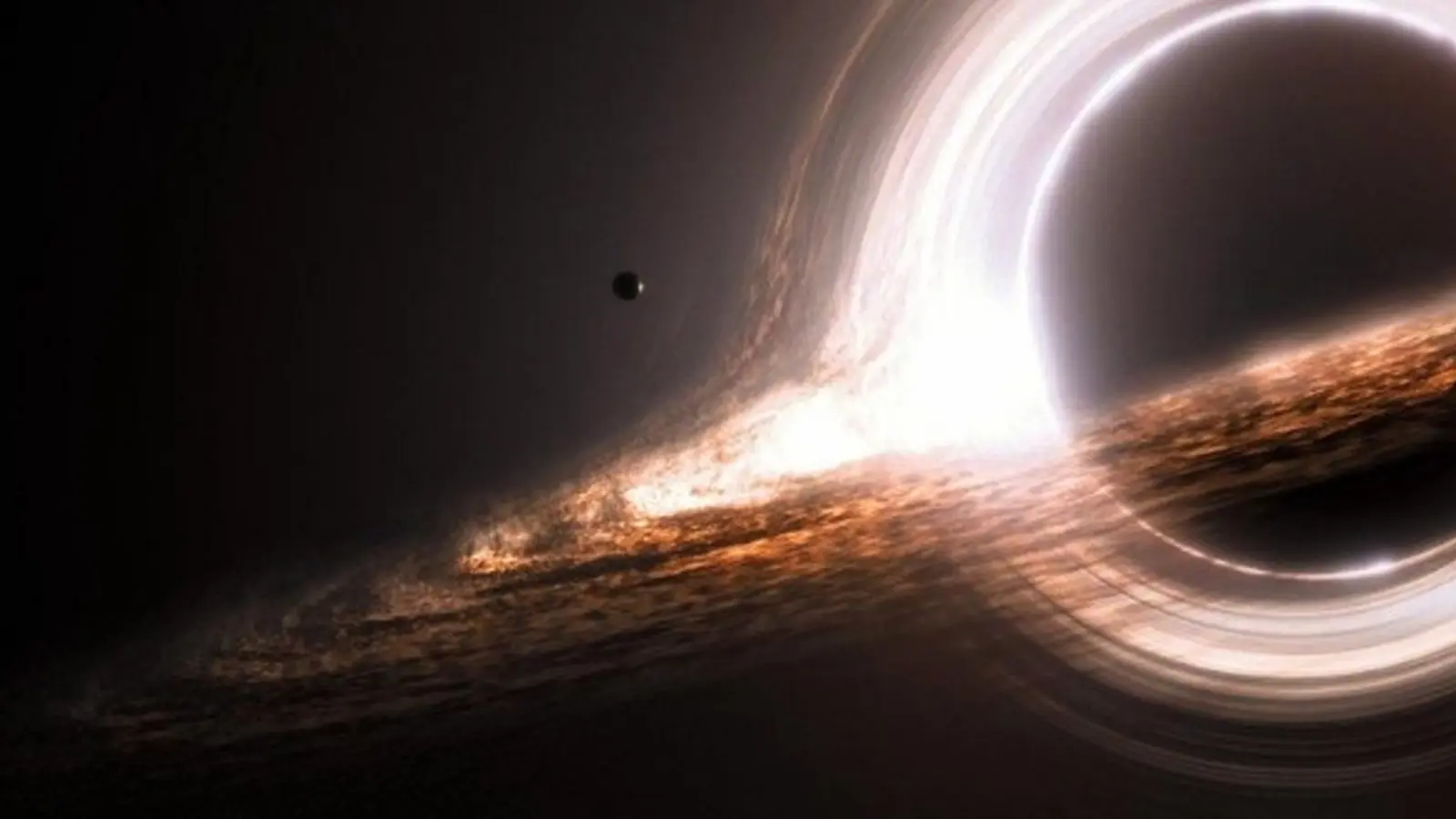
Imagine standing on a shoreline while a hidden storm rips open the ocean. At the center of our galaxy, astronomers have found a similar rupture in the sea of gas that surrounds Sagittarius A*. Instead of only swallowing matter, this supermassive black hole also drives a powerful outflow that carves a cone-shaped cavity through the surrounding hot gas.
Peering through the galactic fog
Sagittarius A* sits roughly 26,000 light-years from Earth and packs about four million times the mass of the Sun into a region far smaller than our solar system. From that compact mass springs gravity so strong that beyond a boundary called the event horizon, even light cannot escape. Yet observing what happens near that boundary is notoriously difficult. We view the galactic center from inside the Milky Way's disk, behind layers of dust, ionized gas, and tangled magnetic structures that blur and absorb the signals astronomers rely on.

To cut through that veil, a research team based at Northwestern University led by Elena Morchikova and co-leader Gursky analyzed very sensitive millimeter and submillimeter observations from the Atacama Large Millimeter/submillimeter Array, known as ALMA. By carefully filtering out the brightest radio emissions close to the event horizon, they revealed faint, extended features that had been masked for decades.
The unexpected cone
The processed maps expose a cone-shaped cavity extending about three light-years from the central black hole. One light-year is nearly 9.5 trillion kilometers, so the structure spans tens of trillions of kilometers. That geometry points to an organized, directed flow of gas—a wind instead of chaotic spillover.

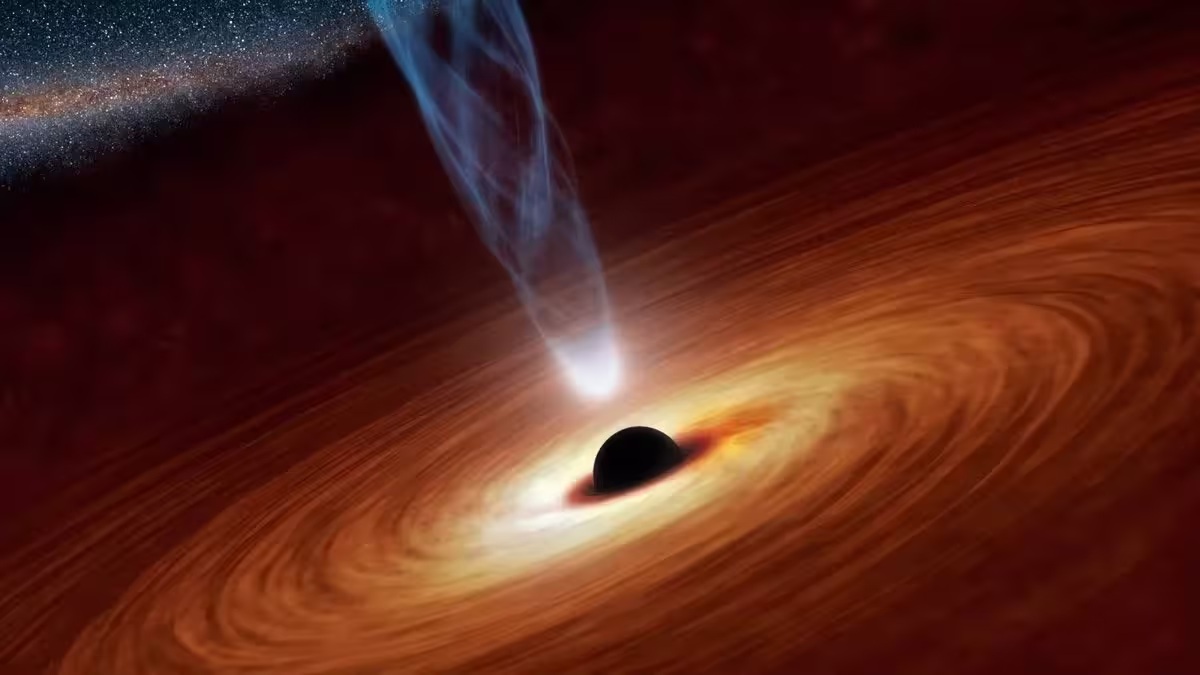
How does this wind form? As gas spirals inward it heats and flattens into an accretion disk around Sagittarius A*. That disk is a furnace of radiation, charged particles, and magnetic turbulence. According to the new analysis, radiation pressure together with magnetic instabilities can redirect a large fraction of the heated gas outward. In this case, the expelled material appears to reach speeds approaching a significant fraction of the speed of light, and the calculated mass loss in the wind may exceed the mass that actually crosses the event horizon.
Such a process flips a long-standing, simplified view of black holes as purely ravenous objects. Instead, the new data imply the center of our galaxy is a dynamic engine that both feeds on and repels matter, a two-way exchange that reshapes the central galactic environment.

Why this matters for galaxy evolution
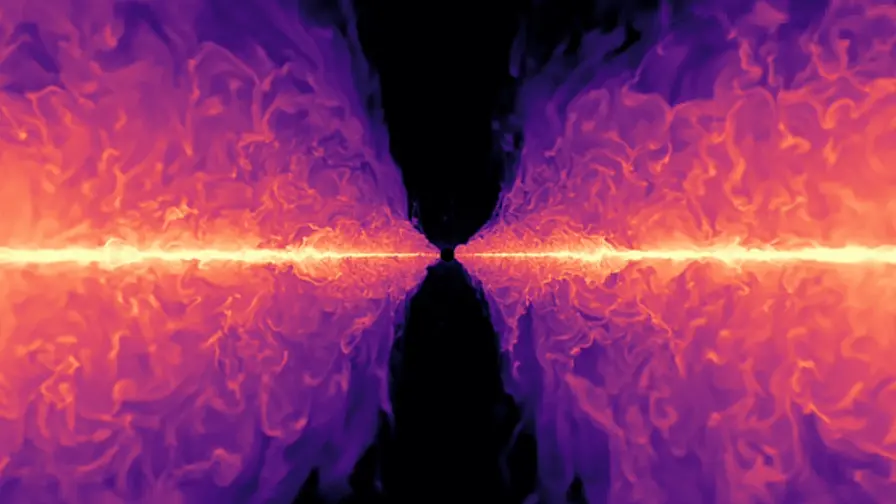
Black hole-driven winds regulate more than the immediate neighborhood of a nucleus. When energy and momentum are injected into the surrounding gas, they change pressure balances, influence where cold gas can condense into stars, and even clear channels through which radiation can escape to larger scales. If Sagittarius A* routinely launches outflows that rival or exceed its accretion rate, those winds could modulate star formation in the central molecular zone and alter the chemical mixing of the inner galaxy.
The new observations were published in Astrophysical Journal Letters and offer an observational template for detecting and interpreting similar phenomena in other galaxies. ALMA’s resolution and sensitivity were critical. By suppressing very bright emission near the core, the team made faint, extended features visible for the first time.
Expert Insight
"We are finally seeing the fingerprints of the black hole's feedback," says a fictionalized composite expert, Dr. Laura Chen, an astrophysicist who studies galactic nuclei. "The cone is like a window into how energy is redistributed in a galaxy. Even a relatively quiet black hole can be influential if it channels its output into directed winds. That changes the lifecycle of gas near the center and, over millions of years, the way the galaxy evolves."
In other words, even when Sagittarius A* appears dim compared with voracious quasars, its intermittent or low-level outflows can have outsized consequences because they act persistently on the dense reservoir of gas in the central few parsecs.
Observational challenges and next steps
Despite this progress, important questions remain. What fraction of the accreting gas is consistently ejected? How steady are these winds over time? Are they collimated by magnetic fields, or shaped by the surrounding interstellar medium? Long-term monitoring across wavelengths will help. Combining ALMA data with X-ray observations and infrared imaging from facilities like the Very Large Telescope and future missions will map how the wind interacts with stars, molecular clouds, and the broader galactic center.

Simulations must also rise to the challenge. Reproducing a cone that extends several light-years requires models that link small-scale plasma physics near the black hole to the large-scale behavior of the galaxy's central gas. That is computationally demanding, but essential if we are to translate images into physical mechanisms.
Conclusion
The discovery of a three-light-year conical cavity around Sagittarius A* reframes our picture of the Milky Way's center. Instead of a passive sink, the black hole is an active participant in galactic ecology, launching winds that sculpt its surroundings. Continued multiwavelength observations and theoretical work will determine how common this behavior is across the universe and how black holes, quietly or violently, steer the fate of their host galaxies.

“My work centers on sustainability, energy, and environmental science — examining how innovation can lead to a greener future.”

Discussion
Leave a Comment
Comments (2)
Mass loss > accretion? Sounds too neat. Are those filters hiding artifacts or is this solid? Need followup, tbh
Wow, a black hole carving a cone? Mind blown. Cosmic gardener vibes, reshaping the core over millions yrs. If real, huge implicatons, whoa