

The headlines landed like a pair of punches. One came from under the hood, the other from inside the battery pack. Both arrive with ambition: to stretch what a car can do inside a fixed shell.
Meet the company that thinks in torque
Horse Powertrain is new but loud. Formed in 2024 by Geely and Renault and headquartered in London, the joint venture quickly folded Saudi Aramco into its shareholder circle and reached a valuation of about 7.4 billion euros that same year. It now runs 17 factories across three continents and five R&D centers, employing roughly 19,000 people. Half of that activity sits in China, though the firm sells hardware and engineering services to a long list of global automakers, including Nissan, Mitsubishi, Mercedes Benz, Volvo and Proton.

What should catch attention is its 3DHT200 hybrid system. Packaged as a compact 13-in-1 solution, Horse Powertrain claims it can deliver up to 4,920 Newton-meters of wheel torque. Yes, that number rings extreme. But the intent is clear: heavy-duty off-road climbs, serious towing and low-speed controllability.
How the 3DHT200 is built to behave
Call it integration. The 13-in-1 label is not marketing fluff. Controllers, P1 and P3 motors, onboard charger, DC-DC converter, power distribution, thermal and transmission management, and a bespoke three-speed hybrid gearbox live in one compact package. That consolidation, Horse Powertrain says, trims system volume by about 10 percent.

Short version: a 110 kW P1 motor wakes the internal-combustion engine and feeds electricity. The P3 motor, at 230 kW, provides main drive torque straight to the wheels. The system can run pure electric, series hybrid or parallel hybrid modes. In town it tends to behave like a range extender. At higher speeds it shifts into direct-drive logic to preserve efficiency. Engineering tweaks to the permanent magnet arrangement, moving from a 2V/VV pattern to a 3V/VVV setup, are said to boost power density without growing motor size.

There is more. The P3 drive motor can spin past 20,000 rpm. High revs help stability and sustained performance at speed. Horse Powertrain puts a 0 to 100 km/h claim around three seconds for the package when installed in the Geely Galaxy Cruiser 700, a boxy flagship SUV that the company lists with a peak system output of 830 kW, roughly 1,113 horsepower. Real-world validation will tell the full story, yet the combination of gears, multi-mode control and electric torque bias is tailored for both trail and highway.
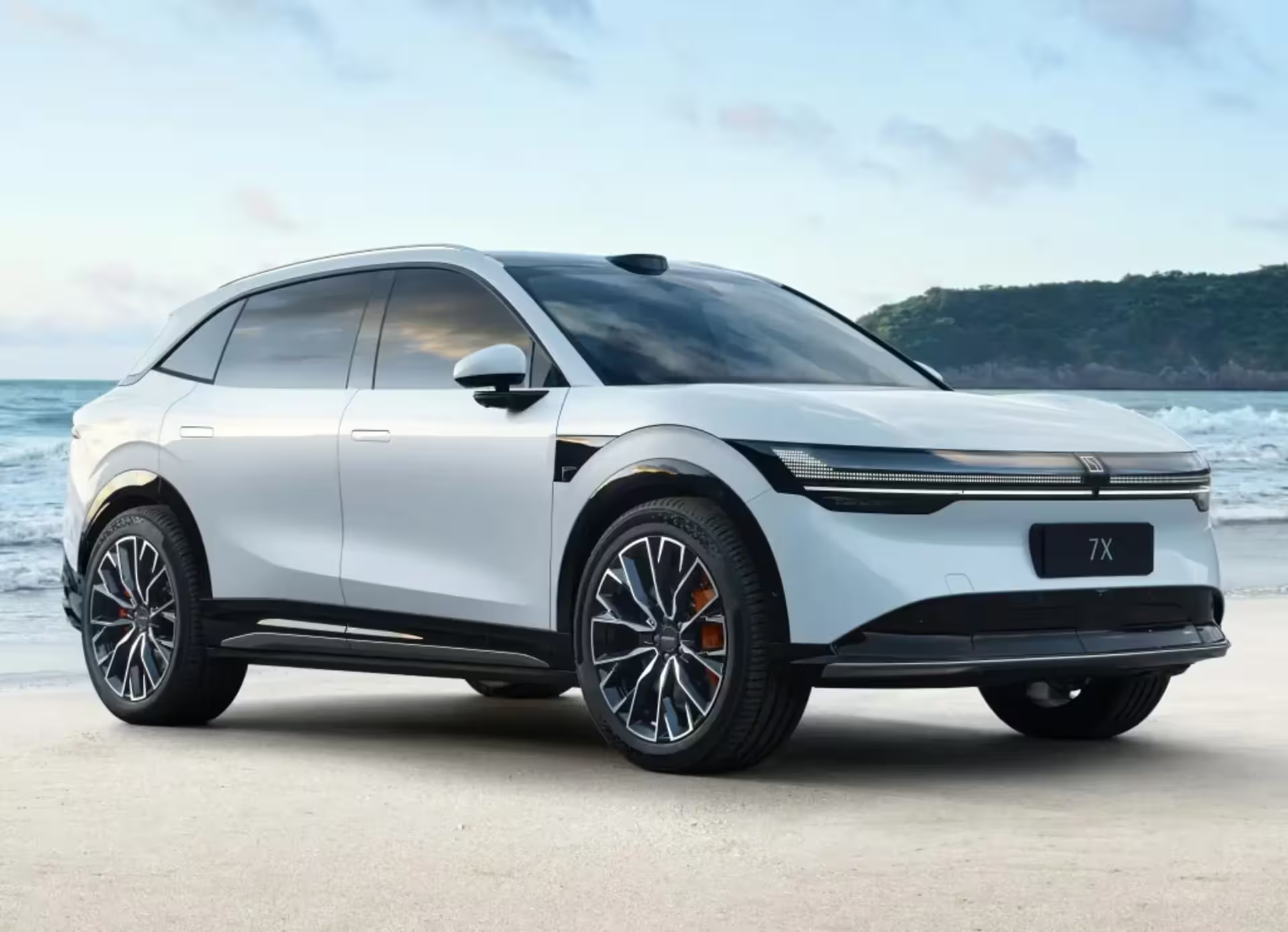
.webp "2026 Zeekr 009 Brings 900V Power to Luxury MPVs")
On paper, fuel numbers look modest for such a big machine. Horse Powertrain quotes about 5 liters per 100 kilometers for the Galaxy Cruiser 700, a figure that only makes sense if engine, electric motors and energy management work in tight harmony. The three-speed gearbox attaches to the ICE while P3 sends torque to the wheels through a single-stage reducer. In the Cruiser this layout pairs with a rear motor to create an e-4WD setup aimed at delivering composure across slow-speed rock crawling and faster road runs.
ZEEKR’s mid-pack battery move
The other story is cleaner in concept: ZEEKR is widening its battery choices for the 7X. The 2027 7X will offer an 85 kWh LFP pack, branded Aegis Golden Brick, built from short blade cells. That pack appears aimed at narrowing the gap between the base 75 kWh and the long-range batteries, giving customers a higher-capacity middle ground.

ZEEKR first showed the 7X in September 2024 and brought it to Europe soon after. The refreshed model in October 2025 bumped peak power from 637 to 784 horsepower. Domestic Chinese deliveries now total more than 136,000 units, according to China EV DataTracker.
Official range and charging specs for the 85 kWh pack are not yet published. Still, placed between the existing 75 and the 103 kWh options, the new pack should nudge CLTC range above 700 kilometers, if ZEEKR’s product mix and efficiency trends hold. For context, a rival like the Li Auto i6 reaches about 720 kilometers with an 87.3 kWh LFP pack.
Current ZEEKR numbers show the standard 75 kWh LFP pack paired with a 370 kW rear motor and a CLTC range of 620 kilometers. That 75 kWh module charges from 10 to 80 percent in roughly 10 minutes and 30 seconds on a 618-volt architecture. The long-range model uses a triple-cell NMC 103 kWh pack with a CLTC figure of 802 kilometers and a similar fast-charge time of about 10 minutes and 15 seconds between 10 and 80 percent.
ZEEKR plans the 2026 fourth-quarter launch of the updated 7X in China. For a short time the brand will bundle optional luxuries with purchases, such as electric rear seats, a built-in refrigerator and 20-inch multi-spoke wheels. That options package is priced at about 2,470 euros.
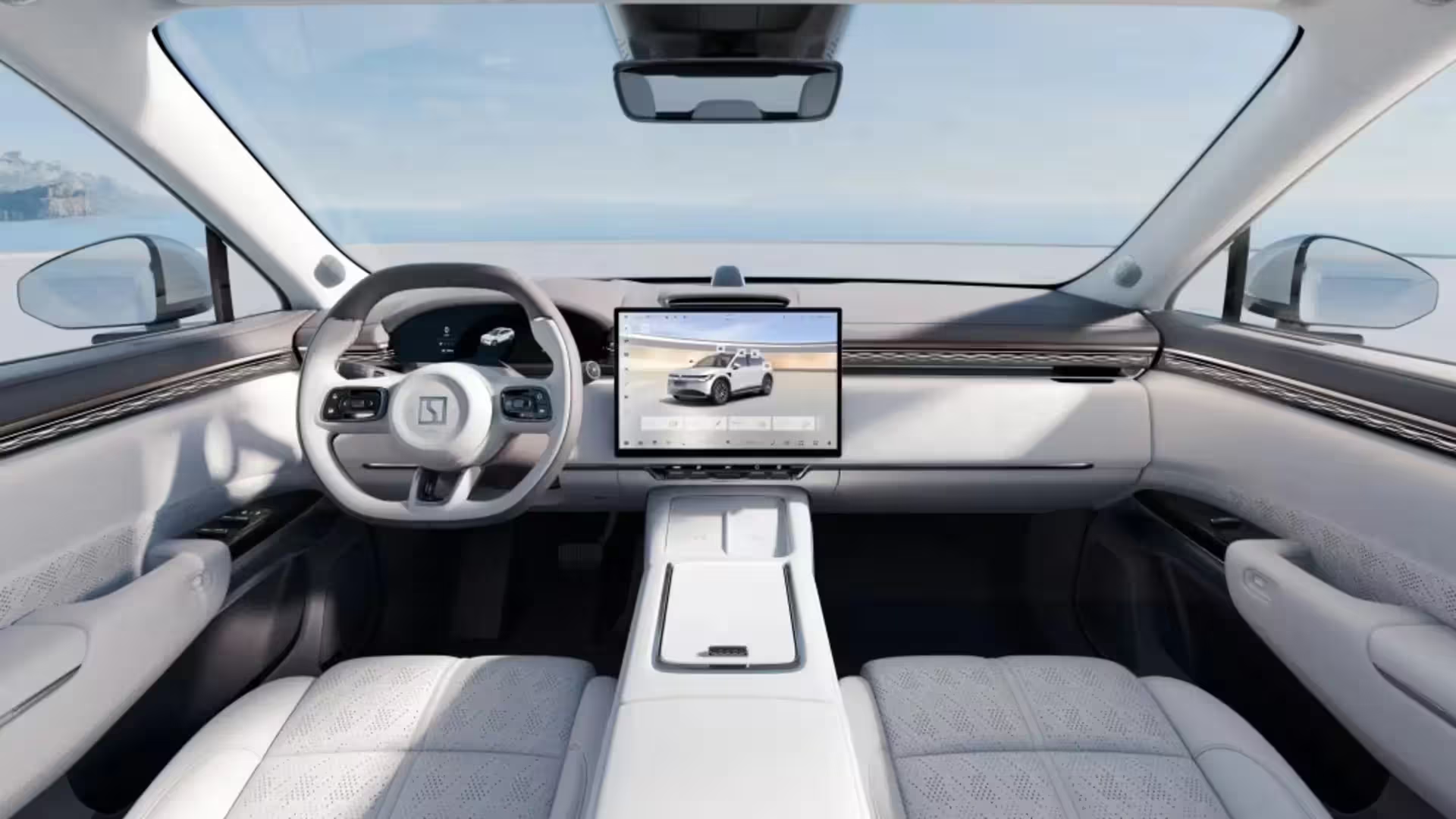
In China the 7X measures 4,825 by 1,930 by 1,666 millimeters with a 2,925 mm wheelbase. Two powertrains are available there: RWD at 370 kW and AWD at 585 kW. Local pricing starts around 31,800 euros and stretches to about 37,340 euros. Global versions are slightly re-dimensioned and carry WLTP ranges: a base rear-drive variant with a 75 kWh LFP pack claims 480 km, while a long-range 100 kWh NMC option reaches up to 615 km WLTP. The global top-tier dual-motor model offers a combined peak around 475 kW.
Two developments. One looks to make hybrid systems more electrically capable and better packaged for tough duty. The other tightens battery lineups to give EV buyers more balanced choices. Both race toward the same prize: more capability from the same box.
Which path matters most to you? Torque for trail and tow, or extra range and flexibility in the battery bay? The market will answer, but for now China’s engineers are proving they can push both frontiers at once.

“I cover automotive innovation, electric vehicles, and the future of mobility — where technology meets sustainability.”

Discussion
Leave a Comment
Comments (3)
Nice to see the mid 85 kWh LFP move, but will it actually nudge WLTP above 700km in real traffic? Feels optimistic, pricing is sharp tho
Is this even true? 20,000 rpm motor and 3s 0-100 in a big SUV... sounds like bench hype, where's real world data ?
Whoa that torque number is insane! 4920 Nm? If real, that Galaxy Cruiser could tow a house... but hope they tested durability, not just bench numbers