
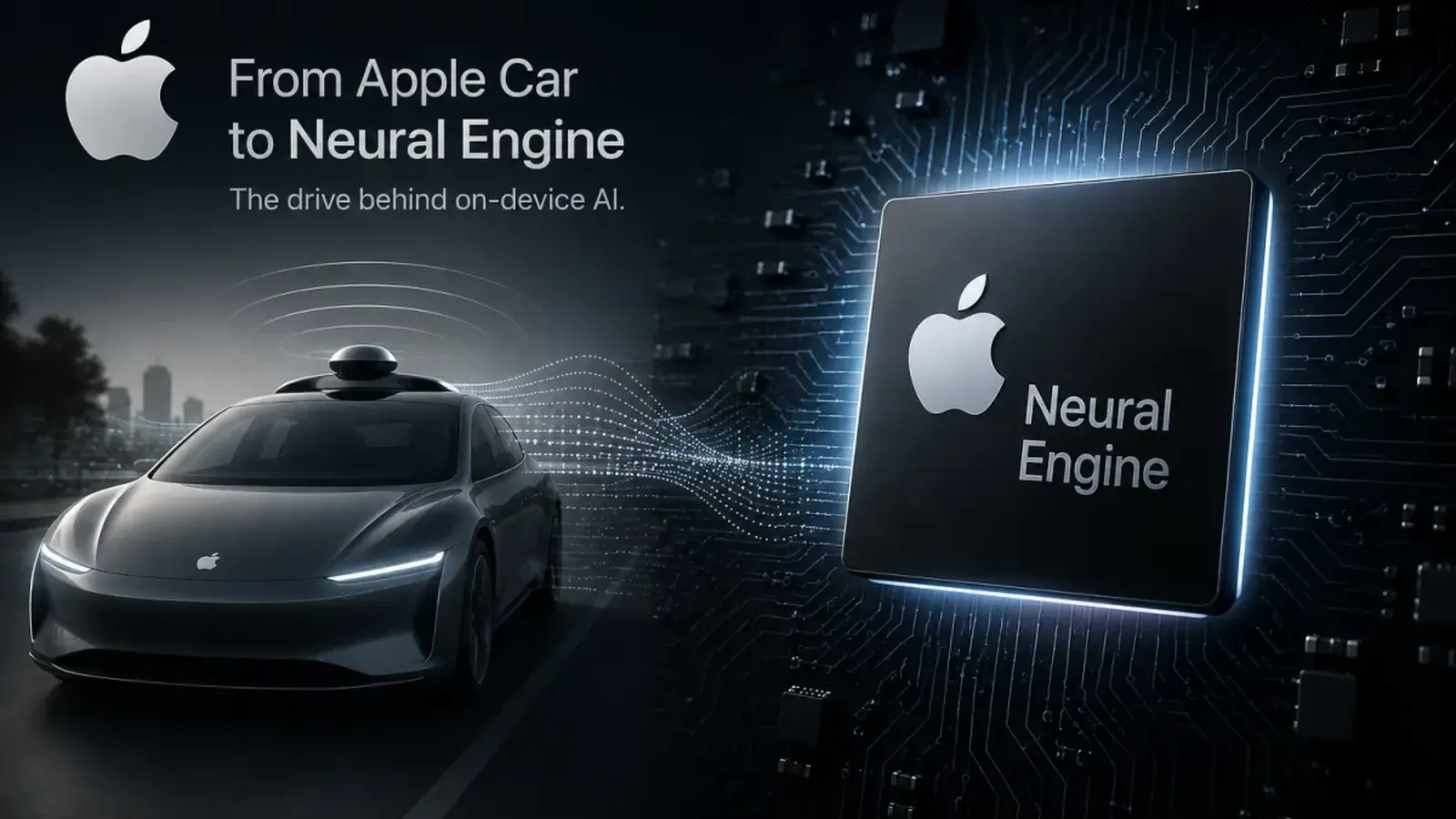
Picture a quiet test track at dawn: engineers pacing beside prototype shells, cameras humming, and a plan so ambitious it blurred the line between carmaker and tech giant. That project never made it to showrooms. Yet its real legacy lives inside iPhones and Macs.
From secret test tracks to the silicon inside your phone
Apple's cancelled self-driving car effort forced a hard question on its chip teams: could the company trust remote servers to do the heavy lifting, or did the future demand powerful AI right on the device? The answer reshaped Apple silicon.
The bespoke processor envisioned for that car never reached production. Instead, the work seeded what we now know as the Neural Engine, Apple’s dedicated on-device AI hardware. Launched with the iPhone X and the A11 Bionic, it began life solving vision tasks — face recognition, Animoji, and early augmented reality experiments. Short, fast, and local. That was the point.
Why does on-device AI matter? Speed. Privacy. Resilience. When your phone can infer, filter, and react without pinging the cloud, interactions feel instant and data stays closer to you. Apple extended that philosophy to desktops and laptops via the M-series chips, reducing reliance on external servers and staking a claim as a leader in edge AI.

News now suggests another strategic pivot. Apple reportedly has no plans to launch Pro, Max, or Ultra variants of an unreleased M6. Instead, the design teams are accelerating M7 development. Expect to see that chip in the first half of 2027, with a major boost to its Neural Engine capabilities.
And there are server ambitions too. The flagship M7 Ultra is slated to anchor Apple's new server lineup, supporting up to 1.5 terabytes of RAM. That configuration signals a move to consolidate AI processing across devices and backend infrastructure, keeping more workloads within Apple’s ecosystem.
So the car that never was still steered the company toward a different road: prioritizing on-device intelligence. It’s a reminder that failure can be directional, not terminal. The prototypes may have been scrapped, but the lessons they taught continue to drive chip strategy and, ultimately, the user experiences people notice every day.

“I cover automotive innovation, electric vehicles, and the future of mobility — where technology meets sustainability.”

Discussion
Leave a Comment
Comments
No comments yet. Be the first.