
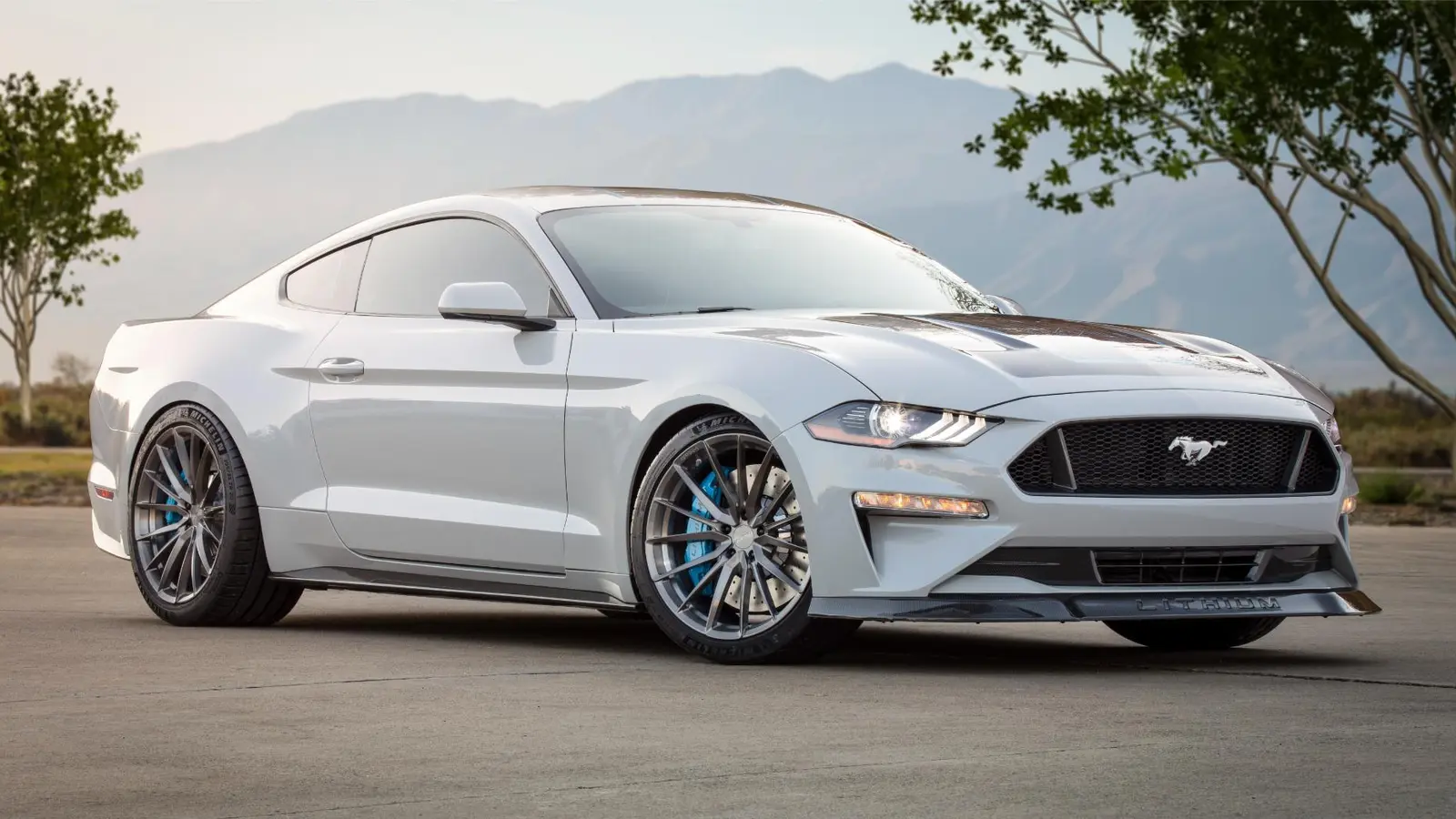
The 2019 SEMA show was a circus of chrome and noise, yet tucked between the over-the-top builds sat a Mustang that spoke in a different register: quiet, focused, slightly mischievous. At first glance it looked like any other S550 Mustang GT. Then you noticed the clutch pedal. Then the six-speed shifter. Then the fact that the engine bay held batteries and an axial-flux electric motor instead of a V8.
This was the Mustang Lithium, a one-off from Ford Performance and supplier Webasto that dared to answer a question most manufacturers had quietly avoided: what if an electric car could still demand your footwork and gear changes the old-fashioned way?

The three-pedal plot twist
On paper it reads like a stunt. Nine hundred horsepower. 1,356 newton metres of torque. Dual-core axial-flux propulsion developed by Swiss firm Phi-Power AG. An 800 volt electrical architecture. Split battery packs under the hood and over the rear axle, each holding up to 35 kWh. All packaged inside a Mustang body that kept its silhouette and much of its character.
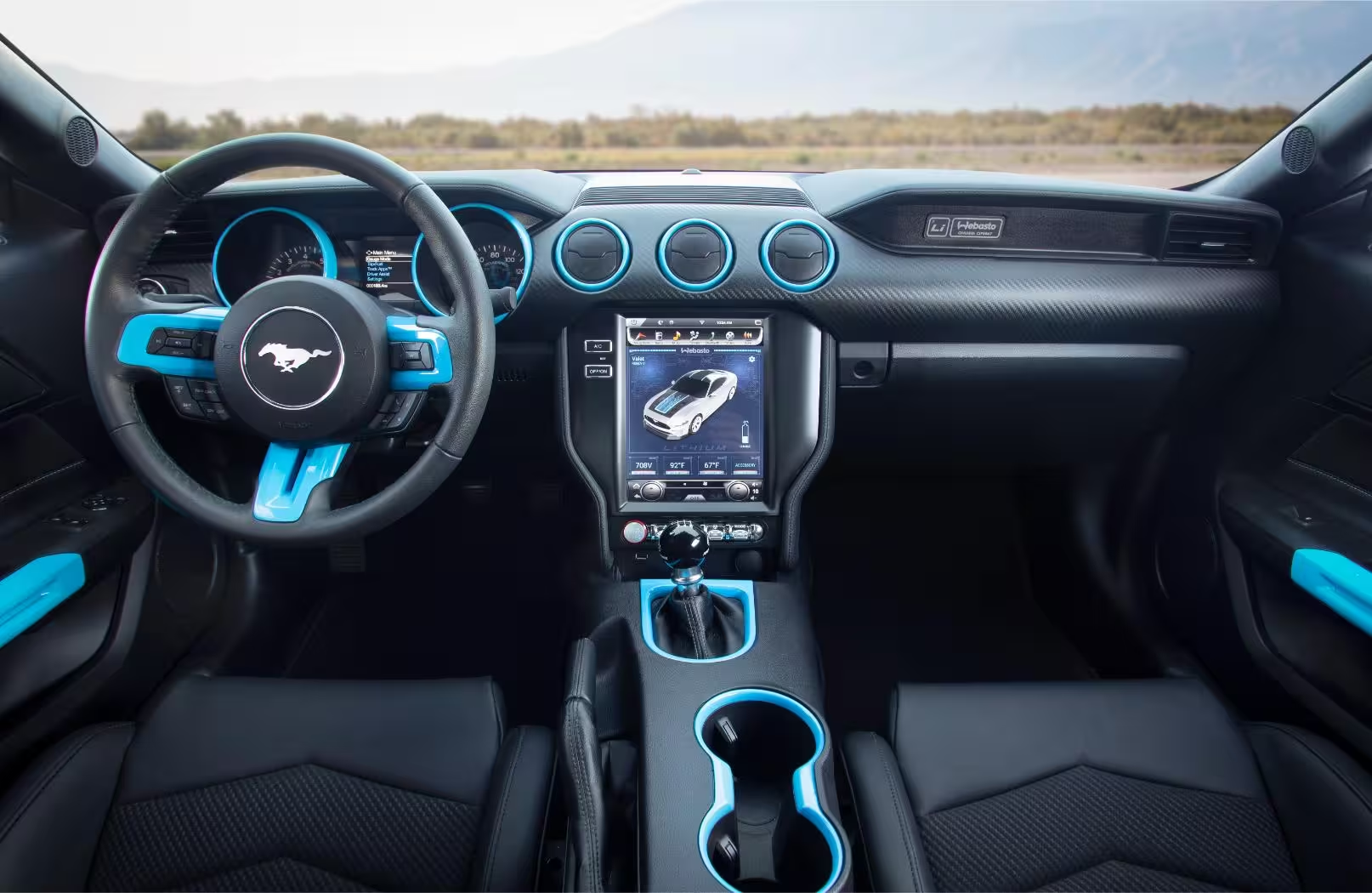
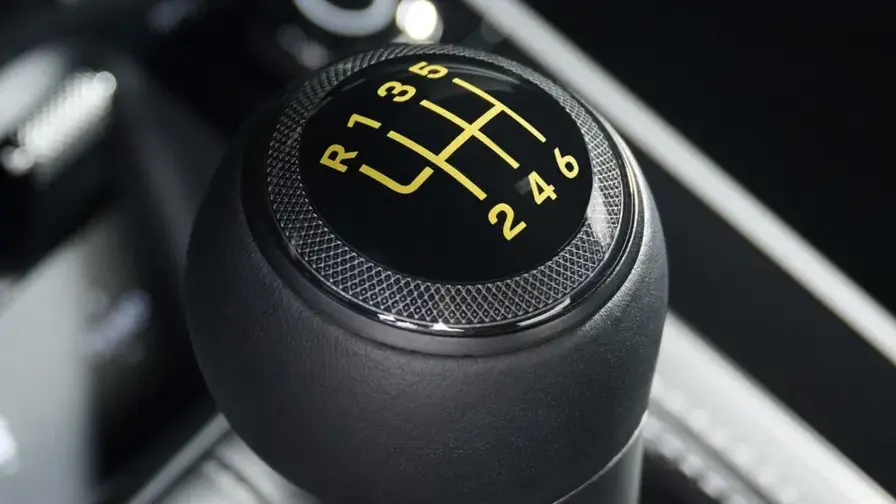
But the headline was not the power figures. It was the Getrag MT82 manual transmission bolted to that electric motor, complete with a reinforced clutch and a third pedal. Why is that remarkable? Because electric motors make full torque from zero rpm, which normally makes multi-gear transmissions unnecessary. If you fit a manual gearbox to an EV and do nothing else, the gears will experience brutal torque shocks every time the clutch is let out. The Mustang Lithium’s engineers solved that the old-school way: strengthen everything.

Ford and Webasto handed an MT82 to a specialist named Calimer. Internals were replaced with billet components, gearsets and synchronizers were beefed up, shift forks hardened. The result, Ford said, was drag-strip proven. A Super 8.8 Torsen limited-slip differential and half shafts from Ford Performance completed the drivetrain package.
Short sentence. It worked. The car behaved like a manual muscle car, except instead of a revving V8 you had an electric motor that shoved you back into the seat the instant your right foot asked for it.
There’s a lesson in that contrast. Manuals orchestrate an engine’s rise through a power band. An electric motor has no band to climb. So the transmission’s role became less about managing torque curves and more about giving the driver a tactile interface. For many enthusiasts, that tactile feedback is the point.
Small changes, clever packaging
Fitting an electric powertrain into a chassis designed for internal combustion required imagination. The S550 platform had no flat floor for a single pack under the cabin, so Webasto split energy storage into two modules: one where the V8 used to sit, and one where the fuel tank lived. That arrangement created an almost 50:50 weight distribution, a rarity for Mustangs carrying a heavy V8 up front.
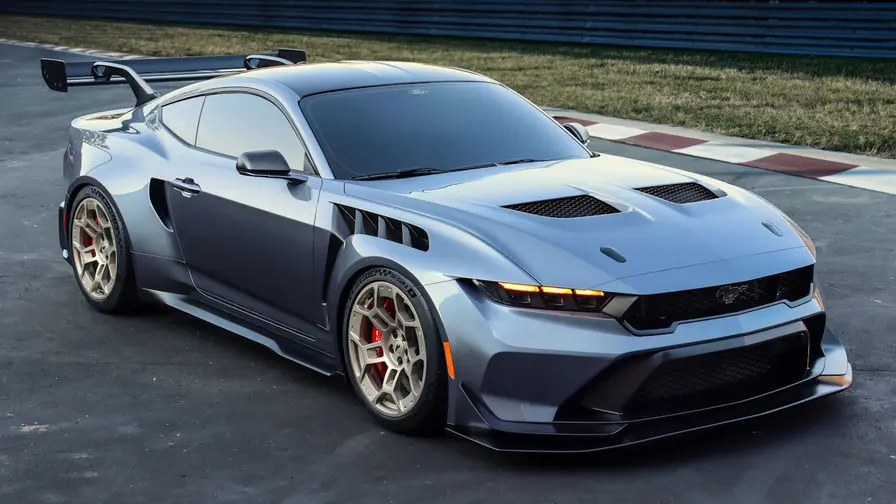
Weight remained substantial. Ford estimated the Lithium’s curb mass at roughly the same as a Shelby GT500, a little over 1,900 kilograms. But the balance, combined with forged Forgeline wheels, sticky Michelin Pilot Sport 4S tyres and six-piston Brembo front calipers borrowed from the GT350R, meant the package felt purposeful rather than merely heavy.
Inside, a custom drive-mode interface lived on a 10.4 inch touchscreen. Valet, Sport, Track, Beast. Naming was cheeky, but the modes were functional, progressively freeing more torque and loosening interventions. On the outside Webasto kept the look restrained. Two polycarbonate windows in a bespoke hood revealed the motor and inverters beneath, a wink to the car’s unusual heart.
It won Webasto an award at SEMA for design achievement. Yet, despite the plaudits, it remained a show car and nothing more.

Why? Because practicality and efficiency usually trump romance in production EV engineering. A single-speed direct drive is lighter, cheaper, and more efficient. A two-speed box makes sense in some high-performance EVs for efficiency at high speeds, as Porsche did with the Taycan, but sticking a six-speed manual in an electric Mustang asked engineers to accept trade-offs for the sake of feel.
And Ford had other plans. The Mustang Mach-E would become the brand’s electric headline: a crossover, a 400 volt architecture, and the sort of product that scales. Even then, company leadership made their position clear about not turning the traditional Mustang into a mainstream EV. The Lithium was, in many ways, an engineering love letter rather than a production preview.

Meanwhile, the industry took a different, more digital route to preserve driver engagement. Hyundai, Mercedes-AMG and Porsche have all introduced virtual gearshift experiences, synthesized engine notes and haptic feedback to trick the senses into feeling shift rhythm. It is clever and sometimes convincing. It is also a simulation rather than a mechanical truth.
Which begs a question: do you prefer the illusion of involvement or the real, messy engagement of a clutch and stick? For the purist, the Mustang Lithium chose the latter.
Seven years on it remains a fascinating detour in the evolution of performance EVs: a reminder that engineers can solve almost any problem if the goal is clear, and that sometimes the most meaningful innovations are the ones that preserve what enthusiasts love, not replace it.

“I cover automotive innovation, electric vehicles, and the future of mobility — where technology meets sustainability.”

Discussion
Leave a Comment
Comments (2)
Is this even practical? Cool stunt sure, but who wants the weight penalty and inefficiency for feel... real drivers or just purists?
Wow a manual EV? My brain cant decide if thats brilliant or mad genius. Would love to heel-toe it, but weight tho, feels wild.