
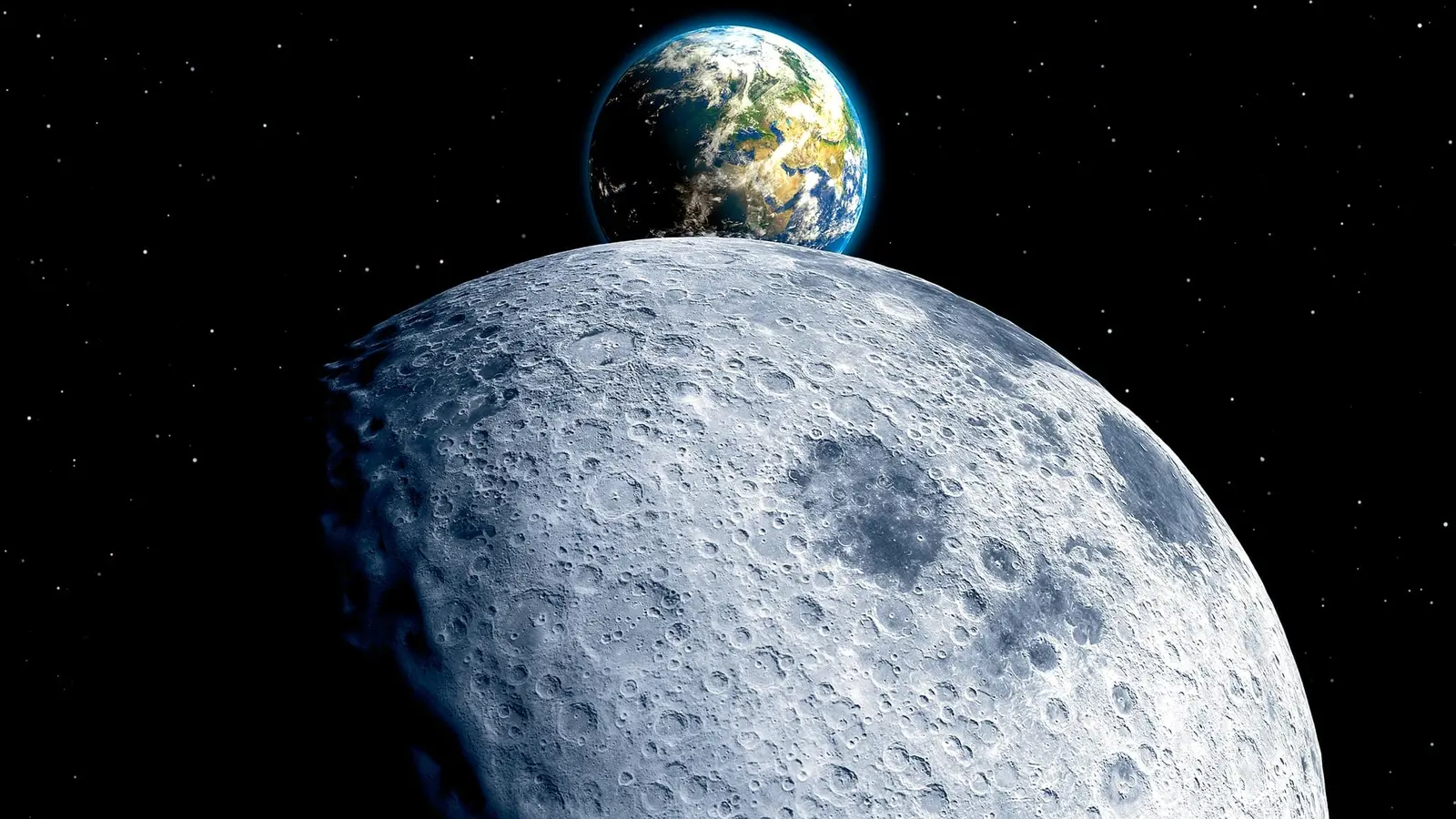
Think of a grain of moon dust as a tiny time capsule. Inside, a mineral secret waits: a rare form of metallic iron that should not exist at the Moon’s cold surface. Scientists analyzing soil from China’s Chang'e-6 mission have identified face-centered cubic gamma iron, written as γ-Fe, locked inside microscopic impact glass. The find changes how researchers might probe the Moon’s lost magnetic past.
How a high-temperature metal survived a lunar impact
Gamma iron normally appears only at very high temperatures and reorders into the common alpha phase as it cools. So why was γ-Fe present in lunar soil? The team, led by Professor Haifeng Du at the High Magnetic Field Laboratory of the Hefei Institutes of Physical Science, used focused ion beam techniques and transmission electron microscopy to cut and inspect tiny shards of impact glass returned by Chang'e-6. Chemical analyses confirmed that γ-Fe dominated the metallic particles within two studied samples.
Impacts on the lunar surface create momentary furnaces. Molten droplets fly, then quench almost instantly into glass. That rapid cooling, combined with trace elements—small amounts of carbon and other alloying atoms—and the protective glass matrix, can freeze atomic arrangements in place. In short: extreme heat, then a sudden freeze. The result is a metastable crystal structure preserved for billions of years.
There is elegance in the mechanics. Imagine a pebble of molten metal hurled into vacuum, then caught mid-flight in cooled glass. No atmosphere. No weathering. A snapshot preserved. That snapshot is what allows γ-Fe to survive where it ordinarily would not.
What the magnetic signatures may reveal
Finding γ-Fe is not just mineralogical trivia. The team mapped magnetic fields at the nanoscale with off-axis electron holography, a technique that visualizes magnetic flux lines across single particles. Some relatively large γ-Fe nanoparticles showed a stable single-vortex magnetization pattern, where magnetic moments curl around a center. These particles also held a consistent response when scientists exposed them to external magnetic fields in the laboratory.
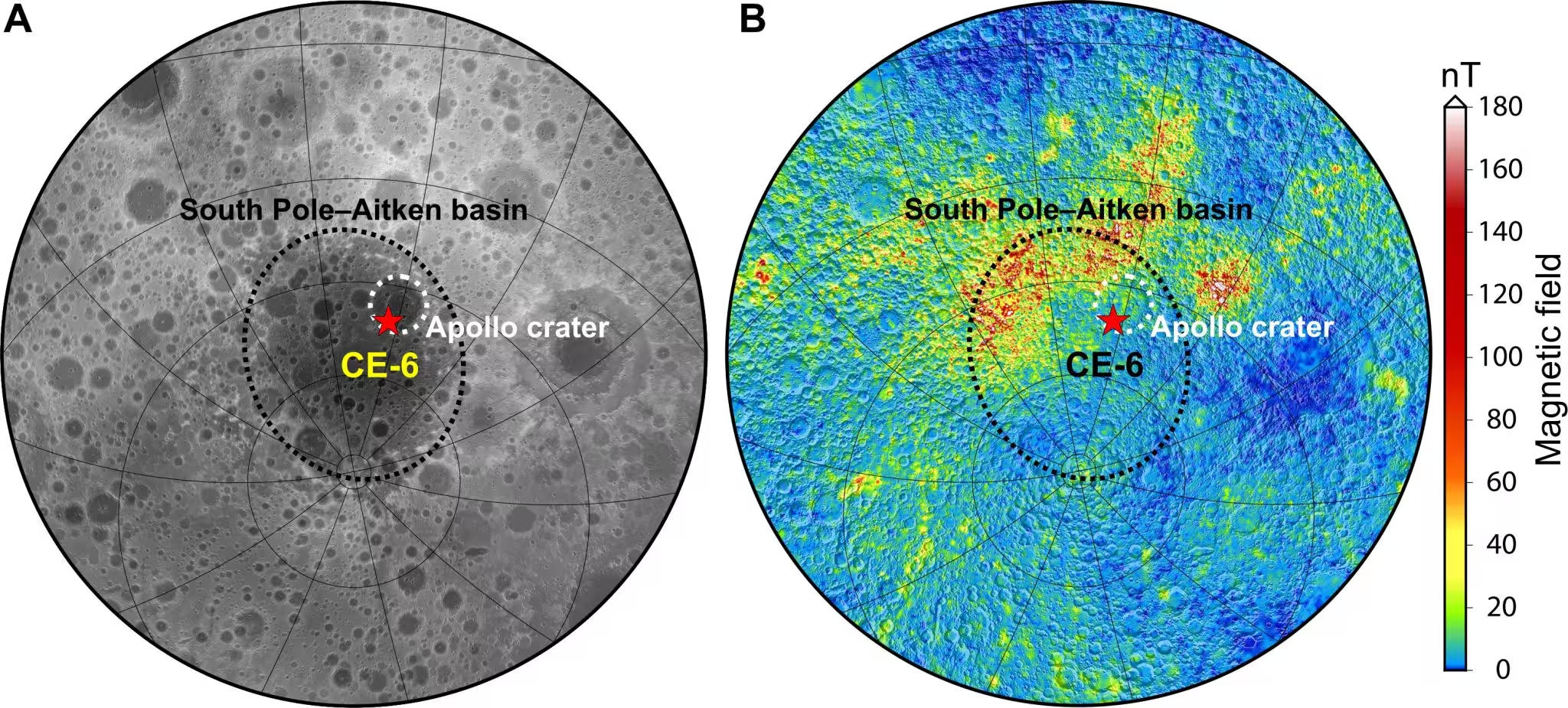
Lunar topography and magnetic anomalies.
Why does that matter? Because the Moon no longer has a global magnetic field, researchers rely on preserved magnetic minerals to reconstruct ancient magnetism. Different iron phases form under distinct thermal and chemical conditions and can record diverging snapshots of an impact event or the ambient magnetic field at the time of formation. γ-Fe and α-Fe could thus complement one another, offering layered clues about when and how magnetic signals were written into lunar soils.
Dr. Long Li of HFIPS, a member of the research team, suggested that these nanoscale grains act like magnetic fossils that could help untangle the Moon’s magnetic history. The study, published September 16 in the Proceedings of the National Academy of Sciences, broadens the palette of materials scientists have to work with when attempting such reconstructions.
Conclusion
Discovering γ-Fe in Chang'e-6 samples reframes what tiny bits of lunar dust can tell us. They are not inert debris but preserved records of violent events and, possibly, of magnetic environments long gone. The next steps will test how reliably these particles preserve ancient magnetic information and whether similar grains exist in other returned samples from the Moon. If they do, a new set of magnetic probes may be waiting inside the soil: microscopic, stubborn, and surprisingly informative.

“My work centers on sustainability, energy, and environmental science — examining how innovation can lead to a greener future.”

Discussion
Leave a Comment
Comments (2)
huh, gamma Fe at surface? sounds neat but is contamination ruled out? one sample only? curious if this is global, or just a lucky shard...
wow moon dust literally hiding metallic time capsules? mind blown, gamma Fe surviving impacts is wild, weirdly poetic. if that holds, historys gonna change