
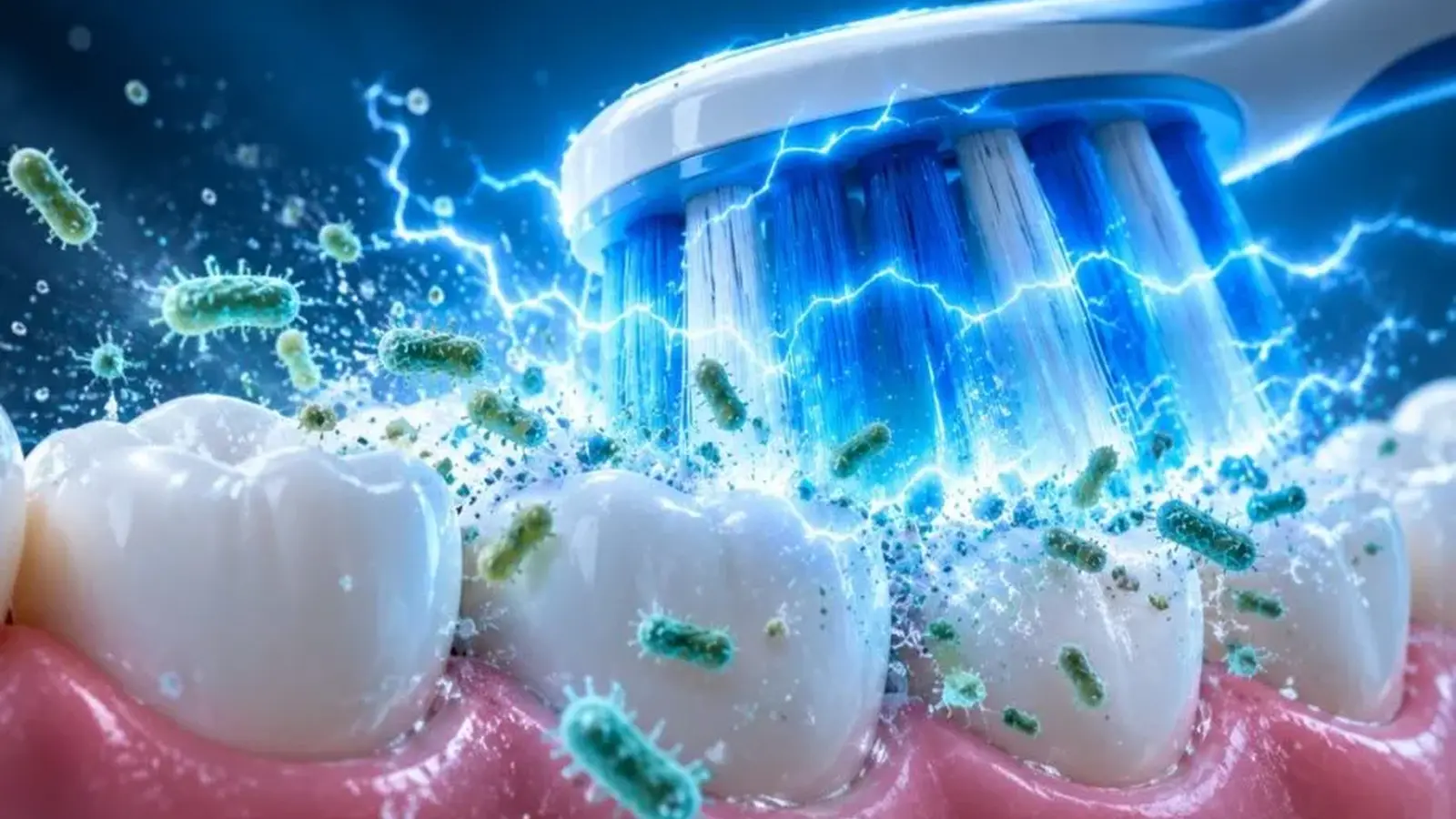
Imagine a toothbrush that does more than scrub. Every stroke becomes a tiny generator, converting friction into an electrical pulse that selectively disrupts the microbes that build dental plaque. That is the promise of a new self-charging toothbrush under development, and early tests show effects that go well beyond ordinary nylon bristles.
How simple friction becomes an antimicrobial weapon
Traditional brushing relies on mechanical action to remove plaque. It works, but not perfectly. Some bacteria cling on and rebuild their colonies within hours. The new design adds a physical twist: specially engineered bristles develop an electrical charge as they move across enamel. That electric field appears to stimulate production of reactive oxygen species, or ROS. These are chemically reactive molecules that can damage bacterial membranes, proteins, and DNA.
Why does that matter? ROS are a common antimicrobial mechanism in biology, used by immune cells to neutralize pathogens. Harnessing them locally, with each brushing motion, could create a short-lived but potent biochemical environment hostile to disease-causing microbes without systemic drugs.
Lab tests and what they revealed
In laboratory experiments on isolated microbes, charged bristles reduced populations of Streptococcus mutans by more than half. S. mutans is a major driver of dental caries. For comparison, standard nylon bristles killed only about nine percent under the same conditions. The toothbrush also lowered counts of Porphyromonas gingivalis, a bacterium strongly linked to gum disease, by roughly 78 percent. Conventional nylon bristles achieved less than an eight percent reduction.
Those are striking differences. Researchers then added an antioxidant compound to the environment to mop up ROS. The antibacterial effect disappeared. That is a key clue. It points to ROS as the primary mechanism by which the charged bristles act.
Genetic analyses offered another angle. Exposure to charged bristles suppressed expression of certain bacterial genes associated with ABC transporters. These molecular pumps help bacteria import nutrients and export toxic compounds. If transporter function is compromised, microbes may struggle to survive and to adhere to tooth surfaces. Causality is not proven, but the link is plausible and worth following up.
From enamel chips to human mouths
To test performance against real dental plaque, scientists grew human plaque on cow enamel. The charged-bristle toothbrush removed more than 99 percent of that biofilm, outperforming standard brushes by a wide margin. Biofilms are notoriously resistant to antimicrobials because cells are embedded in a protective matrix, so this result is encouraging.
The team moved next to a randomized trial in people. One hundred and fifteen adults with gum inflammation or tooth decay were assigned to use either the new toothbrush or a standard nylon-bristle brush twice daily for three months. At the end of the trial, users of the charged-bristle brush had less plaque, reduced gum inflammation, and fewer bleeding sites. Microbial analysis of plaque samples showed a shift: fewer disease-associated species and more bacteria believed to support oral health.
Researchers hypothesize that some pathogenic bacteria have more fragile cell envelopes, making them more vulnerable to ROS than beneficial species. That selective vulnerability would be ideal. But selection needs to be demonstrated firmly over longer periods.
Reservations and safety questions
Not everyone is convinced the mechanism is fully understood. Dr. Nicholas Yakubowicz, an oral microbiologist at Newcastle University who was not part of the study, cautions that ABC transporters move many different substrates. He says the present data do not clearly show how altered transporter expression translates into bacterial death or reduced adhesion.
Yakubowicz also raises a practical point about exposure time. In vitro experiments often expose microbes to electric fields for extended periods, whereas in the mouth a bristle touches a given patch of surface only briefly. That calls for careful studies of dose, frequency, and long term safety for oral tissues.
There is also a regulatory path ahead. Any device that changes the oral microbiome or generates reactive species must demonstrate that it does not harm enamel, gum tissue, or the balance of beneficial microbes over months or years.
Expert Insight
"The idea taps into a clever intersection of materials science and microbiology," says Dr. Laura Mendes, an oral health researcher not affiliated with the project. "If short, repeated pulses of ROS can suppress pathogens without disrupting the broader microbiome, this could be a game changer for preventive care. But we need longer trials and rigorous safety profiling before recommending widespread use."
Conclusion
This self-charging toothbrush represents a novel, nonpharmaceutical approach to managing dental plaque and inflammation. Early laboratory and clinical results are promising: targeted reductions in key pathogens, dramatic biofilm removal in model systems, and improved clinical markers in a modest human trial. Yet science demands restraint. Longer-term studies, careful safety testing, and mechanistic clarity are essential before this technology can move from prototype to bathroom cabinet. Still, the concept is a reminder that small physical innovations can open new paths in oral health.

“The cosmos has always fascinated me. I write about space missions, astronomy, and the technologies pushing humanity beyond Earth.”

Discussion
Leave a Comment
Comments (1)
wait, so the bristles make ROS? sounds promising but is that safe for gums long term, and do short pulses really kill biofilms in real mouths? curious…