
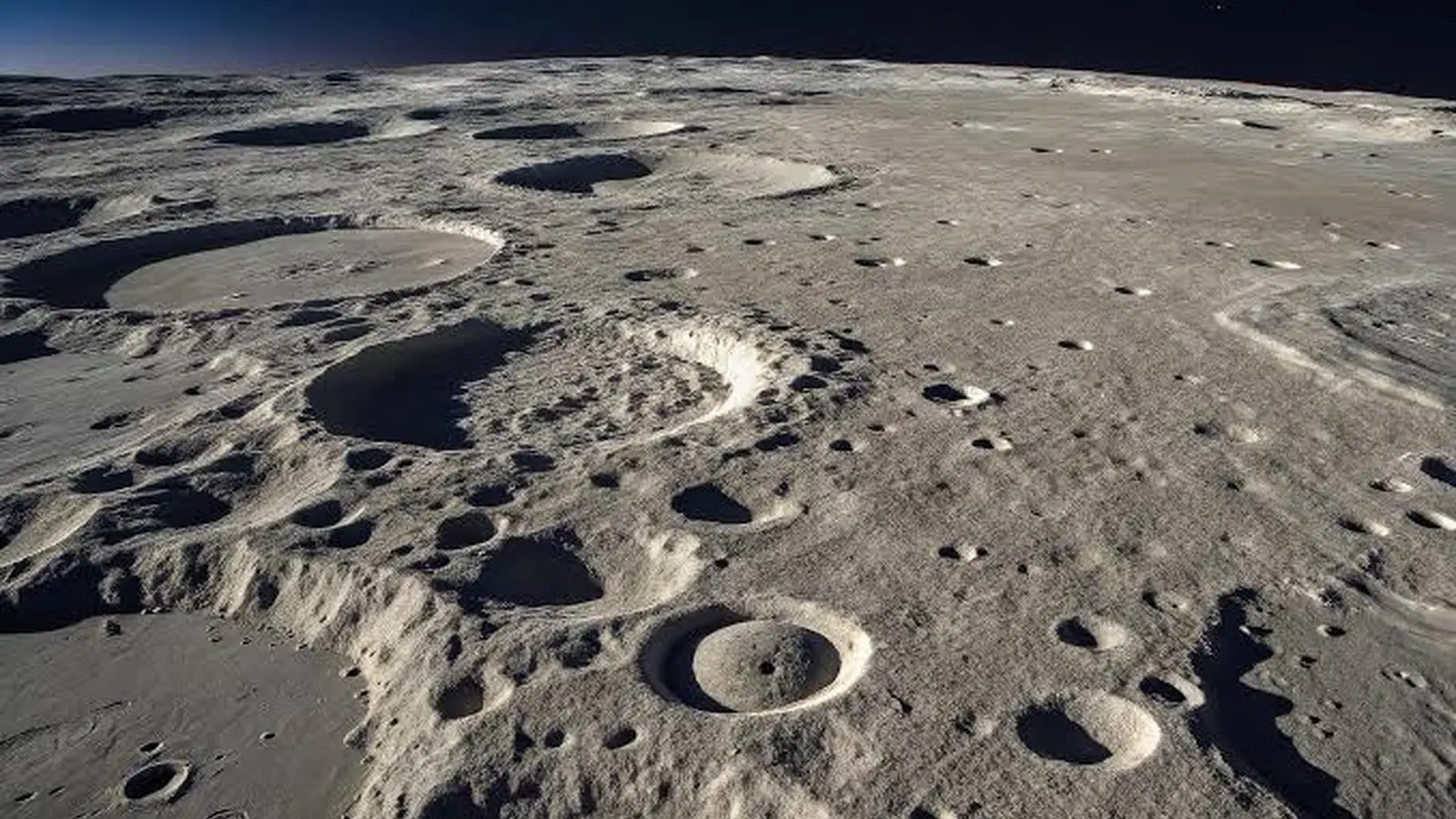
On the Moon’s far side a hidden, iron-rich body of rock may be keeping a secret about the satellite’s violent youth. The feature sits under the Dewar region and, like a fossilized compass, carries a record of magnetism that scientists say is hard to explain without a once-active lunar core.
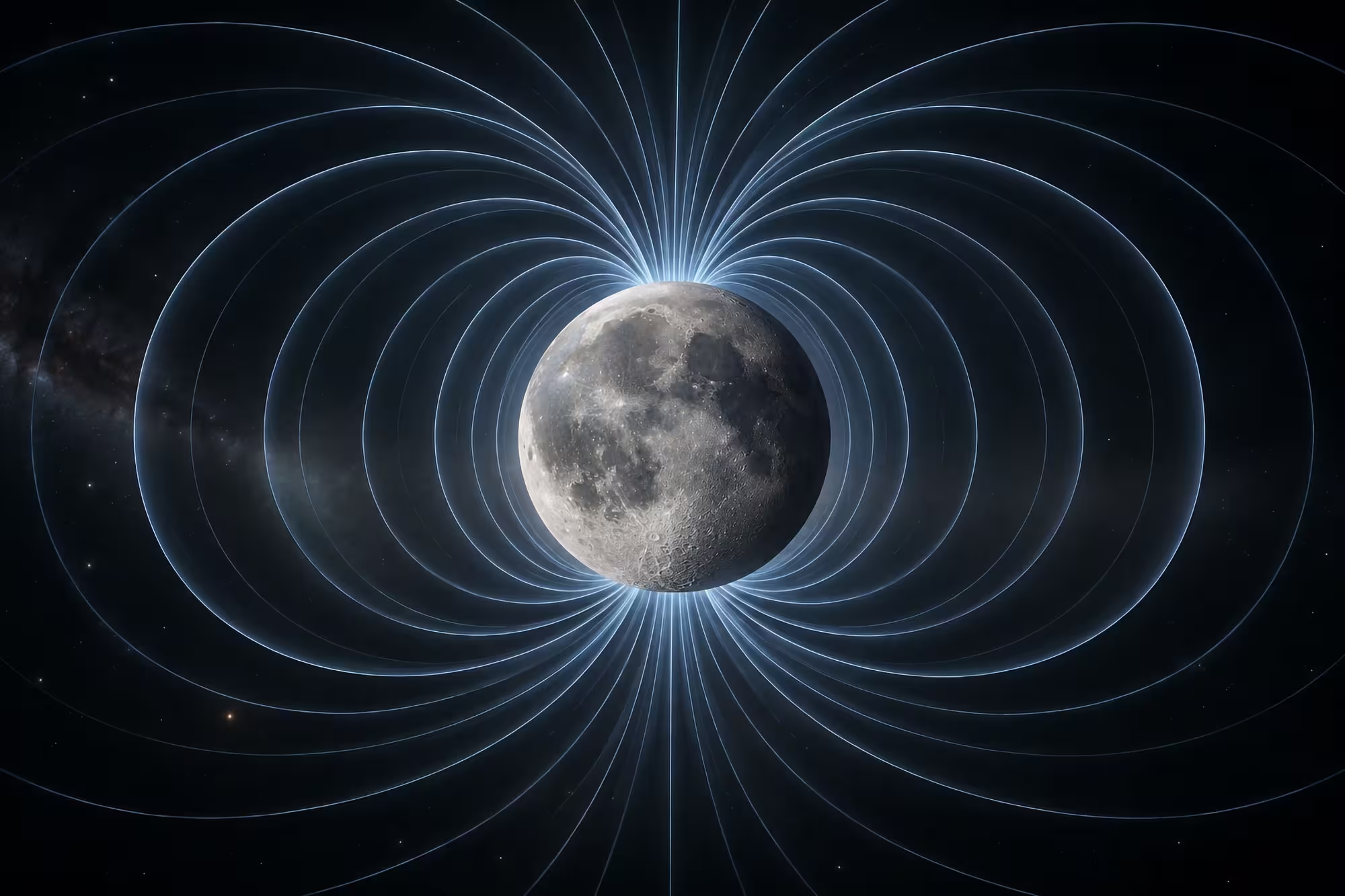
Artist’s concept of the ancient Moon surrounded by magnetic field lines, illustrating the global field that may once have been generated by a dynamo within its core.
Gravity and magnetism tell a compatible story
Researchers layered two kinds of orbital data to uncover the anomaly. Gravity measurements from NASA’s GRAIL mission mapped mass concentrations beneath the surface. Magnetic readings from Lunar Prospector and Japan’s Kaguya mission revealed fields tethered to specific subsurface structures. Where the gravity signal pointed to a dense body about 60 kilometers across and roughly 9 kilometers deep, the magnetics showed unusually strong, stable remanent magnetization.
Put together, those datasets imply the Dewar structure is a cooled, iron-bearing magma body. As it solidified billions of years ago, it recorded the ambient magnetic field. By estimating the iron content and cooling history of that rock, the team calculated the minimum field required to magnetize it. That number sits above 10 microtesla, a substantial value for a small world whose present-day field is essentially zero.
Why this matters for the Moon's magnetic past
There has been a long-running debate over whether the Moon ever had a geodynamo, an internal engine like Earth’s that generates a global magnetic field through convecting liquid metal in the core. Apollo samples gave conflicting answers: some indicate intense ancient magnetism, others do not. Orbital observations now add an independent line of evidence rooted in spatial context. Dewar lies outside regions where a single impact event could plausibly explain the magnetization, making a short-lived, impact-driven mechanism unlikely.
"The simplest explanation is a longer-lived source inside the Moon," says Xi Yang, a PhD student in Earth and Planetary Sciences at ETH Zurich and a member of the research team. The implication is not only that a dynamo existed but that it was strong enough at times to imprint deep-seated volcanic rocks.
The finding also links to curious surface patterns known as lunar swirls. These bright, sinuous markings often coincide with localized magnetic highs. One practical interpretation is that horizontal magnetic fields deflect the solar wind and reduce space weathering, preserving brighter soil. Anna Mittelholz, a geophysicist involved in the study, points out a human angle: swirls might mark places with natural shielding from charged particles, information that could inform future exploration and site selection.
Open questions remain. The Moon’s core is small, and generating a global-level field with that limited heat and volume challenges standard dynamo models. Was the dynamo intermittent? Fueled by a different mechanism than Earth’s? Or stronger early thermal or compositional gradients made it possible for a brief epoch? The Dewar result shifts the debate from existence to mechanism.
Beyond the Moon, the method used here is adaptable. Combining gravity and magnetic maps offers a way to probe other planetary bodies for hidden magnetized structures. Mars is a candidate, although current orbital datasets for the Red Planet are not yet fine-grained enough for identical analysis.
Closing thoughts
Finding a magnetized, dense volcanic body on the lunar far side does more than add a chapter to lunar history. It reframes the questions we ask about small-world dynamos and gives mission planners a new kind of geological waypoint to consider. The Moon keeps teaching us how complex and dynamic small planets can be, even after they seem to have gone quiet.

“My work centers on sustainability, energy, and environmental science — examining how innovation can lead to a greener future.”

Discussion
Leave a Comment
Comments
No comments yet. Be the first.