
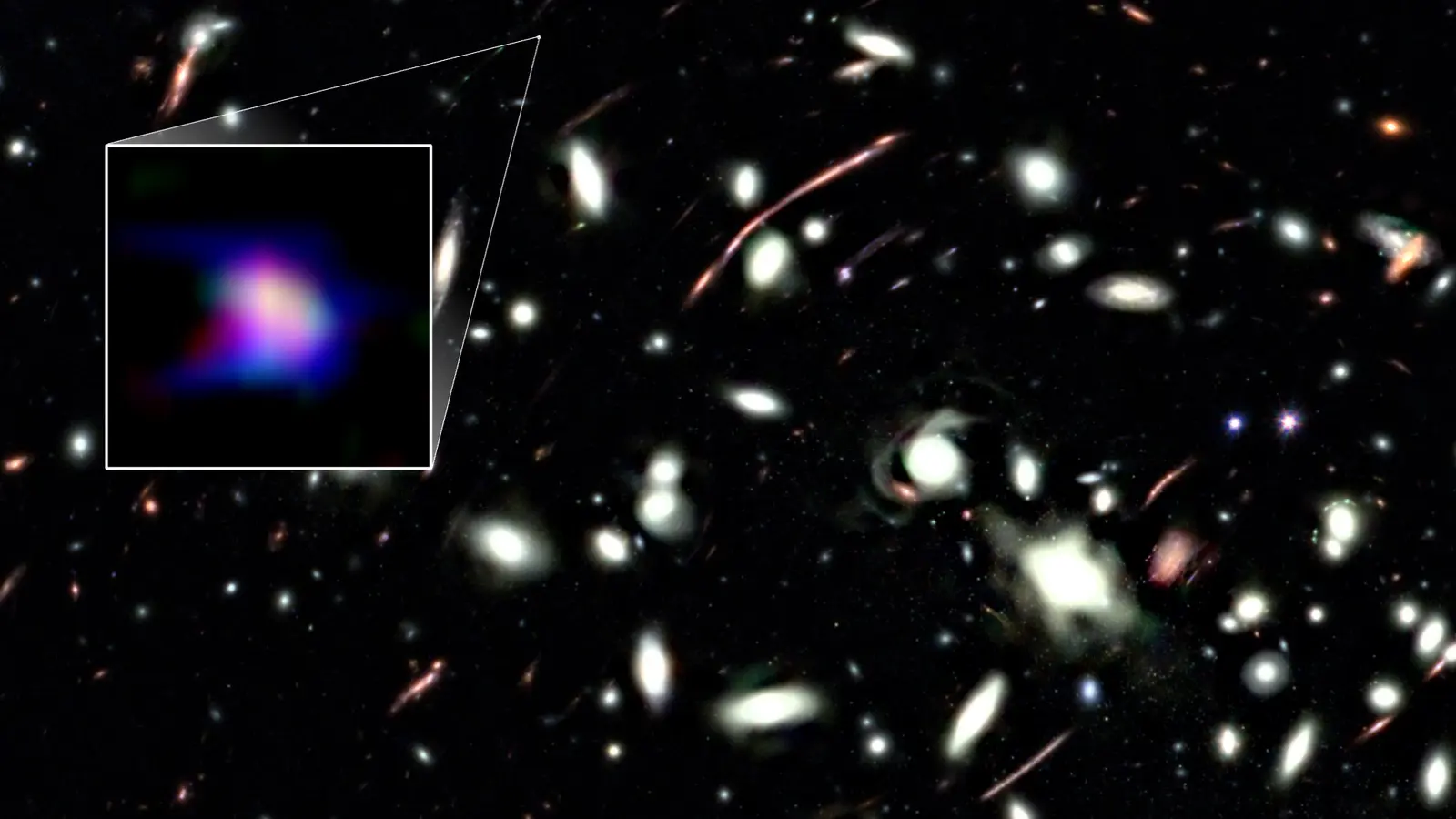
The universe still remembers its childhood. Hidden inside light that began traveling when the cosmos was only a few hundred million years old, astronomers have found a speck of a galaxy so chemically simple it reads like a fossil record from the first stars.
When a whisper of light becomes a time machine
LAP1-B is not a billboard. It is a whisper, a faint glimmer stretched by gravity and time. Without the magnifying effect of a foreground galaxy cluster, and without the sensitivity of the James Webb Space Telescope, it would remain invisible. Instead, that glow revealed spectral fingerprints telling a story about elements forged long before our Sun existed.
Spectroscopy is the method. Break the light into its colors. Look for signature emission lines produced by hydrogen, oxygen, and other atoms. Each line is a clue to how much of a given element a galaxy contains. For LAP1-B, the lines were measured with JWSTs NIRSpec instrument after more than 30 hours of observation time. Those long exposures were necessary because the galaxy is tiny, faint, and far away. Even so, gravitational lensing amplified the signal roughly one hundred times, converting a nearly undetectable speck into data good enough to measure chemical abundances.
Oxygen at a record low and what that implies
The headline figure is stark: LAP1-B contains about one two-hundred-fortieth of the Sun's oxygen abundance. That places it among the most chemically primitive star-forming galaxies ever characterized. Oxygen, like many heavier elements, is made inside massive stars and dispersed by their explosive deaths. A low oxygen abundance means the gas in LAP1-B has seen only a handful of enrichment events, if any. We are watching a galaxy caught near the dawn of its chemical life.
The spectrum also shows an unusually high carbon to oxygen ratio. That detail is important. Different types of early stars produce different element mixes. When the first generation of massive stars ended their lives, they seeded the surrounding gas with yields that theory predicts would raise the carbon to oxygen ratio in a pattern that matches what astronomers now measure in LAP1-B. Put simply, the chemistry fits a scenario where the first stellar explosions have started to pollinate the galaxy but full chemical maturation has not yet happened.
This picture turns LAP1-B into more than an object at a great distance. It becomes a laboratory for studying the first cycles of star birth and death, and for testing models of early nucleosynthesis, the process that built the first heavy elements from primordial hydrogen and helium.
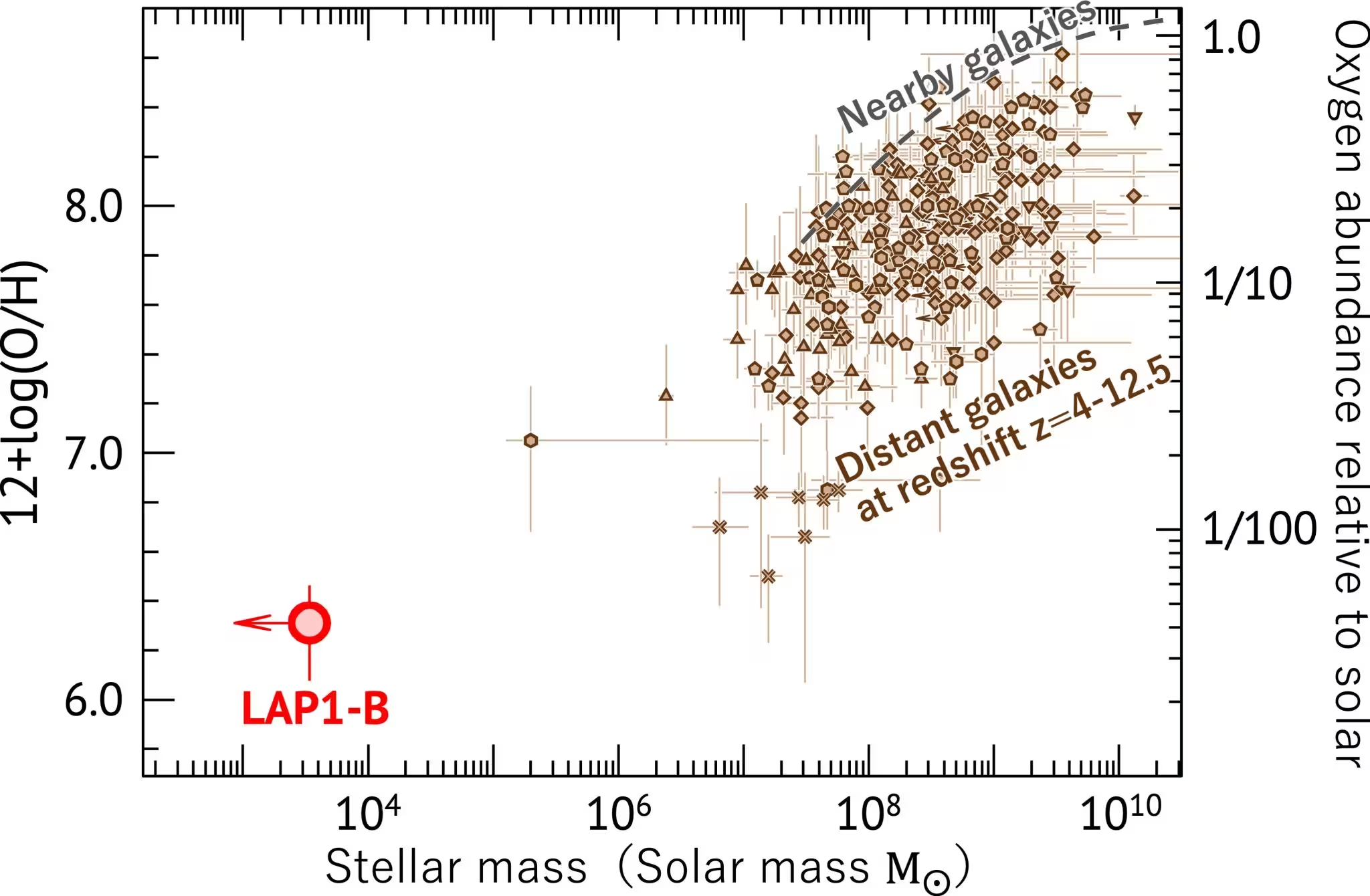
This diagram compares galaxy stellar mass and oxygen abundance. LAP1-B (red circle) has an exceptionally low stellar mass and just 1/240th the Sun’s oxygen abundance, a record low for a star-forming galaxy, revealing its chemically primitive state. Brown symbols represent distant galaxies, while the dashed line shows the trend in nearby galaxies.
Small in mass, big for theories
Mass estimates place LAP1-B's stellar content at less than about 3,300 solar masses. That is tiny. For comparison, the Milky Way contains hundreds of billions of stars. The galaxy’s stellar mass, combined with a dark matter halo that dominates its gravity, makes the system look similar to present day ultra-faint dwarf galaxies found around the Milky Way.
Ultra-faint dwarfs, or UFDs, are dim, low-mass systems whose stars are extremely old, often older than 12 billion years. They are chemically simple, with few heavy elements, and astronomers have long suspected they are survivors from the universe's earliest generation of small galaxies. The chemistry and mass of LAP1-B provide a plausible physical link between those nearby fossils and the tiny primordial systems that first formed after the Big Bang.
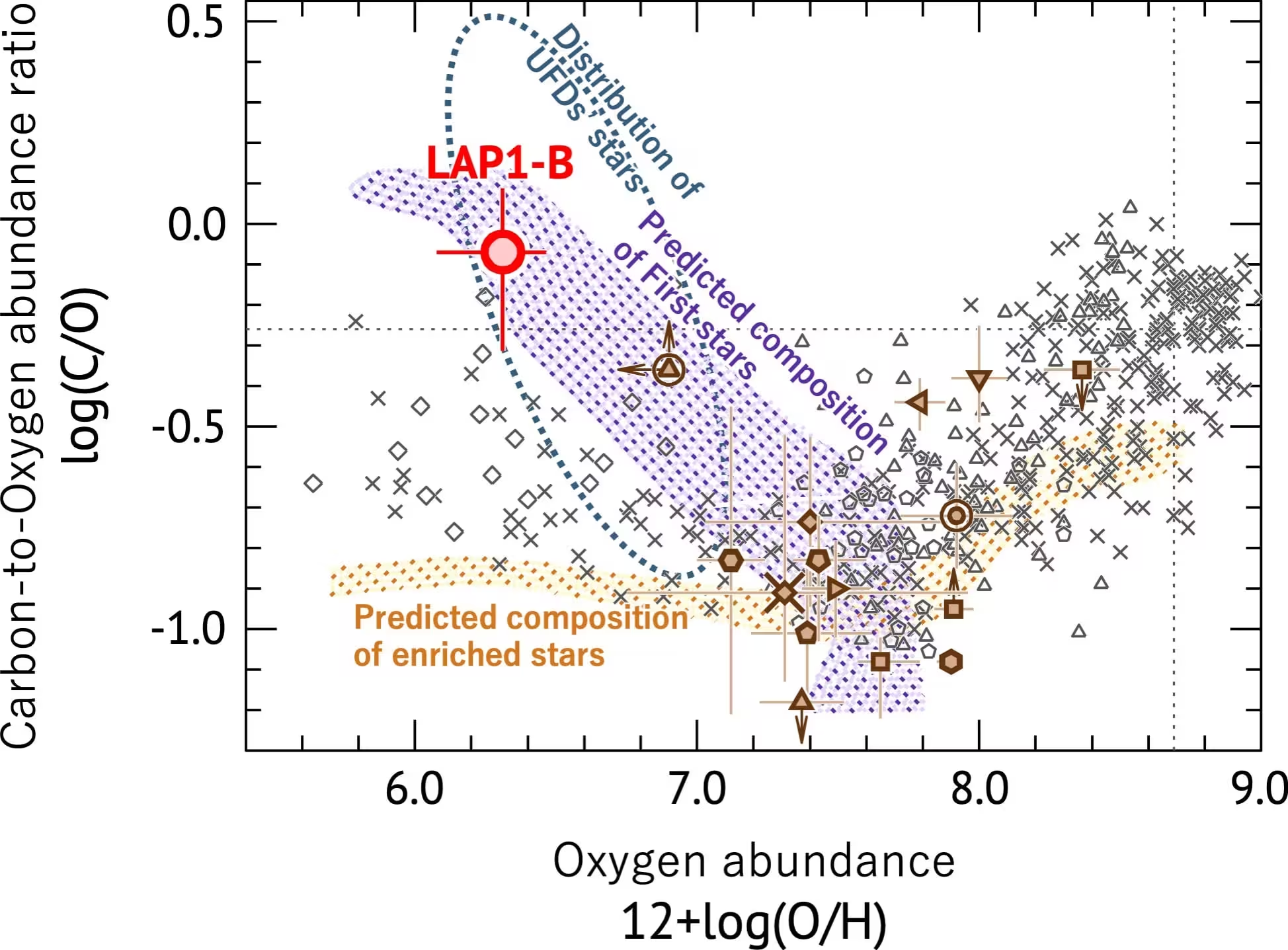
This diagram compares oxygen abundance and carbon-to-oxygen ratios. LAP1-B (red circle) closely matches predictions for material produced by the universe’s first stars (purple region) and the chemical composition of present-day ultra-faint dwarf galaxies (blue outline). Its unusual chemistry suggests enrichment by the earliest stars 13 billion years ago. Grey symbols represent ancient Milky Way stars and distant gas clouds, while orange indicates later stellar enrichment.
Why does that matter? If LAP1-B is representative of the building blocks that merged and survived to become local UFDs, then we have a direct observational handle on the progenitors of the smallest galaxies around the Milky Way. That helps explain why UFDs still exist as relics today. They could be the untouched remnants of early systems that never accreted enough mass or gas to form many more generations of stars.
How the observation was pulled off
Detecting a galaxy from 13 billion years ago is technically demanding. The team relied on JWST's NIRSpec spectrograph to collect faint emission lines in the near infrared. At such redshifts, ultraviolet and visible light from the galaxy are shifted into the infrared. Instruments like NIRCam can image faint sources, but LAP1-B was essentially invisible in the NIRCam frames. It showed up through spectroscopy because emission lines can be stronger than the surrounding continuum light. The signal to noise was boosted by the lensing amplification provided by the foreground galaxy cluster MACS J0416.
Combining long exposure time, advanced instrumentation, and nature's own gravitational lens produced spectra amenable to abundance analysis. The team measured hydrogen lines such as Hα and Lyα, and strong forbidden oxygen emission [OIII]. Spatial and velocity mapping of these features allowed researchers to infer gas motions and distribution within the small system, adding a kinematic dimension to the chemical story.
Expert Insight
"Finding a system like LAP1-B is like finding a single page from an ancient logbook," says Dr. Elena Morales, a theoretical astrophysicist who studies early galaxy formation. "It offers a direct test of stellar yield models for the first generations of stars and gives empirical boundaries for how quickly chemical enrichment progressed on small scales. Observations like this narrow the gap between simulations and reality."
Such commentary underscores how empirical chemistry guides theoretical work. Modelers can now tune parameters for early supernova yields, mixing efficiencies, and star formation bursts to match real, observed abundances rather than relying entirely on indirect constraints from local fossils.
What comes next
One galaxy is a powerful clue, but the census of primitive systems must grow. The team plans more JWST programs aimed at finding similarly metal poor galaxies, with the goal of mapping how common these primitive chemical states were. If LAP1-B proves typical, it implies many surviving ultra-faint dwarfs are direct descendants of such early systems. If LAP1-B proves unusual, researchers will need to account for why such chemical youth is rare.
Beyond abundance studies, future observations may seek direct evidence of the first, massive stars through signatures such as very high energy photons, unusual ionization states, or distinctive abundance ratios in the interstellar gas. Deeper surveys using lensing clusters, wide-area JWST imaging, and complementary ground based spectroscopy will extend the search.
Conclusion
LAP1-B is more than a distant object. It is a bridge across 13 billion years, linking the faint, metal poor galaxies orbiting our galaxy to the small, primitive systems that shaped the early universe. The discovery demonstrates how the James Webb Space Telescope, aided by gravitational lenses, can reveal chemical snapshots from the cosmic dawn. Each new primitive galaxy found will sharpen our understanding of how the first stars seeded the universe with the elements that eventually became planets, oceans, and life.


“The cosmos has always fascinated me. I write about space missions, astronomy, and the technologies pushing humanity beyond Earth.”

Discussion
Leave a Comment
Comments (1)
wow the universe literally keeps receipts. finding a 1/240 oxygen galaxy? mind blown. tiny but epic, like cosmic baby pics… need more of these