
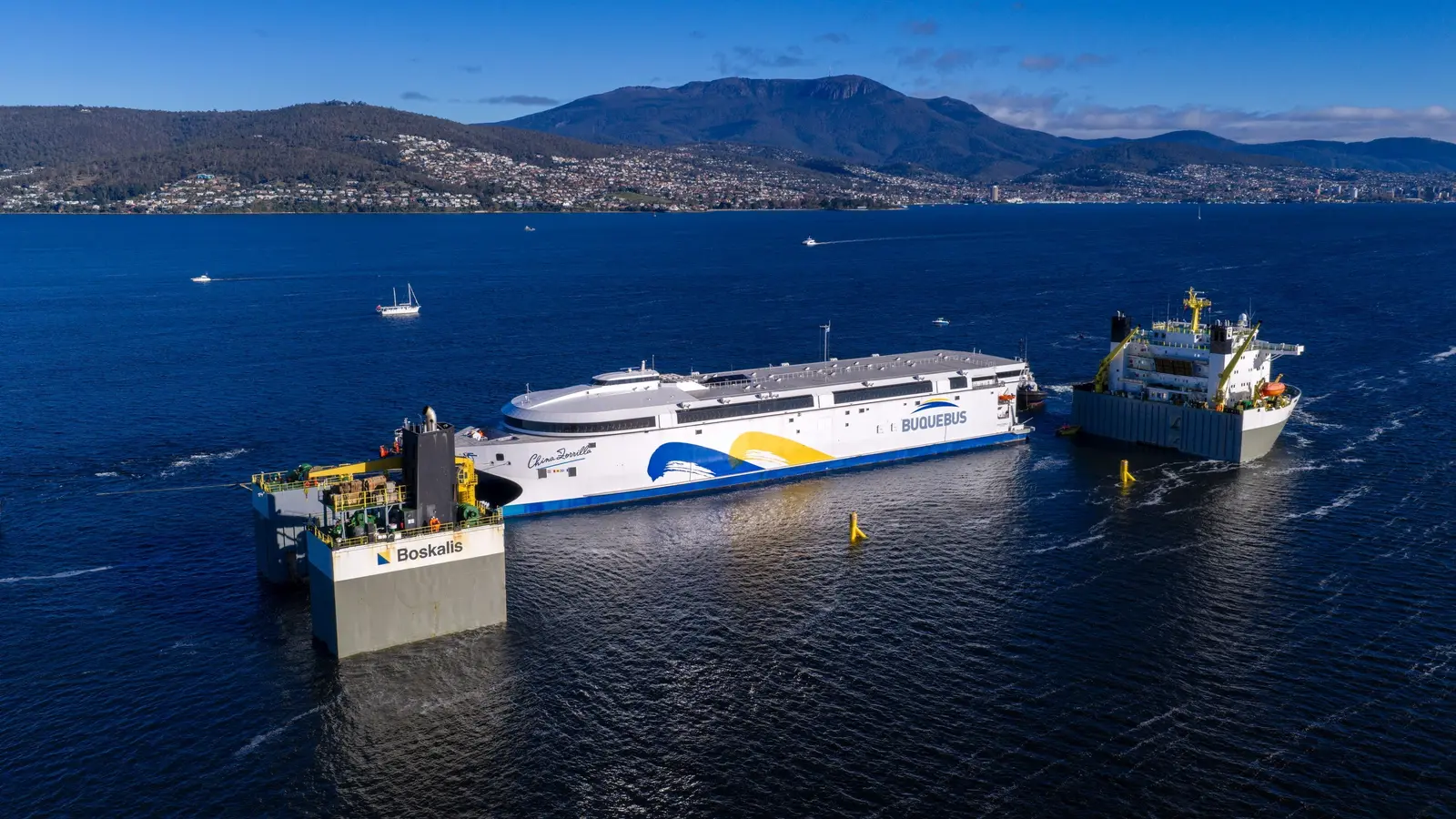
Imagine a ferry so laden with batteries that it needs a giant ship to deliver it to its first route. Strange, but true. Incat Tasmania has just finished what it calls Hull 096 — the China Zorrilla — and instead of slipping away under its own power, the catamaran is riding piggyback across oceans.
A delicate ballet on the water
Why ship a ship? Because this is not a typical ferry. Built to carry commuters and cars across the River Plate between Buenos Aires and Uruguay for operator Buquebus, the Ro-Pax catamaran was craned onto the deck of the MV Black Marlin, a 217.5-metre semi-submersible heavy-lift vessel. The Marlin can sink its central deck below the sea, float a cargo into place and then lift it out of the water — a tidy solution for moving oversized loads like yachts, rigs and now the world’s largest electric ferry.

The lift took place on the River Derwent, near where the ferry was assembled, and sources say the operation went smoothly. The Zorrilla sat on the Black Marlin’s deck while crews completed final lashings and checks before the long transit south and west to its new home.
It carries 250 tonnes of batteries — the largest battery installation fitted to any vessel to date.
That pack is rated at roughly 40 MW of electrical capacity, a figure that’s easier to picture if you think in cars: engineers have compared it to nearly 500 passenger EVs wired together. Those batteries will feed eight Wartsila waterjets, giving the ferry a top speed of about 46 kph and a certified single-charge range of roughly 185 km. That range might sound modest until you remember this boat must move up to 2,100 passengers and 225 vehicles while supporting more than 2,300 square metres of onboard retail space — the largest shopping area on any ferry of this type.

Originally conceived with an LNG powertrain, the project switched to full-electric during construction, a pivot that underscores how quickly maritime electrification is moving from experiment to industrial reality. The engineering trade-offs are obvious: heavy batteries add mass and complexity, but they also deliver zero-emission operations in a region that sees heavy ferry traffic and air quality concerns.
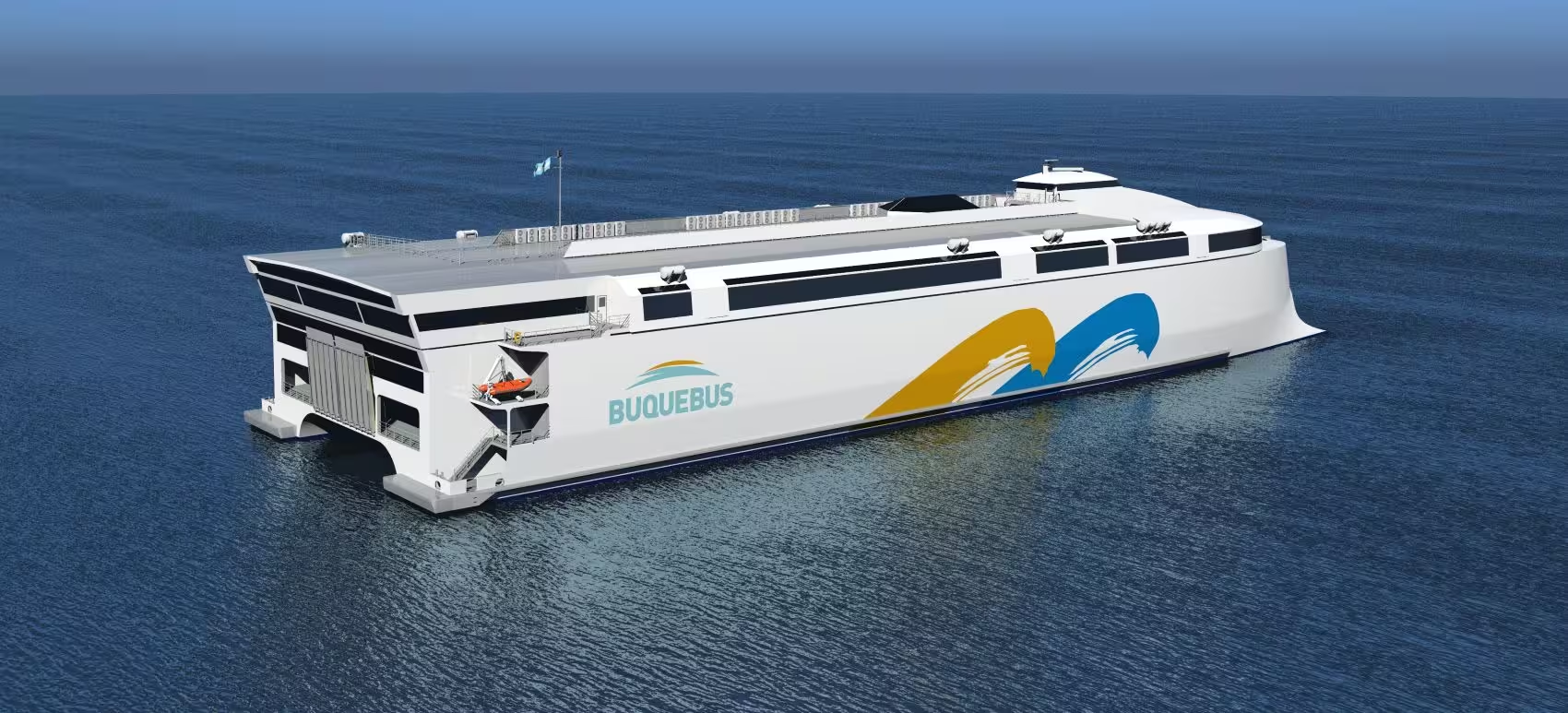
There are still unanswered questions. How long will the Black Marlin’s voyage take? When exactly will China Zorrilla enter commercial service? Incat and Buquebus have not published a firm timetable, so observers will be watching the transit and arrival closely. For now, the image of a battery-packed ferry being eased onto a floating platform — a ship atop a ship — feels like a small prophecy about the future of clean maritime travel.

Keep an eye on this one. It’s a practical machine, but it also carries a symbolism that reaches far beyond the River Plate: electrification at scale, transported across oceans and into service.


“Cars are evolving faster than ever. I cover electric vehicles, smart mobility, and the future of transportation worldwide.”

Discussion
Leave a Comment
Comments
No comments yet. Be the first.