
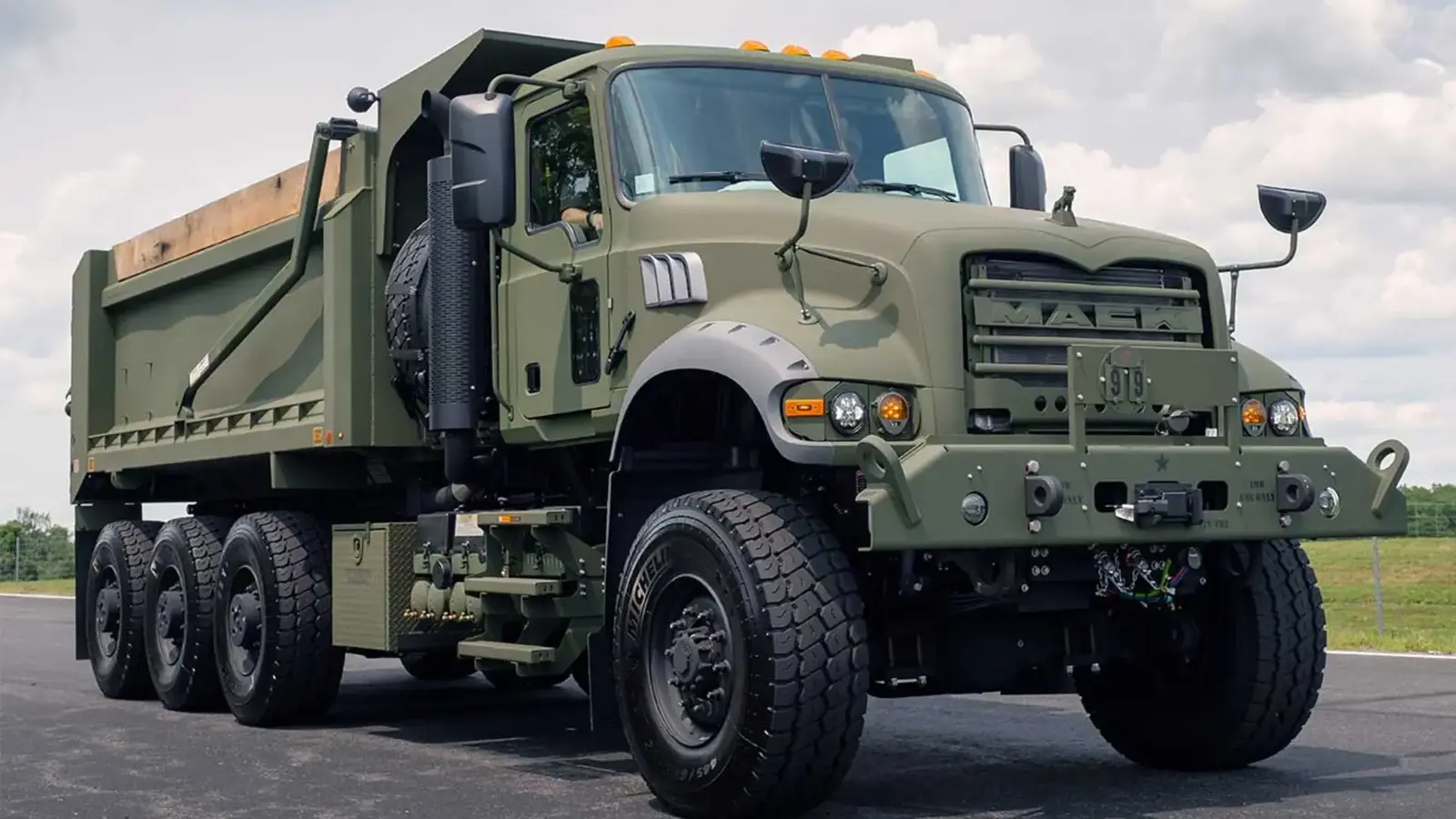
Dust and diesel. A convoy slows at the edge of a blown-out airstrip. Soldiers climb down, squinting at a scarred ribbon of asphalt that once doubled as a runway. What they need is muscle, not a showpiece. Enter the Mack M917A3, a heavy armored dump truck built to make bad ground usable again.
Why the Army keeps ordering more
The U.S. Army has just ordered 115 additional M917A3 units for the National Guard, extending earlier procurement runs. The logic is simple: more payload per trip equals fewer trips through danger zones. Each 8x8 M917A3 carries up to 27 tons of aggregate, soil, or rubble, giving engineering teams the ability to repair roads, restore runways, and rebuild forward support nodes faster than before.

Think of it as logistics compression. With a 27-ton capacity versus the older M917A1 and A2 models that held 22 tons, commanders gain roughly 22.7 percent more hauling efficiency. That reduces convoy size, lowers exposure for drivers and escorts, and speeds recovery after combat or natural disaster.
Under the skin: power and purpose
Underneath that armored shell sits a 13-liter inline-six MP8 turbo diesel. It produces 440 horsepower and 2,240 newton-meters of torque. Power routes through an Allison 4500 automatic gearbox and a Meritor two-speed transfer case, giving drivers precise control when starting on loose ground or climbing steep slopes with a full load. Heavy-duty Meritor axles, Michelin XZY3 tires, front disc brakes and rear drums round out the running gear. With a gross vehicle weight approaching 43 tonnes, a 24-volt electrical system and a 380-liter fuel tank, the M917A3 is built for sustained operations.

How does that translate on the job? The truck can get moving where lighter vehicles would bog down. Low-end gearing and drivetrain control prevent wheelspin when traction is at a premium, so each load actually goes where it is needed, not into the mud.
The M917A3 is designed to keep soldiers moving and alive.
Load handling that thinks like an engineer
The steel cargo bed is a worksite in miniature. Standard volume is 13.7 cubic meters and that expands to 16.8 cubic meters with sideboards fitted. But the real innovation is the controlled-discharge system. Instead of dumping a single heap at one spot, operators can layer material as they drive, creating a graded surface ideal for patching roads or building ramped approaches to damaged runways.

There is also a body heating system to keep asphalt and similar materials workable en route, and external dump controls that spare soldiers from unnecessary climbs into the bed during operations. Small details like these add up when time and safety are on the line.
Protection where it matters
Although the M917A3 uses many commercial components to simplify maintenance, the vehicle is unapologetically military when it comes to crew protection. It meets long-term armor strategic standard level 3.6 and complies with mine blast requirements. Field trials in 2019 and 2020 subjected the truck to mine and roadside explosive threats and ballistic hazards, with results that underlined survivability and crew protection. The cab is armored but no fixed weapon mounts come standard; the focus is on getting logistics teams and their cargo through contested areas intact.
For units operating in unstable environments, that survivability converts directly into mission tempo. Fewer casualties, more material shifted, faster reconstruction.

The bigger plan
The United States aims to field 1,029 of these trucks, a program intended to replace decades-old platforms, some of which date back more than 50 years. Replacing aging vehicles with a modern, protected, higher-capacity fleet is not glamorous. It is practical. It is decisive.
When runways must be reopened and supply lines restored, having the right truck changes outcomes. The M917A3 is not an accessory. It is a tool that turns frontline damage into workable ground.

“Cars are evolving faster than ever. I cover electric vehicles, smart mobility, and the future of transportation worldwide.”

Discussion
Leave a Comment
Comments (2)
Ive seen trucks like this in hurricane relief ops. The layer dumping trick is a game changer, crews reopened roads overnight. Little things like heated bed really matter
Wait so it's armored but no fixed weapon mounts? makes sense for logistics but is that enough vs IEDs and ambushes, curious how crew safety holds up... seems like a heavy mule tho