
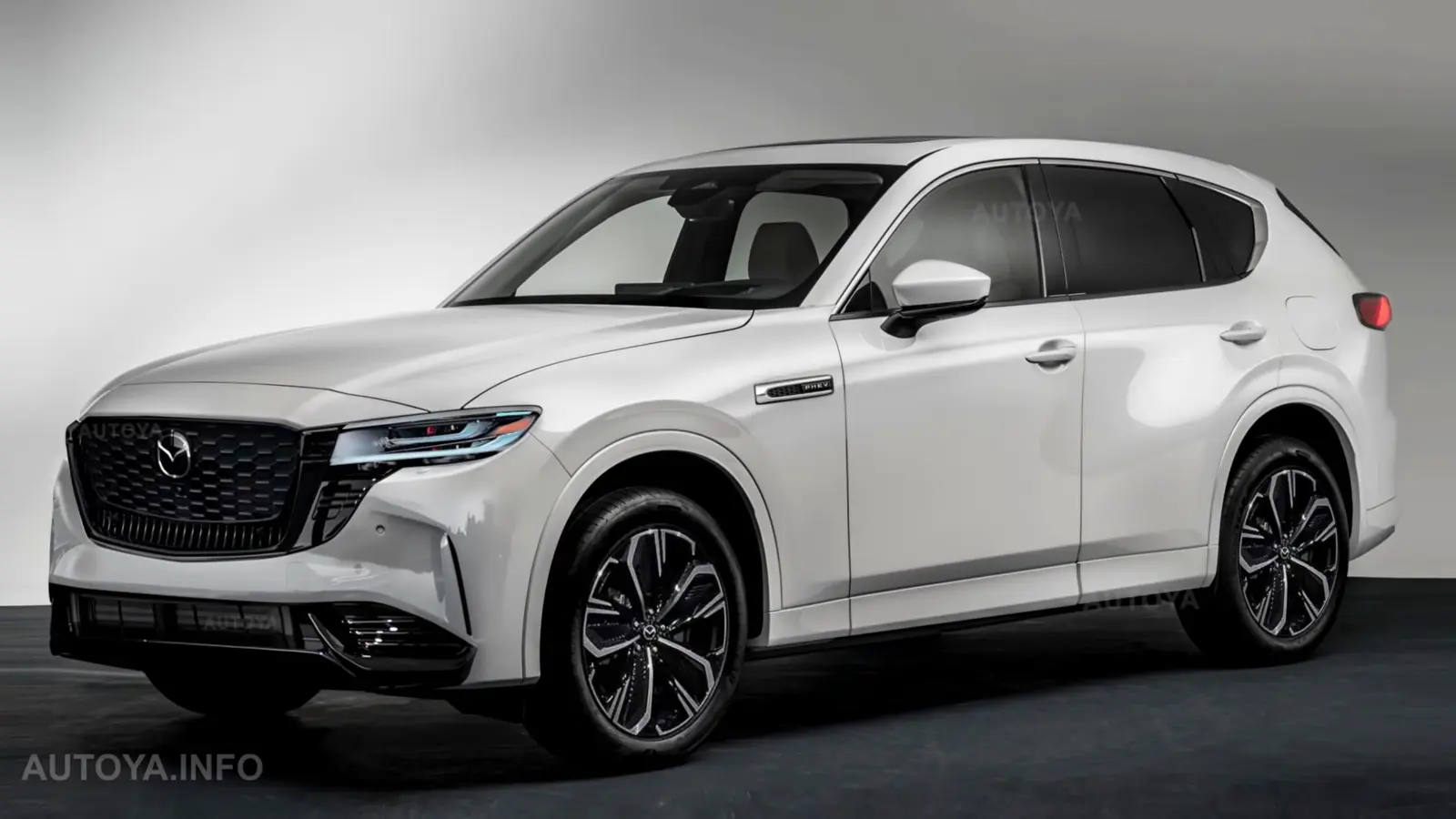
Picture this: a CX-60 rolling into a showroom with a quieter face and a slightly smarter cabin, the sort of nudge that makes buyers glance twice. That’s the promise behind new digital renderings imagining Mazda’s mid-size crossover after a 2027 refresh.
Mazda’s lineup can feel like a puzzle. The CX-60 sits above the CX-50 in some markets and beneath the CX-80 in others. In the UK the CX-80 now starts at about €58,099, while the CX-60’s entry point is around €54,456. The range includes Exclusive-Line, Homura, Homura Plus, Takumi and Takumi Plus, with the latter opening at roughly €62,469.

Under the skin the CX-60 is a clear technical statement. The 2.5-liter e-SkyActiv plug-in hybrid produces 327 ps (322 hp/240 kW), sent through an eight-speed automatic and all-wheel drive. Mazda quotes 0-100 kph in 5.8 seconds and a top speed of 200 kph. Two diesel engines remain on the menu for buyers in markets that still want them.
What the renderings actually change, and what they leave alone
The artist at AutoYa on YouTube imagined a subtle evolution rather than a revolution. Up front the headlights tuck in a little more, with reworked daytime running light signatures and a denser grille pattern. The bumper gets vertical vents and a larger central intake. Side profiles are largely unchanged, save for slimmer fender trim and fresh wheel designs. At the rear the taillights grow in size, reflectors are revised and the bumper has a new layout.

Inside, the makeover leans on screen size. The dash has been smoothed to accommodate a much larger infotainment display; the center console is rethought and the steering wheel receives a new design treatment alongside an updated digital instrument cluster. In short: cleaner graphics, fewer visual distractions, and a cabin that feels a touch more premium than the current car.

Those are cosmetic fixes. They matter. But they won’t hide the things buyers have complained about since the car’s 2022 debut when rushed pandemic-era development left Mazda performing multiple mechanical corrections. The CX-60 has faced criticism for a hybrid system that feels poorly tuned to some drivers, transmission glitches and a suspension that many find firmer than expected. A facelift can polish perception, but real confidence comes from sorting the hardware and software underneath the shine.
Mazda appears to be taking its time, which could be smart. A well-executed mid-cycle update that pairs styling tweaks with clarified hybrid calibration and transmission software would do more than spruce bumpers; it would restore faith.

There’s also a political question in the mix: should Mazda bring the CX-60 to the United States as a bridge between the CX-5 and the CX-70? If it did, entry-level versions might start at about €32,550, assuming a different base engine is specified for North America. That price would position the CX-60 in a crowded segment, but with the right drivetrains and a softer ride it could carve a niche.

Renderings like AutoYa’s do what good concept art does: they let us test-drive ideas in our heads. This imagined 2027 CX-60 looks more composed, more mature. Whether Mazda can match that impression on the road depends on fixes that aren’t visible in pixels.
So tell me: would you welcome the CX-60 here, and do you prefer today’s sharper lines or the softer, more grown-up rendering? Drop a comment and let’s talk.

“Cars are evolving faster than ever. I cover electric vehicles, smart mobility, and the future of transportation worldwide.”

Discussion
Leave a Comment
Comments (2)
Cleaner look, sure. But those renderings dont hide the firmer ride and sketchy hybrid mapping. Give me softer suspension and proper software fixes first
Wait, CX-60 to US? sounds cramped between CX-5 and CX-70, price seems optimistic. If they fix hybrid tuning and trans glitches, maybe... but skeptical rn