
Picture a familiar silhouette under light camouflage, headlights catching puddles as engineers run one more lap. You can almost hear the debate inside Mercedes: how close can a compact executive get to its flagship without losing its identity?
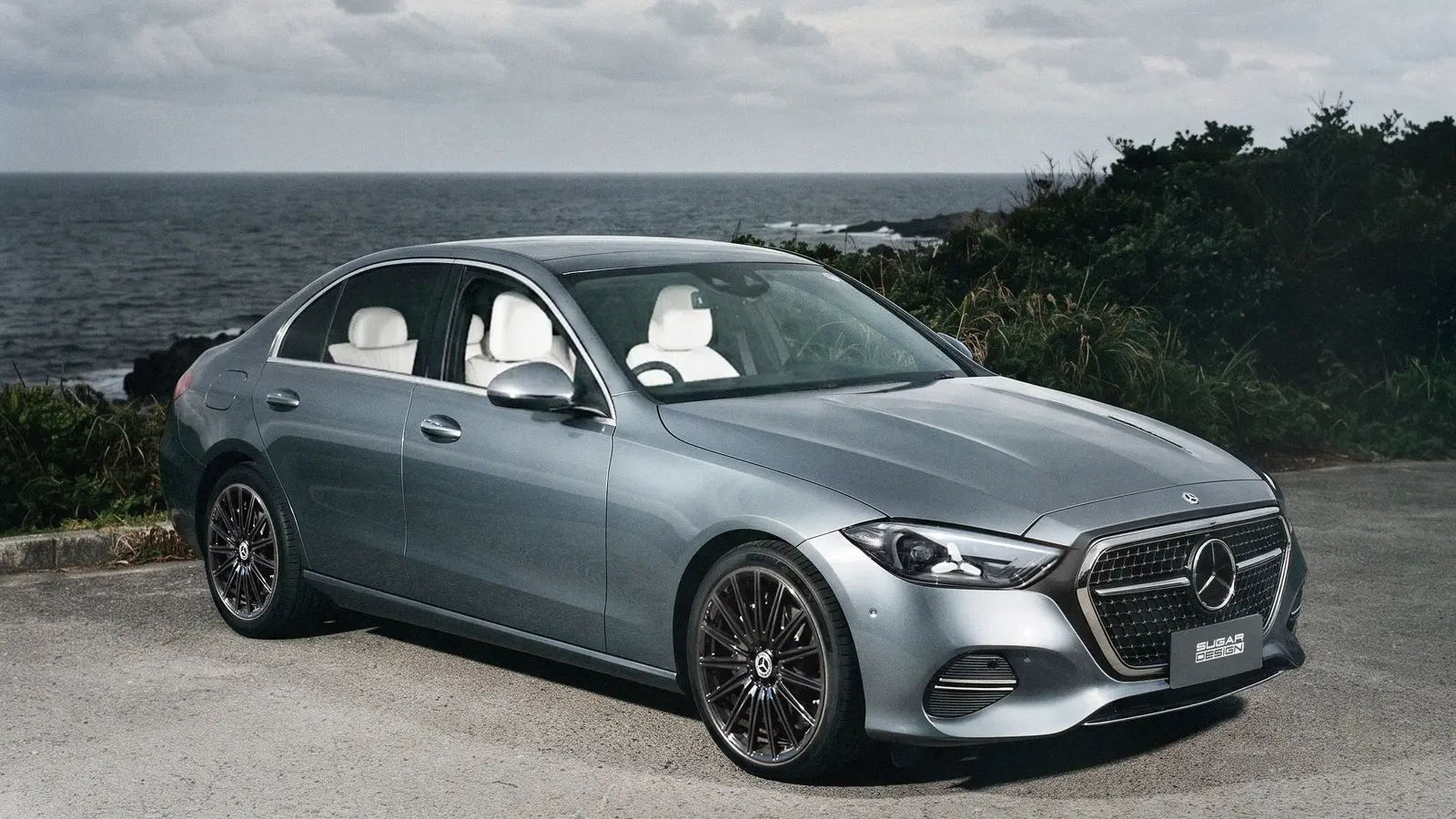
That question is exactly what a handful of spy shots and a recent CGI by virtual artist Sugar Chow — known online as sugardesign_1 — have been teasing. His render imagines the refreshed ICE C-Class leaning hard into S-Class styling cues: a larger, metal-studded grille, yawning with three-pointed stars where LEDs might have been, new headlight graphics that echo star-shaped DRLs, and taillights that tuck tiny LED stars into their lenses. It’s an audacious look, equal parts homage and provocation.

Close enough to taste like S-Class?
The W206 C-Class is not dead. Mercedes hasn’t abandoned traditional internal combustion buyers, and that matters. The fifth-generation sedan, around since 2021, sits on the MRA II rear-wheel-drive platform — the same basic architecture that underpins the current S-Class — which helps explain why enthusiasts often call it a mini-S-Class.
Still, the automaker is also sprinting on the EV front. Earlier this year the brand unveiled a ground-up electric C-Class built on the MB.EA architecture, packing an illuminated grille with 1,050 LEDs, an 800-volt system, dual motors producing 483 horsepower, and a 94 kWh Li-NMC battery. That EV is a statement: Mercedes intends to lead in both electric innovation and traditional luxury packaging. But not everyone wants cables over combustion. Enter the facelifted ICE C-Class — a necessary face-lift for a car that must satisfy both rational buyers and emotion-driven ones.
What the CGI shows lines up with recent prototype sightings: lighter camouflage up front and behind, a bolder front end and refreshed light signatures. The metal three-pointed stars embedded across a bigger grille feel like a deliberate visual shortcut, shorthand for S-Class pedigree. It signals prestige at a glance. Whether it also signals overuse is another matter.
Design language can be powerful. It can also wear out. How many times can a single motif be stretched across a range before it stops reading as family resemblance and starts to feel like repetition? For buyers seeking subtlety and restraint, stars everywhere may feel excessive. For others, it will read as consistent luxury — a clear family tie between showroom staple and flagship royalty.
There’s also substance to consider. Facelifts are rarely just cosmetic. Expect tweaks to driver assistance software, lamp technology, and perhaps mild powertrain updates, even if the core MRA II underpinnings remain. Mercedes has been strategic: refresh the faces, keep the engineering proven, and give buyers a fresh reason to stick with ICE for a bit longer.
This mid-cycle refresh appears to balance S-Class ambition with mainstream appeal, keeping ICE customers in Mercedes’ plans while the electric future accelerates.
So, are these changes a welcome upgrade or an over-familiar styling sprint? That answer will come in dealer showrooms and on owner forums. For now, the CGI has done its job: it sparks the conversation and forces us to ask how luxury should look when a brand is trying to play in two very different futures at once.

“Cars are evolving faster than ever. I cover electric vehicles, smart mobility, and the future of transportation worldwide.”

Discussion
Leave a Comment
Comments
No comments yet. Be the first.