
Picture a rover on a dusty plain, scooping up a sample and checking it without a chemistry lab strapped to its back. Small. Fast. Direct. That is the promise now being tested in laboratories: a microchip that can read the handedness of individual amino acid molecules and flag patterns that hint at biology.
Researchers led by the University of Osaka have built an electrical sensor that detects the chirality of amino acids — whether a molecule is the left-handed (L) or right-handed (D) form — using a gap measured in billionths of a meter between two gold wires. Chirality matters because life on Earth overwhelmingly prefers one handedness over the other; a skewed balance in a sample can be a fingerprint of biological activity rather than random chemistry.
The device works by monitoring an electrical tunneling current that appears when electrons jump, via quantum tunneling, across the tiny gap. Drop a solution containing amino acids onto the microchip and each molecule that passes alters the current in a unique way. Those tiny spikes can be read, analyzed, and classified. Machine learning then sorts the patterns and identifies L and D forms with notable accuracy.
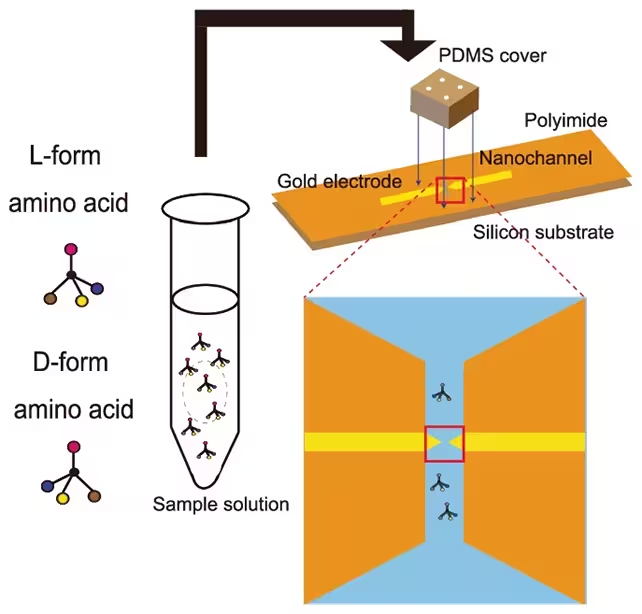
The nanogap microchip identifies amino acids as they pass through.
How the nanogap detector works and why it matters
Liquid chromatography–mass spectrometry, or LC–MS, is the current lab standard for analyzing amino acids and their chirality. Powerful. Reliable. Bulky. It demands sample preparation, solvents, centrifuges, and a bench. That makes it impractical for compact planetary probes or small field instruments.
By contrast, the Osaka team’s approach aims for simplicity: a chip-scale sensor that needs only minute quantities and minimal processing. The core is a pair of gold nanowires separated by a nanogap. When an amino acid crosses that gap, the tunneling current changes in a way that depends on the molecule’s shape and orientation. Training a machine-learning model on those transient signals lets the system tell L from D.
"By combining our nanogap tunneling technique with artificial intelligence, we were able to distinguish between the L and D-forms of amino acids with over 80 percent accuracy," says bioengineer Takahito Ohshiro of the University of Osaka. "This is the first discrimination of amino-acid chirality at the single-molecule level." Short sentence. Big claim.
The team validated the sensor against known targets. They ran tests on fragments from the Murchison meteorite, long prized for its organic inventory, and soil taken from the hyper-arid Atacama Desert. Results tracked closely with traditional LC–MS: both methods captured the key features of amino acid composition in those samples.
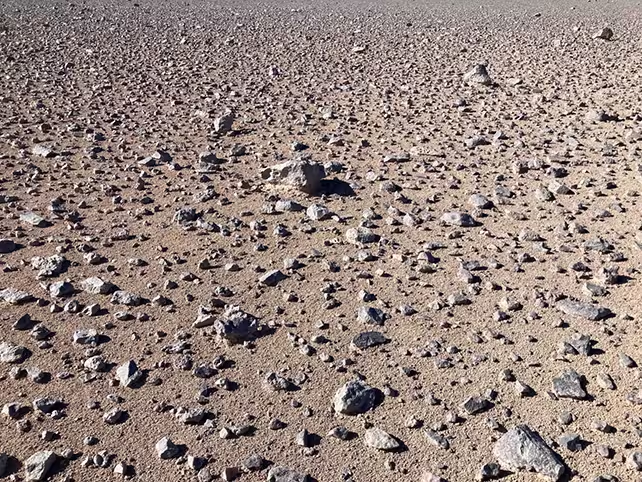
The technique has already been tested on samples from the Atacama Desert in Chile.
What makes this work compelling for astrobiology is not that it finds life at a distance, but that it reduces the distance between sample and verdict. A rover could, in principle, process a sample on-site and report whether molecules show a chiral bias worth follow-up. That modest, pragmatic step would greatly sharpen search strategies: instead of shipping everything home or relying on indirect geochemical proxies, missions could prioritize locales with biological signals.
Nanotechnologist Masateru Taniguchi, also from the University of Osaka, notes the comparative advantage: "Our method was comparable to traditional methods, as both were capable of capturing the major features of amino acid composition." There’s a caveat, though. The current detector needs more development to become a rugged, flight-ready instrument.
Several technical hurdles remain. The machine-learning classifier was trained on known amino acids; unknown or unexpected molecular species could confuse it. Sensors must be hardened against temperature swings, radiation, and contamination. And for true autonomy, on-board algorithms will need to flag genuinely novel signatures rather than only those they recognize.
Expert Insight
"This is a clever fusion of quantum-scale sensing and data science," says Dr. Elena Moreno, an astrobiologist not involved in the study. "A system that can name a molecule as it flows by — and hint whether its abundance pattern points to biology — changes how we design life-detection experiments. It does not replace other instruments, but it can guide them."
Moreno emphasizes realism: "Single-molecule resolution is exciting, but mission planners will want redundancy. Multiple lines of evidence still matter: isotopic ratios, mineral context, and repeatable chirality signals across samples." Short answer: promising, conditional, and complementary.
Conclusion
The Osaka team's nanogap tunneling sensor is not a magic shortcut to extraterrestrial life. It is, however, a credible step toward portable, low-footprint chemical analysis that could increase the yield of life-detection campaigns. The device shrinks a complex laboratory workflow into a chip, and when paired with smart algorithms it can deliver molecular-level insight without the baggage of a full LC–MS setup.
If further testing and engineering make the sensor robust enough for spaceflight, future missions to moons and planets could carry a lightweight sentinel for biological signals. That is the objective: more intelligent sampling, earlier clues, and a better sense of where to look next. And if microbial life elsewhere prefers a molecular handedness different from random chemistry, this tiny gap in gold might help us notice it first.

“My work centers on sustainability, energy, and environmental science — examining how innovation can lead to a greener future.”

Discussion
Leave a Comment
Comments
No comments yet. Be the first.