
Light from a star that exploded nearly a millennium ago is still speaking to us. It has a voice now, clearer than ever.
A Star Exploded 850 Years Ago. Somehow, It’s Still Alive
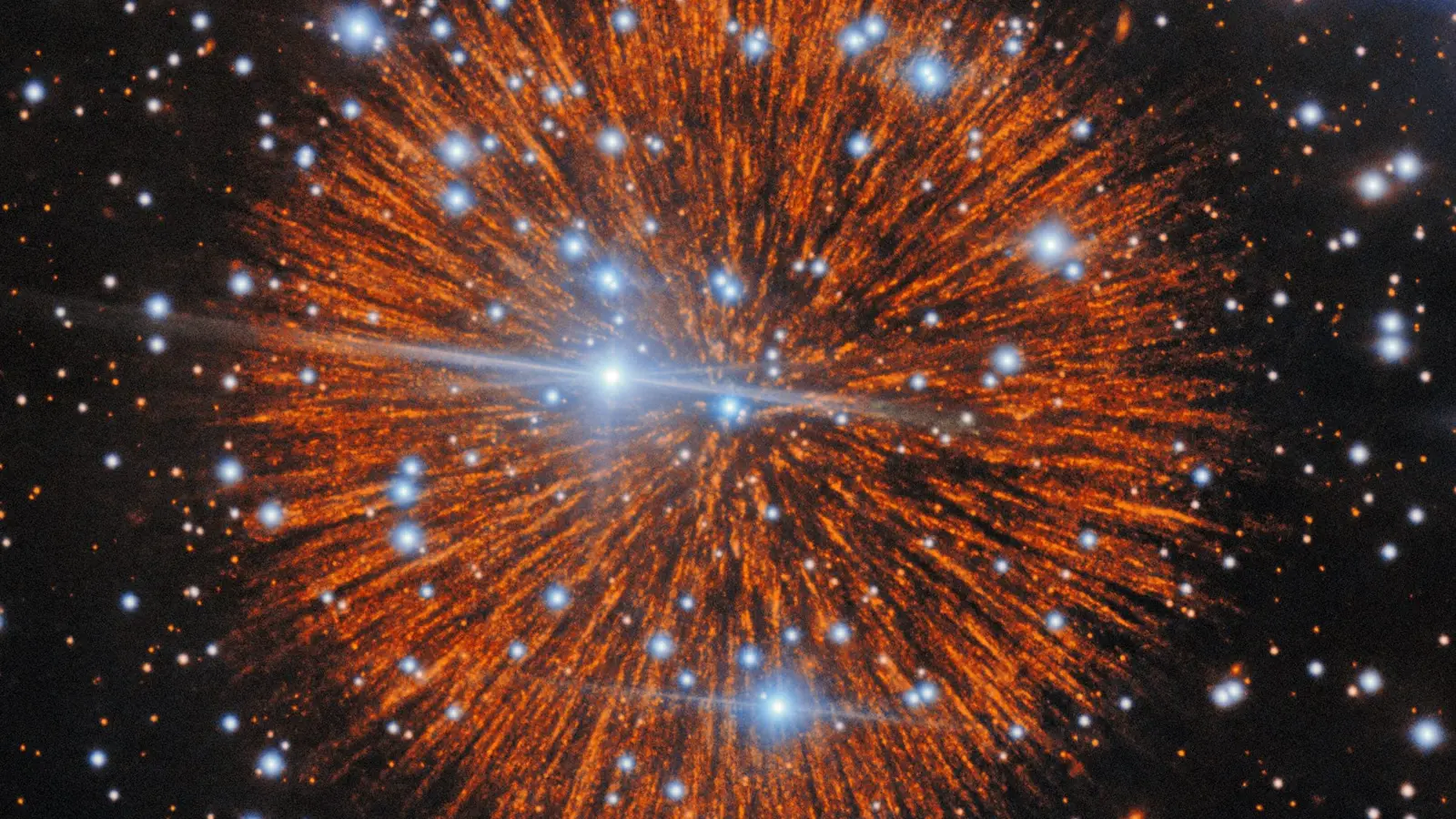
The new Gemini North images transform Pa 30 from a fuzzy smear into a stitched tapestry of gas knots. What had looked like smooth filaments are actually compact chains of emission, each knot dense and uniform enough to invite questions about how they formed and held together for centuries.
Citizen scientists first flagged Pa 30 in 2013. Professional astronomers then dug into archival observations and historical records, connecting the nebula to a supernova observed across East Asia and the Middle East in 1181. That single identification turned Pa 30 into one of only five supernovae witnessed before the telescope age whose remnants we can now link to contemporary observations. It is rare to find a recorded explosion with a surviving stellar core still detectable today.
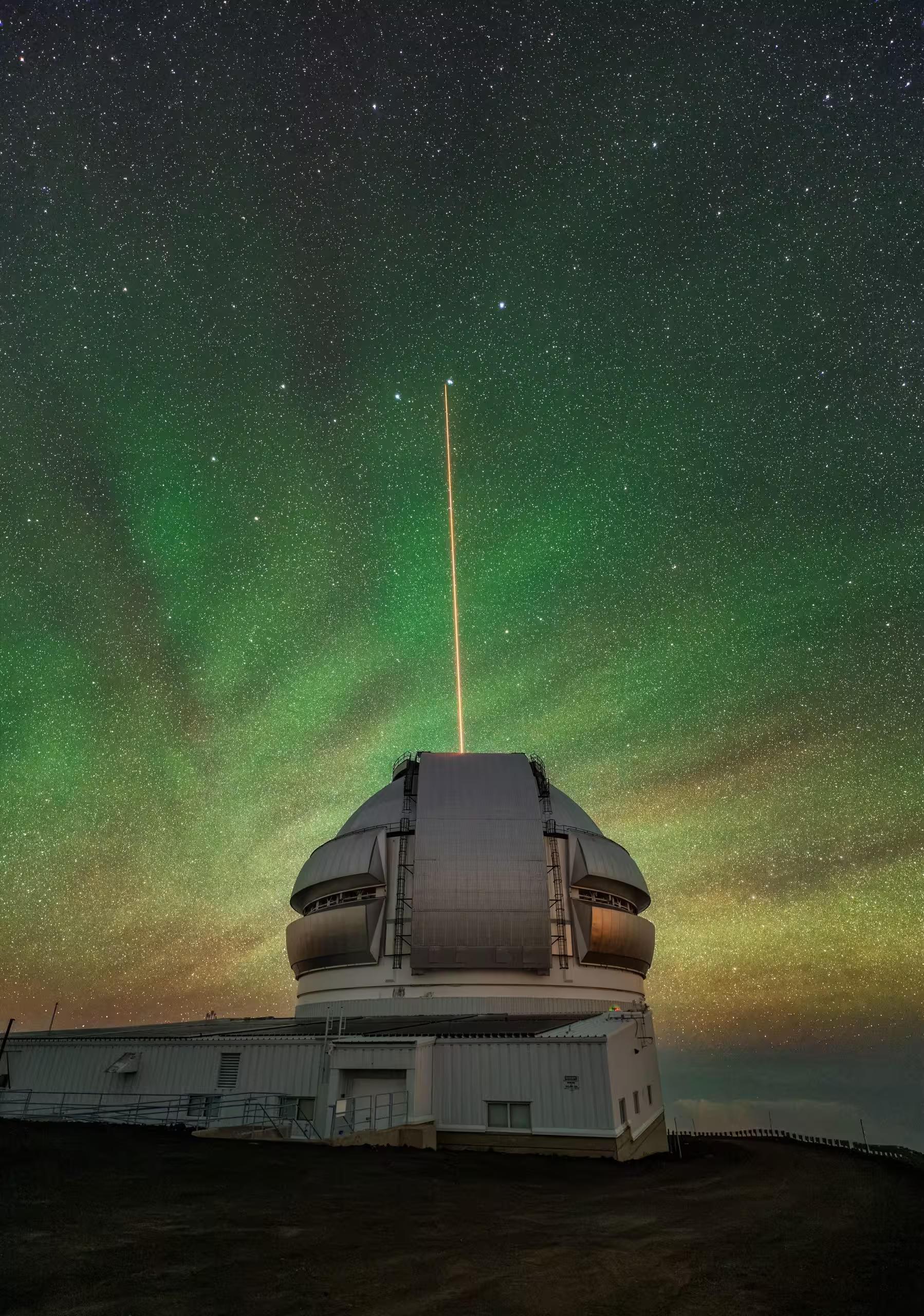
Gemini North’s laser shines through airglow. The Gemini North telescope’s laser guide star beams up into the atmosphere. The laser guide star is used to measure turbulence in the Earth’s atmosphere so the telescope can correct for it and achieve clear images of the night sky.
What the images reveal and how they were made
At roughly 7,500 light-years, Pa 30 sits close enough that Gemini North can resolve fine details. The telescope, perched on Mauna Kea at about 4,200 meters elevation, uses adaptive optics and the Gemini Multi-Object Spectrograph (GMOS) to pierce the blurring effect of Earth’s atmosphere. The team combined deep exposures and narrowband filters tuned to emission lines—specifically ionized sulfur, S II, and doubly ionized oxygen, O III—to map gas at different temperatures and ionization states.
The S II data were the game changer. They revealed about ten times more filamentary structure than previous images had shown. Those filaments are not continuous ribbons; they break into a necklace of knots. Imagine pearls on strings, sprinkled across a faint halo of emission. Each knot is compact. According to the authors, the region inside a single knot could, with room to spare, fit the volume of our solar system out to Neptune’s orbit roughly ten times over. That gives you a sense of scale: small on interstellar terms, but substantial in human terms.
Tim Cunningham, who co-led the observational program while at the Center for Astrophysics, and Ilaria Caiazzo, now at the Institute of Science and Technology Austria, steered the analysis. Their work appeared in The Astrophysical Journal and draws on both fresh Gemini observations and decades of context from historical reports and survey data.
Why a surviving star makes this remnant unusual
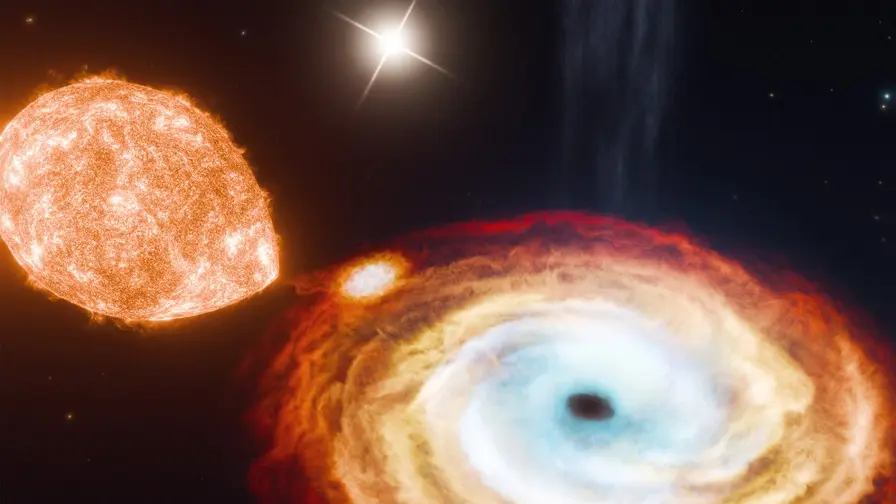
Pa 30 is associated with a Type Iax supernova, an uncommon class sometimes described as a failed or partial thermonuclear explosion. Unlike the canonical Type Ia explosions that entirely unbind a white dwarf, Type Iax events can leave behind a bound remnant. In Pa 30’s case, telescopes can detect a surviving stellar core at the nebula’s center—an observational rarity in our galaxy.
Where many supernovae fling a star away with a noticeable velocity because of explosion asymmetry, the star inside Pa 30 sits almost exactly at the geometric center of the nebula. The team measured the remnant’s transverse speed—the motion across the sky—and placed a tight upper limit on any sideways kick. The conclusion: the explosion must have been unusually symmetric, or the kick transferred to the surviving core was extraordinarily small. That constraint helps narrow theoretical models for how two white dwarfs might collide or interact to produce a Type Iax outcome.
Expert Insight
"Pa 30 is a Rosetta Stone for rare thermonuclear explosions," says Dr. Maya Singh, an observational astrophysicist at the University of Edinburgh. "We can test models with real geometry and real velocities. The knotty filaments tell a story about shock interactions and magnetic confinement that simulations have only hinted at. Finding more objects like this will let us connect explosion physics to population statistics."
Identifying more Type Iax remnants is a realistic near-term prospect. Historical records of bright guest stars extend back only about a thousand years, so many recorded events may still be unlinked to modern remnants. And now that Pa 30’s morphology and spectral fingerprints are better characterized—strong S II emission, distinctive O III structure, compact knot chains—astronomers can mine survey archives and upcoming wide-field datasets to flag similar candidates.

Cunningham notes that modern sky surveys and machine-learning pipelines generate an enormous volume of potential targets. Pa 30’s detailed map will serve as a template for screening. In the big-data era of astronomy, having a well-probed exemplar is invaluable. It teaches algorithms what a Type Iax remnant looks like when resolved, and it trains human classifiers to prioritize the most promising candidates for follow-up spectroscopy.

Ilaria Caiazzo, assistant professor at the Institute of Science and Technology Austria (ISTA). Caiazzo co-led the study with Tim Cunningham from the Center for Astrophysics | Harvard & Smithsonian, now assistant professor at the University of Warwick.
Broader implications and next steps
Beyond identifying kin to Pa 30, these observations press on fundamental questions. How do compact knots form in expanding ejecta and survive over centuries? Are magnetic fields threading the remnant confining those knots? Do the knots mark clumps launched during the explosion, or are they the outcome of later hydrodynamic instabilities as the ejecta interact with a faint surrounding medium?
Answering these questions requires both modeling and more data. Higher-resolution spectroscopy could map velocities within individual knots. Polarimetric measurements might reveal the role of magnetic fields. Long-term monitoring will test whether the knots evolve or disperse on observable timescales.
Finally, Pa 30 is a reminder that our galaxy still keeps secrets in plain sight. Some stellar deaths leave no tidy ending. In a few, the star survives—scarred but luminous—and tells a complex tale. Pa 30 gives astronomers a rare laboratory in which to study the boundary between total disruption and survival in thermonuclear explosions.
Conclusion
The Gemini North images of Pa 30 lift this ancient supernova remnant out of ambiguity. Knots replace smooth filaments. A surviving core sits where physics predicts it could if the explosion conserved symmetry. For researchers hunting the fossil record of stellar explosions, Pa 30 is both a benchmark and a beacon. With new surveys coming online and analysis tools improving, more of these rare, partially exploded systems may soon step into view. When they do, Pa 30 will be the yardstick by which they are measured.

“My work centers on sustainability, energy, and environmental science — examining how innovation can lead to a greener future.”

Discussion
Leave a Comment
Comments (1)
Wait, it exploded in 1181 and we can still see a surviving core? Mind blown. Those knotty filaments sound like cosmic pearls. Need more spectra pls