
On a crowded clinic porch in a West African city, a young mother asks a nurse if the new advice will actually help her child. The nurse answers with facts. The mother scrolls her phone and reads a post that contradicts the nurse. Which voice will she trust? Surveys suggest the social answer is shifting, and the consequences reach far beyond that porch.
What the global survey revealed
The latest wave of the Wellcome Global Monitor — the most comprehensive international study of public attitudes toward science — interviewed more than 140,000 people across 140 countries. The headline is stark: the share of respondents who say they trust science at least somewhat has fallen from 80 percent in 2020 to 72 percent in 2025. That reverses earlier gains: trust was 77 percent in 2018, nudged up during the early pandemic years, then slipped back.
Numbers alone understate the story. Regional differences are profound. Only 21 percent of respondents in sub-Saharan Africa report 'a lot' of trust in science, while in Western Europe that figure is 54 percent. In much of sub-Saharan Africa just 28 percent of people felt science was benefiting most people in their country. The survey links lower trust to financial hardship and low confidence in national health systems — a pattern with practical consequences for vaccination campaigns, outbreak responses, and public-health messaging.
Why trust is eroding, according to frontline experts
'Public trust determines whether scientific advances translate into real improvements in people’s lives,' said John-Arne Røttingen, chief executive of the Wellcome Trust. 'When communities do not see science as a force for collective good, its potential to improve health, influence climate policy, or address mental health is weakened.' It is a blunt observation with ripple effects.
Experts working in affected regions point to a chain of causes. Economic shocks and rising costs of living mean health and survival decisions are dominated by immediate needs. Health systems strained by chronic underfunding, the lasting impact of COVID-19, and recurring outbreaks such as Ebola and monkeypox create visible evidence that health interventions often arrive late or incompletely. When clinics run out of medicines or diagnostics, or when communities feel excluded from decision-making, science and public institutions lose credibility.
Dr Anise Ahmed, who directs programs at Amref Health Africa, explains that trust is largely experiential. 'Communities judge science by what they actually encounter: vaccination drives, mobile maternal clinics, or a visit from a community health worker,' she says. 'If those services are unreliable, or if people feel programs ignore their realities, uptake will lag even if the science behind a program is sound.'
Another recurring theme is misinformation. Reduced confidence in institutions creates fertile ground for rumors, amplified by social media, that directly undermine public-health measures. In regions where donor funding has declined and health systems are thinly resourced, the gap between scientific recommendations and community experience can grow wide and persistent.
Early diagnostic gaps and the trust penalty
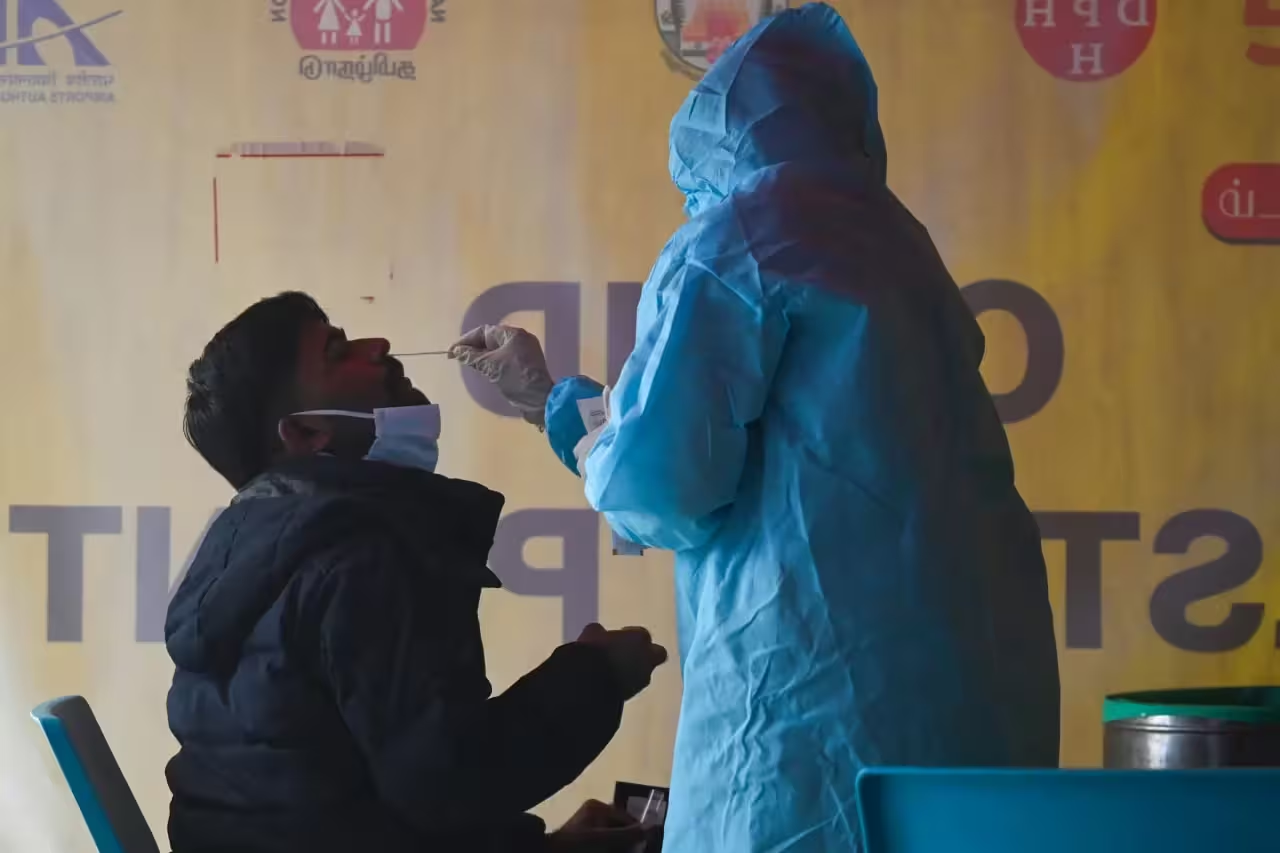
Technical failures also matter. Dr Olwen Gitau, chief scientific officer at Science for Africa, points to diagnostic shortages during early outbreaks as a trigger for skepticism. 'When testing is limited, communities see delayed responses and unmet promises. People may know what should be done, but when the measures are slow or inaccessible, they reject them — not because the advice was wrong, but because the system failed to deliver,' she observes.
That sequence — underfunded health services, unmet promises, and spreading rumors — helps explain why some regions registered a temporary rise in trust during the pandemic and then a steady decline thereafter. Where pandemic responses were visible and effective, trust rose. Where infrastructure was absent or weak, the brief uptick evaporated.
Public health implications and near-term risks
Lower trust in science is not an abstract problem. It affects vaccine acceptance, adherence to prevention guidelines during outbreaks, participation in screening programs, and the willingness to support public policies on climate and mental health. Policymakers and practitioners must confront a stark reality: scientific breakthrough means little if communities distrust the institutions that deliver or explain those advances.
There are practical steps that can mitigate decline. Strengthening local health infrastructure, investing in consistent community-facing services, and involving local leaders in decision-making help rebuild credibility. Transparent communication about uncertainties, realistic timelines for interventions, and rapid diagnostic capacity during outbreaks are equally important. Trust grows in small increments. It is earned through performance and participation, not slogans.
Expert Insight
'Restoring public trust requires a dual approach,' says Dr Maya Reynolds, an infectious disease epidemiologist who has worked on outbreak responses in Africa and Asia. 'First, strengthen the delivery chain: diagnostics, medicines, and trained staff. Second, co-design interventions with communities so people see their priorities reflected. When both are done together, scientific recommendations become legible and relevant.' Her comment underlines a common theme: credibility is built at the intersection of evidence and experience.
Conclusion

The Wellcome survey is a warning and an opportunity. The drop to 72 percent global trust in science signals vulnerabilities in health systems, the spread of misinformation, and gaps between scientific recommendations and on-the-ground realities. Reversing the trend will demand long-term investment in health infrastructure, genuine community engagement, rapid diagnostics in outbreak settings, and consistent, honest communication about what science can — and cannot — deliver. The stakes are high: lives, public resilience, and the capacity to respond to future crises depend on whether societies can restore faith in science as a force for common good.

“The cosmos has always fascinated me. I write about space missions, astronomy, and the technologies pushing humanity beyond Earth.”

Discussion
Leave a Comment
Comments (1)
This hits home... If clinics run out of tests, why trust the advice? Sad. Need long term funding, not headlines. People remember broken promises