
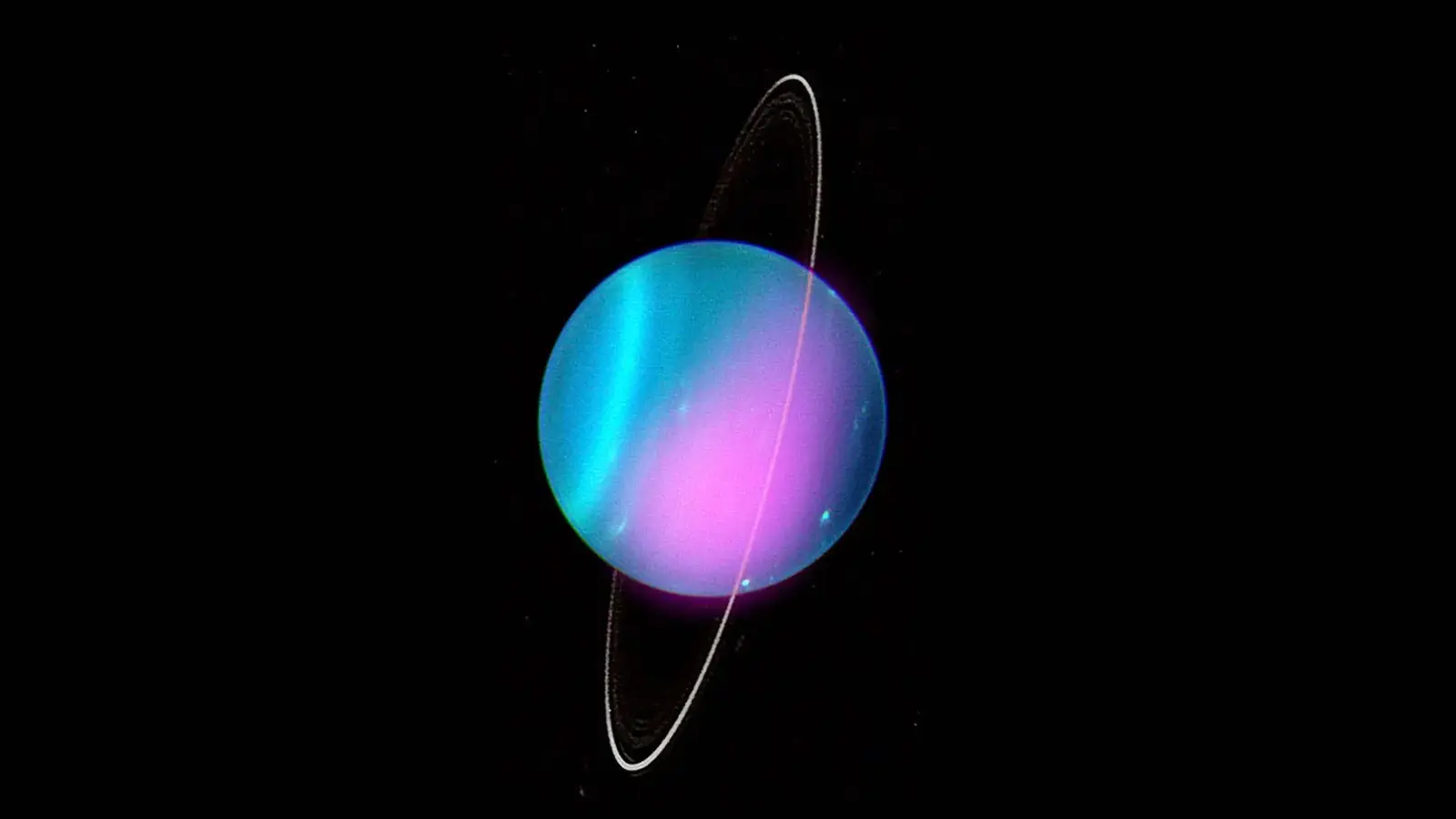
Imagine a planet that rolls along its orbit instead of spinning upright. It is not a metaphor. Uranus literally rotates almost on its side, an oddball in a family of planets that mostly keep their poles near perpendicular to their orbital planes. That tilt shapes seasons that last decades and a system of moons and rings that seem to share the same peculiar orientation.
Astronomers have argued about the cause for decades. Was it a single cataclysmic collision with a planet-sized object long ago, or a slower, subtler choreography involving moons and resonances? Recent computer models revive an elegant middle ground: a now-lost giant moon, tugging and migrating outward, could have slowly nudged Uranus into its present tilt before ultimately being destroyed or absorbed.
Uranus is a different kind of giant. It is an ice giant, colder than its peers and wrapped in muted blue-green haze. Its current axial tilt sits near 98 degrees. For comparison, Earth tilts about 23.5 degrees. That extreme obliquity means each pole spends roughly 21 Earth years either bathing in sunlight or shrouded in long night. During equinoxes, sunlight streams almost directly at the equator, producing dynamics unlike those on any other major planet in our system.
A few historical facts anchor the mystery. Early observers mistook Uranus for a star until William Herschel, using a home-built telescope in 1781, realized it was something else. In later centuries, astronomers cataloged at least 27 moons and a faint ring system. The moons themselves display orbital orientations that reflect Uranus's odd tilt, hinting that the planet and its satellites share a linked history.
.avif)
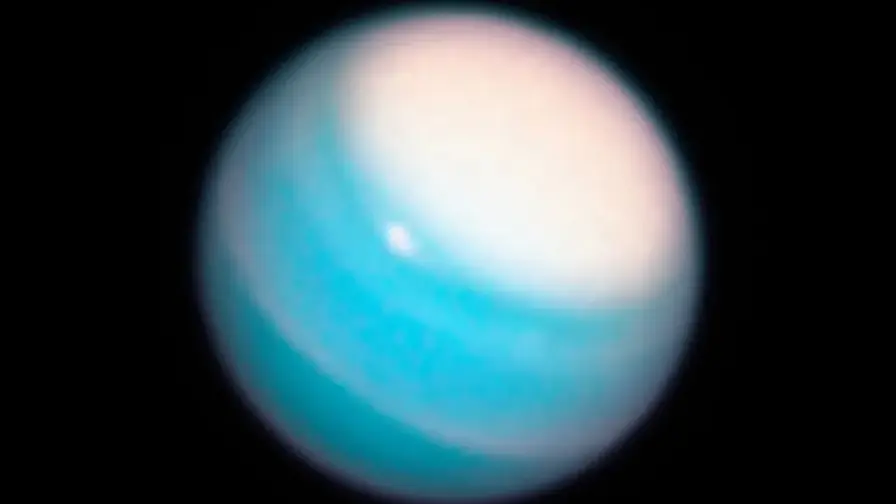
Image: A wide-field view of Uranus captured by the Hubble Space Telescope in November 2018. The photo shows large bands of bright, stormy clouds across the planet's northern polar region. NASA Goddard Space Flight Center, and M. Wong and A. Hsu (University of California, Berkeley)
Why a single collision does not close the case
The simplest explanation seems visceral. Early in the solar system, collisions were common. A glancing blow from a massive protoplanet could conceivably tilt a growing Uranus drastically. That scenario has strong intuitive appeal and has featured in textbooks and popular articles for years. It is also not without problems.
Simulations show that a lone giant impact can change axial tilt. But it must be tuned. The impactor needs the right mass, speed, angle, and timing. Too little, and Uranus would not tip much. Too much, and the collision would leave scars in the form of a different satellite architecture or even strip away atmosphere and rings. Observations of Uranus today put constraints on how violent any ancient collision could have been. The moons we see around Uranus are small and numerous. They do not look like survivors of a single, recent, planet-scale smash up.
That discrepancy drives researchers to consider alternative or complementary mechanisms. Could the tilt be cumulative rather than the product of one dramatic event? Could moons, through long-term gravitational interactions, slowly pry open a planet's axis?
A migrating moon as a cosmic lever
In 2022 a team led by Mélanie Saïnfest at the Paris Observatory revisited this possibility with fresh simulations. The team asked what would happen if Uranus once hosted a large satellite that later vanished. Their models tracked the gravitational interplay among Uranus, its hypothetical moon, and the broader solar system over millions of years.
Here is the core idea. A moon orbiting close to its planet modifies how the planet's rotation axis precesses, that is, how the axis slowly wobbles under external torques. If the moon migrates outward over time, perhaps driven by tidal dissipation within Uranus, that precession rate changes. When the precession frequency locks into a resonance with the motion of the planet's orbit, the tilt can be pumped up progressively. Resonant capture is not explosive. It is a gradual transfer of angular momentum that can push Uranus toward a near sideways orientation.
Once the obliquity approaches about 90 degrees, the moons' orbital geometry becomes unstable. Orbits that were once regular can chaotically shift, collide, or be ejected. Saïnfest and colleagues show that such a chain of events could take the system from modest tilt to the present 98 degrees, with the final act being the destruction, collision, or assimilation of the migrating moon. Importantly, their simulations indicate the moon itself was likely too small to create the tilt by direct impact alone. Instead, its role was as a resonant agent, a long-term lever that reshaped the planet's spin over time.
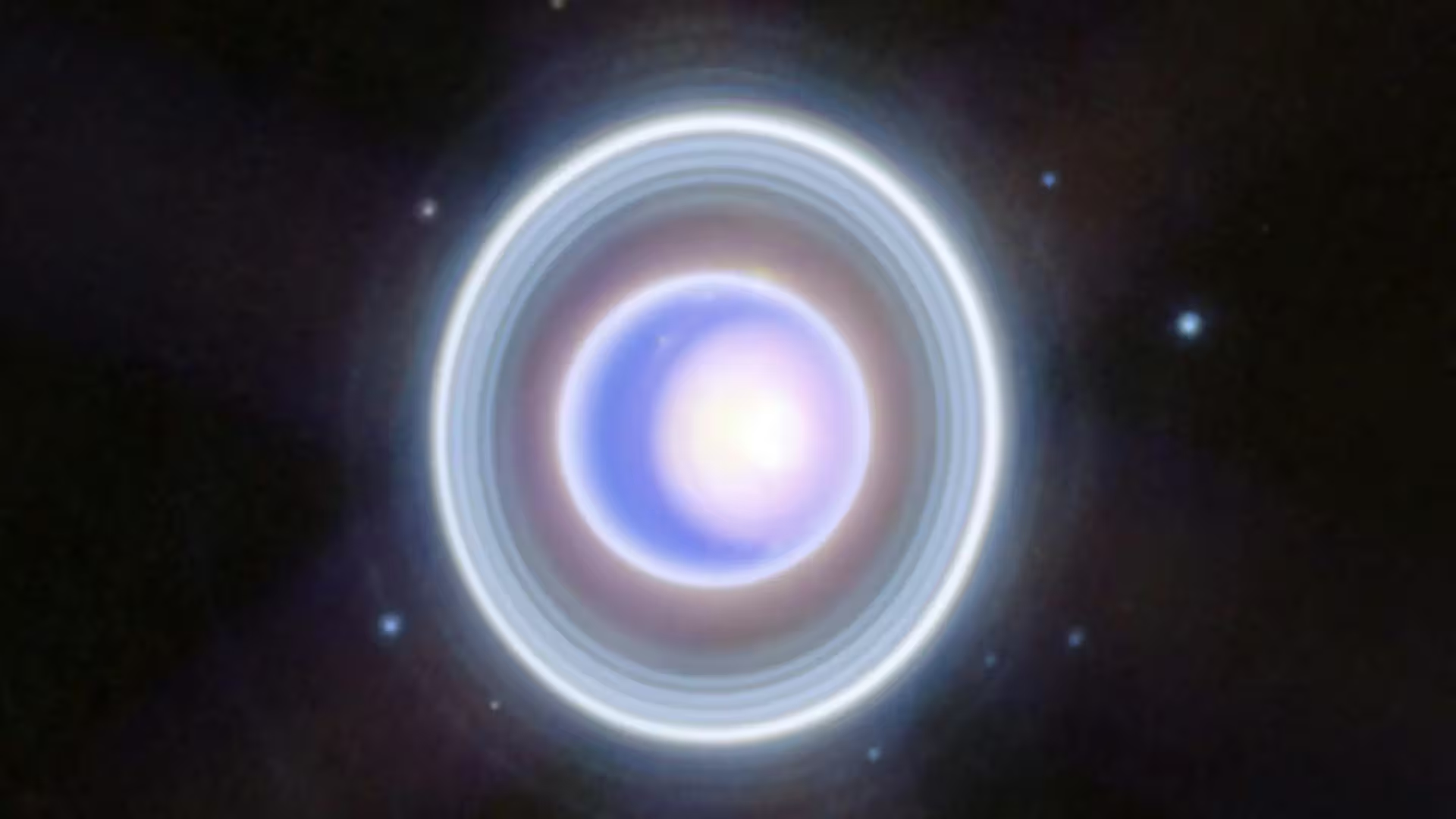
Uranus and nine of its moons along with its rings as seen by the James Webb Space Telescope in 2023. NASA, ESA, CSA, STScI
Testing the lost moon hypothesis
Models are compelling, but nature is the final arbiter. Saïnfest's team outlines observational tests that could lend weight to the lost moon picture.
- Measure current moon migration rates. If Uranus is dissipating tidal energy efficiently, its moons should be moving outward measurably, at rates of centimeters per year. Precise astrometry over decades could reveal that motion.
- Estimate the ages of the moons. If the present satellites are younger than the solar system, they could be second generation fragments created when an earlier, larger moon broke apart during the instability. Surface crater counts, spectral studies, and thermal models may constrain relative ages.
- Map internal heat loss. The lost moon scenario requires that Uranus was able to dissipate a significant amount of tidal energy as heat. Measurements of Uranus's internal heat and of subtle changes in its rotation could help quantify dissipation rates.
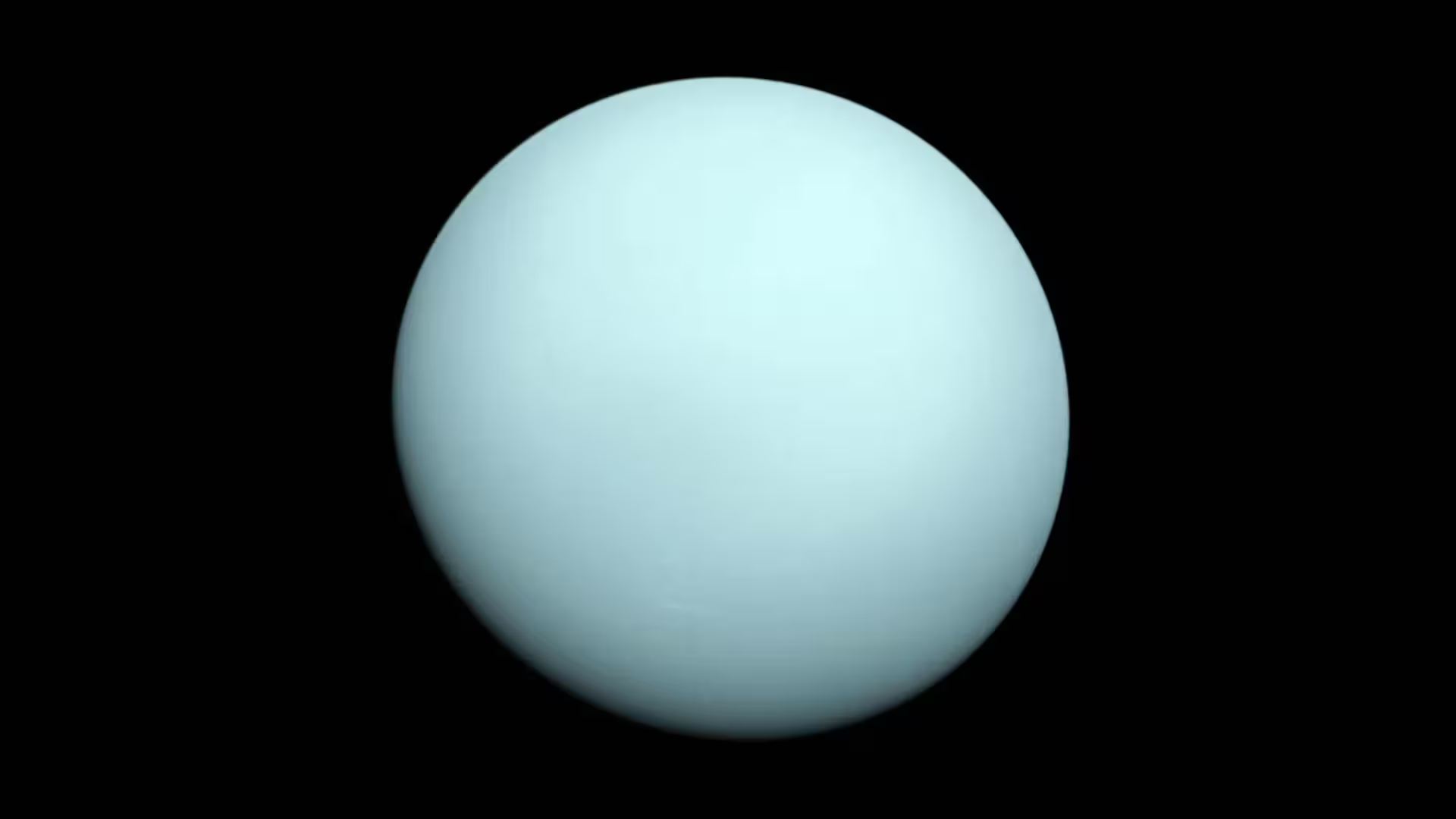
Voyager 2 captured a close view of Uranus on December 18, 1986. Newer telescopes and instruments, however, now let astronomers probe the planet in wavelengths and resolutions Voyager never could. NASA/JPL Caltech
Implications for moons, oceans, and rings
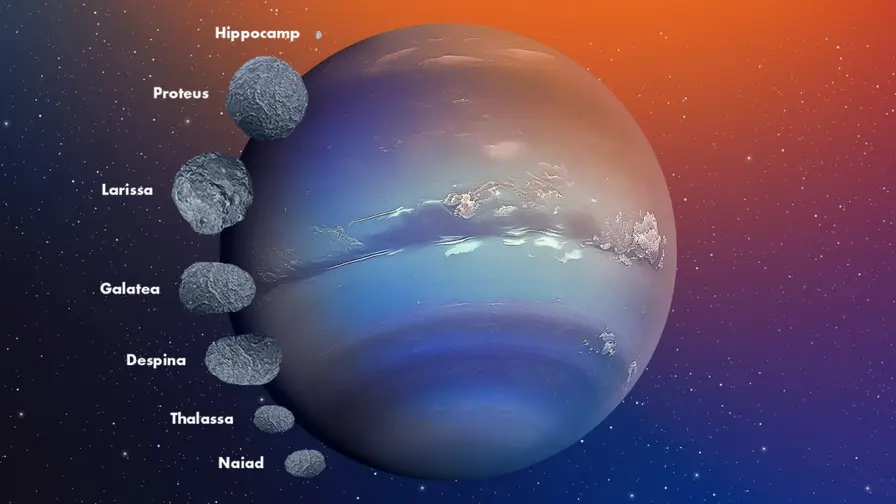
The lost moon hypothesis reframes our thinking about Uranus's family. If a large moon once migrated outward and destabilized the system, today's satellites might be fragments, survivors, or later accretions. That, in turn, has implications for subsurface oceans, thermal histories, and potential habitability of icy moons elsewhere. A moon that formed from debris after a destructive phase could retain heat from the event or from radiogenic decay. Younger surfaces also tend to carry less impact gardening, making their geology easier to interpret.
More broadly, the mechanism highlights how planetary systems evolve not just by single collisions but also by resonant dances that redistribute angular momentum. Such processes may be common around exoplanets as well, especially for systems with multiple large satellites or close-in companions. Understanding Uranus therefore informs models of planetary tilt, climate cycles, and satellite formation across the galaxy.
Expert Insight
Dr. Lina Moreno, a planetary dynamicist at a university research center, comments: 'Resonant interactions between a planet and its satellites are subtle but powerful. They operate like a slow gear shift spread over millions of years. When a moon migrates outward, it nudges the planet's precession and can lock the system into states that are hard to reach by impulsive collisions alone. Observations that show active outward migration or anomalously young moons would be a smoking gun for this pathway.'
Her assessment reflects a growing consensus that multiple processes can act in concert. A system may be nudged by tides and resonances, then capped by a collision or a breakup that leaves the present architecture.
What observations will decide the story
Several lines of investigation will sharpen the picture. Long term monitoring of Uranus's moons with ground based telescopes and space observatories can detect tiny outward drifts. Spectroscopy across visible to infrared wavelengths can probe surface composition to estimate relative ages. Future missions would be decisive. An orbiter equipped with a magnetometer, gravity science package, and imaging suite could measure Uranus's internal structure, its tidal dissipation factor, and map the orbits and masses of small satellites precisely.
There is also growing interest in targeted flyby or orbit missions to the ice giants. Those missions face engineering and budgetary challenges but would return transformational data. An orbiter could test whether Uranus has the internal thermal plumbing required by the migration scenario and could search for evidence of past violent events preserved in the crater record and ring structure.
Conclusion
Uranus's sideways spin remains one of the solar system's most evocative mysteries. The lost moon hypothesis does not dismiss the idea of violent impacts. Instead it suggests a layered history where tidal dissipation, resonant locking, and eventual catastrophe combined to tip the planet into its current posture. The idea is testable. It predicts measurable moon migration, potentially younger satellite surfaces, and specific requirements for Uranus's internal heat budget. In the coming decades, better observations and eventual missions to the ice giants may confirm whether a vanished moon was the quiet architect behind one of the solar system's strangest tilts.

“The cosmos has always fascinated me. I write about space missions, astronomy, and the technologies pushing humanity beyond Earth.”

Discussion
Leave a Comment
Comments (3)
Pretty wild how slow dynamics can beat a giant crash. Also, 21-year polar days?? thats camping-level long night lol
Is the lost moon idea testable though? measuring cm/yr drift seems insane, only decades of precise astrometry will do. sounds plausible but hard
Wow, a vanished moon slowly tipping Uranus? Mind blown, kinda poetic. But also wild to imagine decades-long seasons... makes me wanna see an orbiter