
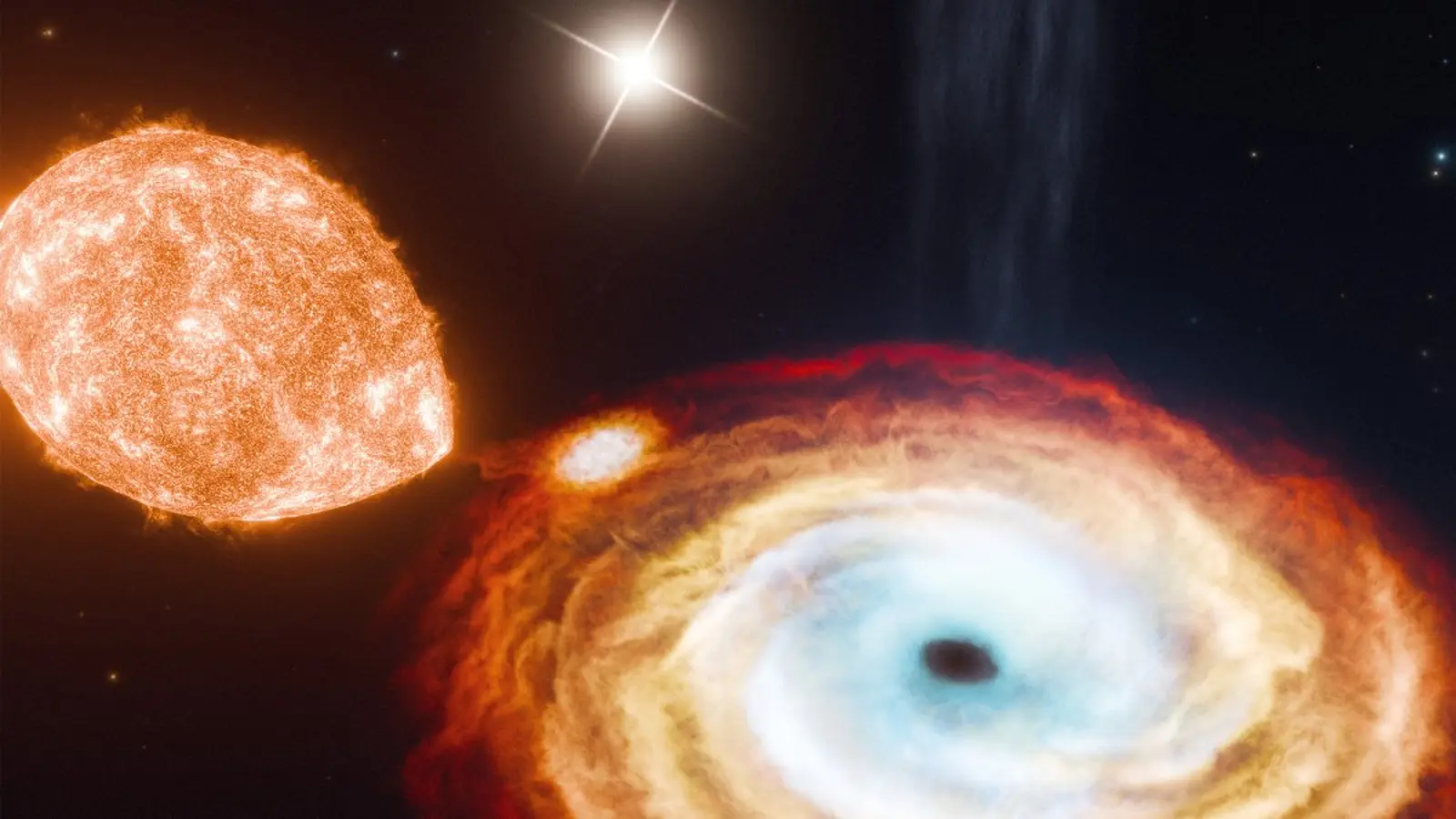
Imagine a tiny, invisible object threading through a star and, in the blink of cosmic time, turning a stable ember into a cosmic blast. That is the provocative idea emerging from recent models: primordial black holes might slip through white dwarfs and set off some Type Ia supernovae.
Primordial black holes are hypothetical compact objects formed in the dense, turbulent moments after the Big Bang. Unlike the black holes born from collapsed massive stars, these relics could have a wide range of masses and roam the galaxy as quiet, unseen passengers. Could they also be part of the dark matter puzzle? Possibly. Could they trigger stellar detonations? New work suggests yes.

Primordial black holes may pass through white dwarfs and ignite a subset of Type Ia supernovae. New models suggest these hidden encounters could reproduce observed explosion signatures while leaving distinctive chemical traces across the Milky Way.
How a stealthy encounter detonates a white dwarf
White dwarfs are compact. Think of a Sun-like star compressed down to Earth-sized proportions. Dense and degenerate, they normally cool for billions of years. But push the local conditions just enough and carbon fusion can run away. That runaway is the hallmark of a Type Ia supernova, an event astronomers use as a cosmic yardstick and a factory for heavy elements.
Enter the primordial black hole. As it crosses a white dwarf, its gravity produces tidal forces that heat matter along the path. If the heating raises the temperature above roughly half a billion kelvin in a sufficiently large region, neutrino cooling can no longer balance nuclear heating. Local carbon burning runs away, forming a thermonuclear flame that can propagate and unbind the star. Short. Violent. Bright.
Shing-Chi Leung of SUNY Polytechnic Institute, together with Ken'ichi Nomoto and Alexander Kusenko at the Kavli Institute for the Physics and Mathematics of the Universe, led a team that built models of these interactions. Their simulations seek to reproduce emission, expansion, and the chemical yields from explosions initiated by primordial black holes. The results echo an earlier 2025 study by the same group showing that PBH-triggered explosions can closely mimic conventional Type Ia events in many observable respects.
Schematic illustration of the primordial black hole passing through a white dwarf. Along its trajectory, the gravitational force of the passing black hole creates tidal heating to the surrounding matter inside the white dwarf. As the heated matter reaches the threshold temperature (<~0.5 billion Kelvin), the hydrostatic carbon burning will exceed the neutrino cooling, creating an uncontrolled burning. When the burning zone is large enough, the heated matter can form a local thermonuclear runaway which triggers the later Type Ia supernova explosion. Credit: Generated using Gemini AI (Banana Pro))
Observational fingerprints across the Milky Way
Models are only useful if they meet observations. So the team compared predicted signatures with well-studied remnants and nearby explosions: Tycho, Kepler, 3C 397, SN 2011fe, and SN 2012cg. They also examined the large-scale chemical patterns present in Milky Way stars.
Key diagnostics include radioactive isotopes such as nickel-56 and nickel-57, and stable elements like manganese and nickel. The relative production of these species depends sensitively on the progenitor mass and metallicity. The PBH-triggered models can reproduce several observed isotope ratios and abundance trends, suggesting that at least a fraction of Type Ia supernovae might originate from this stealth pathway.
Why does that matter? Because Type Ia explosions are major contributors to the galactic inventory of iron-group elements. If a non-zero fraction of these supernovae were triggered by primordial black holes, the additional pathway would subtly shift the chemical evolution of the galaxy. Observed abundance trends among stars in different ages and locations in the Milky Way may already carry hints of that shift.
"Our work suggests that some supernovae that we observe in the sky could be a result of PBHs," Leung said in a statement accompanying the paper. "Therefore, even though we cannot directly observe these evasive entities, they leave many interesting clues in nature for us to probe their properties." The research appears in The Astrophysical Journal.

Expert Insight
Dr. Mira Santos, an astrophysicist not involved with the study, offers a practical perspective: "This idea brilliantly links two puzzles at once: the origin of certain Type Ia events and potential dark matter constituents. The challenge now is observational. We need high-fidelity isotope measurements from remnants and more detailed rate estimates to pin down how common PBH triggers might be."
Going forward, the authors plan to widen their parameter surveys, compare rates with the observed Type Ia population, and refine predictions for chemical yields. Future X-ray and gamma-ray observations of young remnants, improved isotopic abundances from spectroscopy, and precise modeling of stellar populations could all help test the hypothesis.
Whether primordial black holes turn out to be rare curiosities or a subtle but measurable channel for stellar destruction, the idea forces astronomers to consider a stranger universe. Objects that are essentially invisible may have left a visible legacy written in starlight and supernova ashes.

“The cosmos has always fascinated me. I write about space missions, astronomy, and the technologies pushing humanity beyond Earth.”

Discussion
Leave a Comment
Comments (2)
Is this even true? PBHs as supernova triggers sounds exciting but where are the rate estimates, can isotope signals really single out PBHs or is it a stretch...
Whoa, PBHs punching white dwarfs and lighting them up? Mind blown. Feels like sci fi, if true this reshapes dark matter ideas. isotope ratios... hope obs catch signs soon