
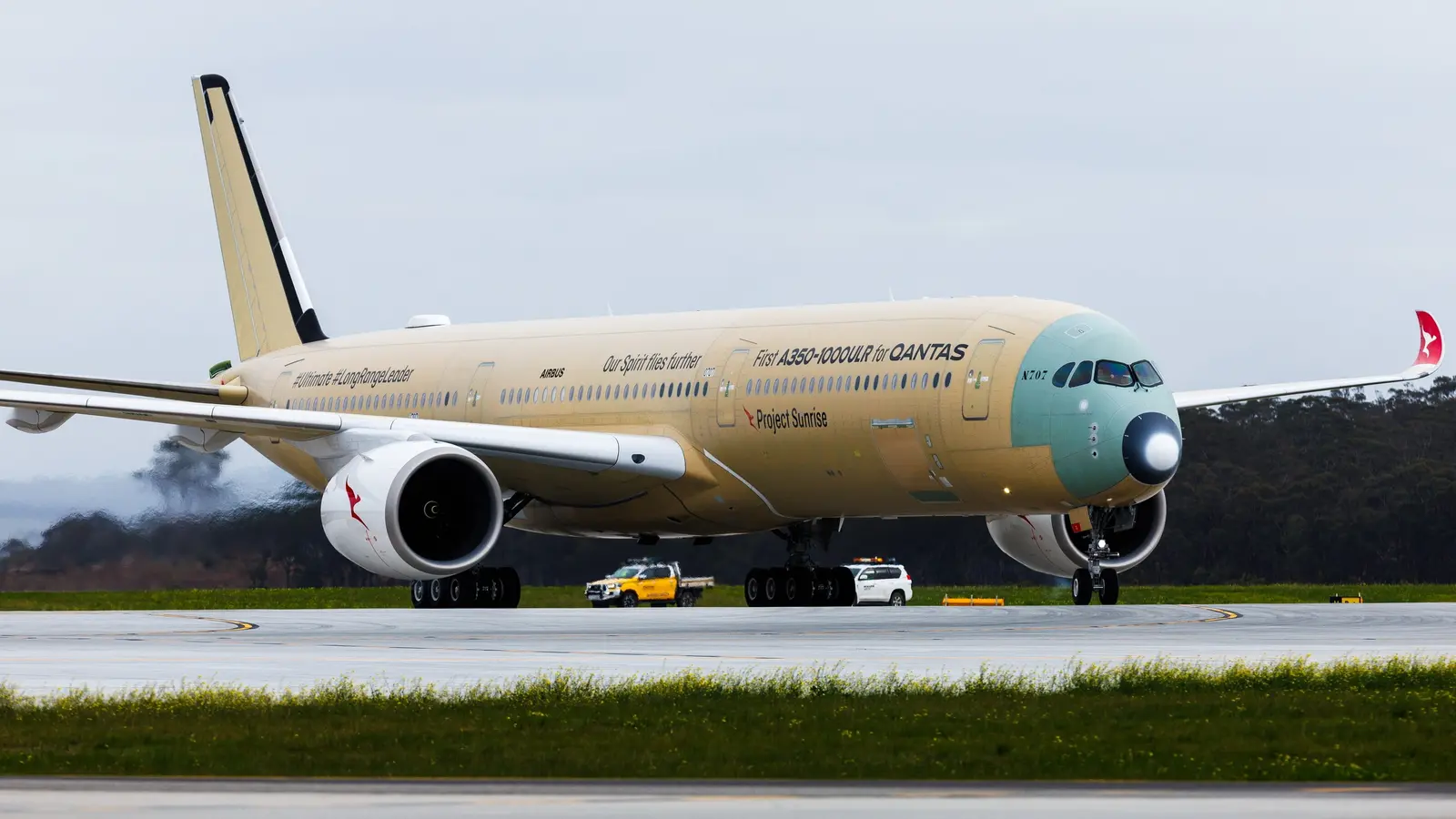
Melbourne got a taste of aviation history when a pale A350-1000ULR rolled onto the tarmac, engines still warm and five flight test engineers on board. It was not yet wearing Qantas red. It did not need to. The airplane itself was the story.
Onboard the flying lab
This is the testbed for Project Sunrise, the program that aims to stitch Sydney and London together without an intermediate stop. Airbus modified the A350-1000 into an ultra long-range machine by adding roughly 20,000 liters of extra fuel capacity. That boost gives the airframe the reach to cover more than 16,000 kilometers, approaching a nonstop 22-hour mission. You can almost feel the scale when you imagine three meals, a movie library and two sleep cycles aboard one craft.
The aircraft that visited Australia on July 24 flew in from Toulouse, carrying engineers and pilots who are putting the redesign through its final paces. It is a test version, not one of the 12 production jets Qantas will operate, yet these trials are the last, crucial steps before the service begins in October 2027. After a brief stop, the test A350 returned to Europe on July 27 with two extra Qantas pilots on board, gathering experience and data in real world conditions.
Why test so thoroughly? Because pushing a passenger jet into a 22-hour envelope alters everything. Fuel systems, weight distribution, crew procedures, and cabin climate controls all behave differently when endurance is measured in hours rather than legs. Airbus has already run extensive ground campaigns in Toulouse, focusing on the redesigned fuel system that makes this range possible.
Numbers matter. Twelve aircraft are on order for Project Sunrise. The first production A350-1000ULR, christened Vega, is due to be delivered to Qantas in April 2027. Seats will be limited compared with other A350 layouts: just 238 across the cabin. That lower-density arrangement is deliberate. It buys space for features designed to help passengers survive a 22-hour day in flight.

Project Sunrise is as much about human endurance as it is about distance; the aircraft is the tool to make long-haul travel humane again.
Expect unusual cabin elements. Qantas and Airbus have shown images of a dedicated Wellbeing Zone, a first for commercial aviation, plus bespoke suites, finely tuned lighting systems and extra entertainment and rest options. The goal is to reduce jet lag and keep passengers functional on arrival, not merely rested enough to find a hotel bed.
Flight testing is not glamorous. It is detailed, repetitive and sometimes uncomfortable. Engineers monitor fuel burn, structural behavior, systems redundancy and emergency procedures. Pilots log hours in varied conditions. Data is collected and fed into refinements. Small changes here can yield big safety or comfort gains later.

When will you be able to try it yourself? Qantas plans to open bookings in February 2027 for the inaugural Sydney to London nonstop. If tests continue to validate the concept, October 2027 will mark the first regularly scheduled slot in aviation history to bridge those cities without a stop.
What will travel feel like when 22-hour flights are routine? Faster on paper, certainly. Different in practice. Fewer connections. Longer single-seat time. New expectations for cabin design and service. For now, the arrival and brief stay of the A350 testbed in Australia was a concrete reminder: the era of true ultra long-haul travel is moving from concept to calendar.


“Cars are evolving faster than ever. I cover electric vehicles, smart mobility, and the future of transportation worldwide.”

Discussion
Leave a Comment
Comments (2)
Wow the Wellbeing Zone is neat, but 238 seats only? Means expensive tickets, less choice. Clever engineering, yet feels aimed at elites not everyday travellers. curious
Really? 22 hours nonstop sounds brutal. How do they expect cabin crew, toilets and emergency procedures to hold up for a full day? If tests fail, this'll be a nightmare...