
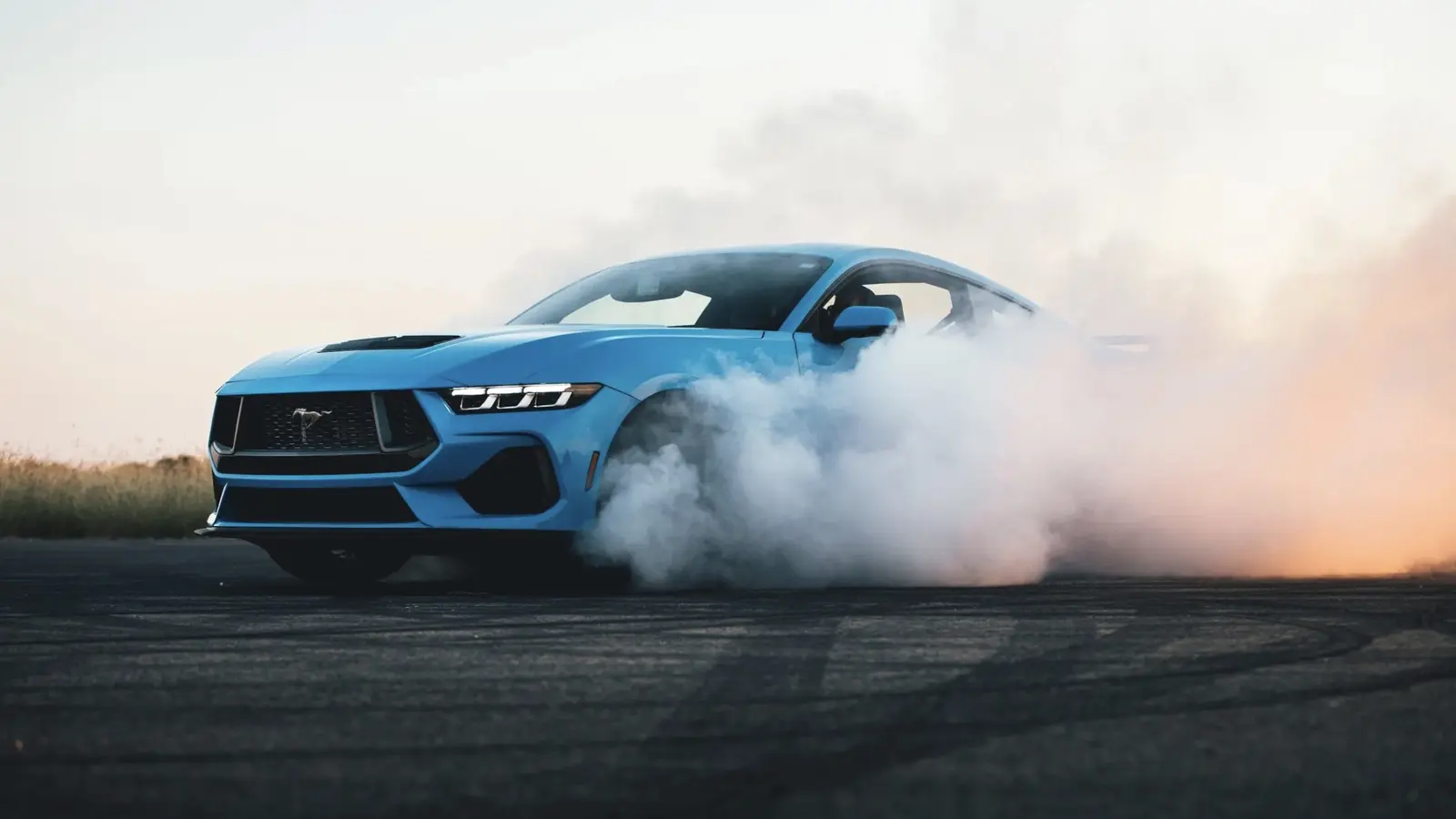
Press the pedal and the room rearranges itself. That’s the simplest way to describe what Roush Performance has done to Ford’s V8 workhorse: it took the Mustang GT’s already rowdy Coyote V8 and catapulted it into a very different class.
Small bolt-on, huge personality shift
Factory Mustang GT figures read like a promise: 480 horsepower (486 PS) and 415 lb-ft (563 Nm) from the 5.0-liter Coyote, good for a 0–60 mph sprint in about 3.9 seconds with the ten-speed auto. The Dark Horse nudges that to roughly 500 hp (506 PS) and 418 lb-ft (567 Nm). All impressive, all part of the muscle-car script.

Roush didn’t rewrite the script. They wrote a new chapter. Their supercharger lift kit bolts on without cutting up the engine bay, and it doubles the factory rating on paper — the Mustang GT and Dark Horse now sit at 810 horsepower (821 PS) and 630 lb-ft (854 Nm). That puts these cars squarely between the Dark Horse SC and Ford’s no-compromise GTD, in terms of straight-line threat.
The secret sauce is an Eaton TVS R2650 spinning at 13 psi of boost. Add dual intercoolers, a front-mounted heat exchanger, a high-flow Bosch intercooler pump, high-flow dual-cone injectors, CNC-machined billet fuel rails, new director plates and fresh spark plugs and you have a system designed to keep the Coyote happy under far more pressure than Ford intended.
Here’s the kicker: Roush claims the kit is still compliant in all 50 states and requires no invasive surgery under the hood. Swap it in, enjoy the extra shove, and you can revert to stock if you must — though once you feel 800-plus horsepower underfoot, reversal feels almost academic.
Roush backs the kit with a three-year/36,000-mile limited powertrain warranty.
There’s a practical angle. Roush charges roughly €9,719 for the upgrade. The Mustang GT’s starting price converts to about €48,015, while a factory-built GTD sits near €308,282. So for a fraction of the GTD’s cost you can achieve near-GTD performance numbers — at least on paper and on the straights.

But numbers don’t tell the whole story. A GTD is an engineered package from the ground up, with bespoke cooling, aero, suspension tuning and a chassis calibrated for that output. A bolted-on supercharger delivers a rush, yes, but it also shifts the balance of the car and demands upgrades elsewhere if you want repeatable, track-day pace. Brakes, tires, suspension, cooling: these all become the next items on the shopping list.

So what does this mean for buyers? If you want drama and a staggering power-to-dollar ratio, Roush’s kit is a brilliant shortcut. If you want an integrated high-performance racecar straight from the factory, the GTD still has the upper hand.
Either way, Ford’s little V8 has never been more adaptable. Bolt-ons have always been the aftermarket’s romance with potential. Roush just turned that flirtation into a full-blown love affair.

“I cover automotive innovation, electric vehicles, and the future of mobility — where technology meets sustainability.”

Discussion
Leave a Comment
Comments (2)
Is this even legal everywhere? 3yr warranty ok but sounds like a money pit if you want repeatable track pace. Sketchy yet tempting
Insane. 800+ hp from a bolt on? Roush did the unthinkable, but brakes and cooling will cry after a lap, lol. Worth it tho