

Less Sugar in Early Life Could Protect Your Mental Health Decades Later
A natural experiment involving sugar restrictions suggests that our earliest nutritional environments may influence mental health far into adulthood.
Imagine being born as a nation slowly loosens its grip on sweetness. One month you have just enough jam for a small slice of bread. The next, sugar is suddenly plentiful and custards return to the table. That shift after World War II in Britain created a rare research window, and scientists have used it to ask a surprising question: can the sugar available to pregnant people and infants shape mental health many decades later?
A real-world experiment in postwar Britain
The researchers turned to a historical policy change. Britain rationed sugar during the war and in the years that followed. When rationing ended in September 1953, sugar consumption rose sharply. That abrupt change, while messy in daily life, serves researchers as a natural experiment. It lets them compare people born just before the policy change with those born just after, treating the policy as a kind of population-level exposure.
Using UK Biobank data, the team examined records from 66,223 participants whose birth dates clustered around the end of rationing. They matched birth timing to later diagnoses of anxiety and depression as recorded in health records. The headline result was notable. People whose earliest months overlapped with rationing had lower risks of anxiety and depression decades later. Across the analysis, early exposure to limited sugar corresponded with roughly 17 percent lower risk of anxiety and 14 percent lower risk of depression. The strongest signals occurred for people whose exposure spanned the first 1,000 days around conception and early infancy. That group showed about 24 percent lower relative risk of anxiety and 21 percent lower relative risk of depression.
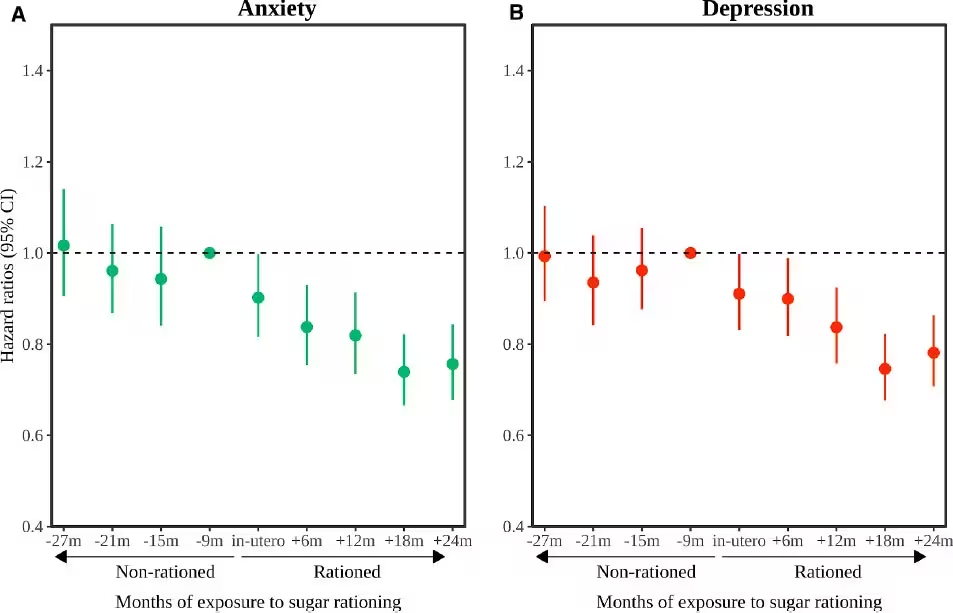
Associations of sugar rationing with the risk of anxiety and depression. (A) Anxiety; (B) depression.
Reading the numbers with care
Statistics can be blunt instruments. The dates of first recorded diagnoses were also shifted. For people exposed during those first 1,000 days, the first recorded anxiety diagnosis appeared about two years later, and the first recorded depression diagnosis about four years later, compared with those without early exposure. That suggests either later onset of clinically recorded symptoms, delayed help seeking, or differences in disease progression.

Crucially, this study does not capture what individual mothers or infants actually ate. The exposure is estimated from birthdate relative to a national policy, not from household-level food diaries. Other changes in postwar life, or unknown differences between families, could confound the result. Observational studies cannot prove cause and effect on their own. Instead they point to a plausible association that deserves further study.
Possible biological pathways
How could early sugar availability plausibly influence mental health decades later? Several mechanisms fit into current biological thinking. Nutrition during pregnancy and infancy shapes brain development, the wiring of stress response systems, and immune regulation. High sugar intake can promote low grade systemic inflammation, alter gut microbiota, and affect metabolic programming. Epigenetic changes, where early nutritional signals tweak gene expression without altering DNA sequence, are another credible route.
None of those pathways were tested directly in the UK Biobank analysis. Rather, the authors drew on prior research to sketch mechanisms that might explain the associations. To move from hypothesis to mechanism, future studies need individual diet records, biological samples from infancy, and replication in other populations.
What this means for public health
The findings add a provocative angle to discussions about early nutrition. If early-life sugar exposure does affect long-term mental health, prevention strategies could begin as early as pregnancy. Policies that shape food environments for expectant parents and infants may have ripple effects decades later. But policy recommendations require stronger causal evidence and careful weighing of benefits, risks, and social contexts.
Expert Insight
"These results are intriguing because they use a historic policy change as a kind of natural laboratory," says Dr. Laura Miles, a developmental neuroscientist who studies nutrition and brain health. "We know the first 1,000 days are critical. This study flags sugar as a variable worth studying more rigorously. The next step is targeted cohort work that measures early diet, inflammatory markers, and neurodevelopmental outcomes over time."
Conclusion
The study does not settle whether sugar in early life causes changes in adult mental health. What it does do is point to an association that was only visible because of a dramatic, well documented social change. The result is a reminder that public policy, household food access, and developmental biology intersect in ways that can echo across decades. Careful follow-up research could either confirm the link or reveal other forces at work, but the basic message is clear: what happens in the womb and in early infancy matters for much more than infancy alone.


“My work centers on sustainability, energy, and environmental science — examining how innovation can lead to a greener future.”

Discussion
Leave a Comment
Comments
No comments yet. Be the first.