
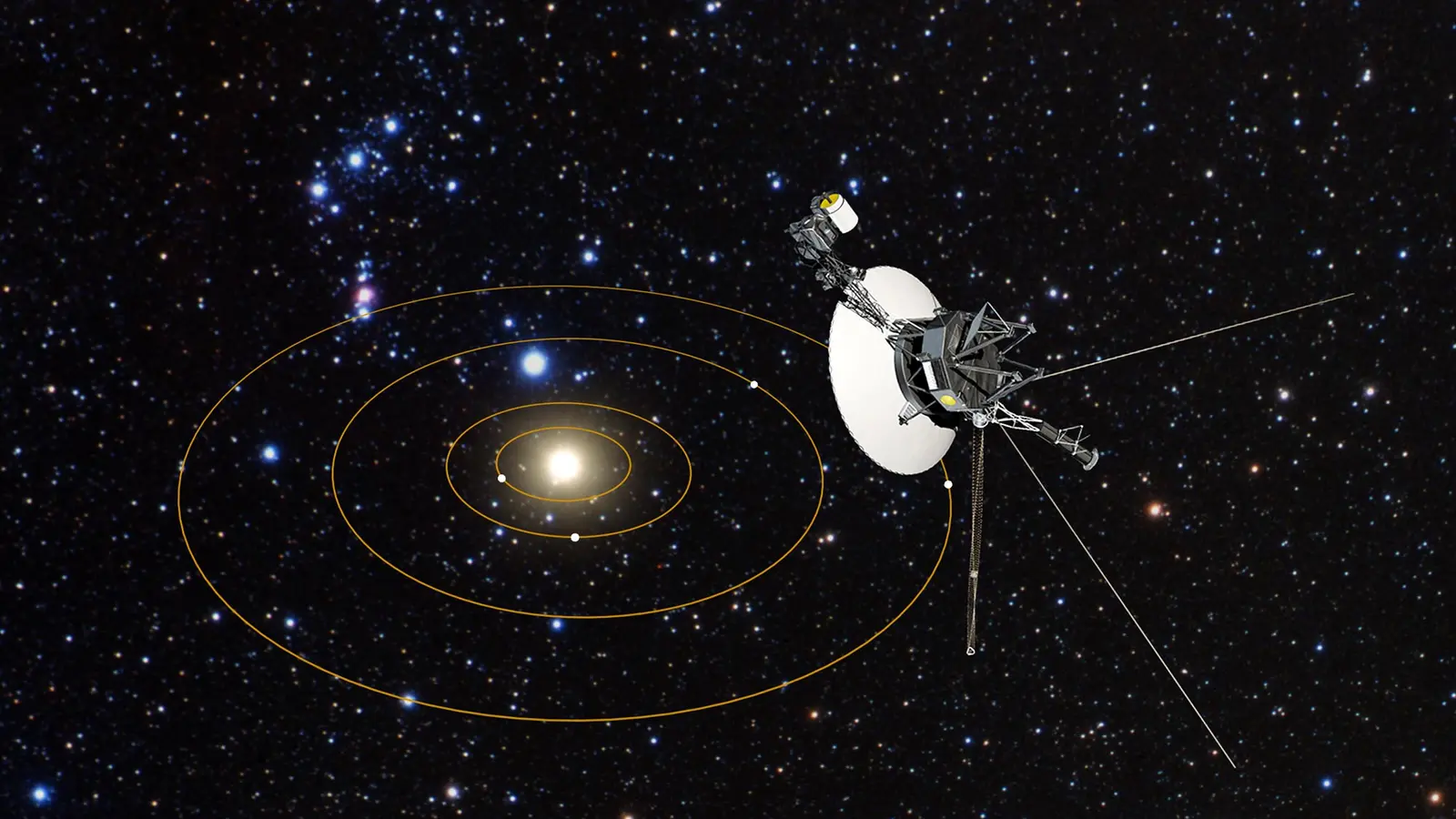
Imagine sending a question into the dark and waiting two days for an answer. That is the practical reality of speaking to Voyager 1 as it journeys farther from Earth than any human-made object has ever gone. The probe is approaching a distance where light, and radio signals, take one full day to travel one way. Simple, ordinary signals have become a long-distance conversation with time built in.
Facing glitches while pushing farther into interstellar space
Late October brought a reminder that old machines in deep space are still subject to surprises. For 48 hours, NASA's Deep Space Network did not detect Voyager 1 during two scheduled contacts 24 hours apart. The signal returned before engineers had time to issue troubleshooting commands, but investigation showed that a group of attitude-control thrusters had gone offline and their redundant units had automatically taken over.
Thrusters are tiny rocket engines that nudge the spacecraft, keeping its antenna pointed at Earth and its instruments oriented correctly. Voyager 1's onboard software is designed to react when a component misbehaves, switching to backups and placing the spacecraft in a stable configuration while ground teams sort out the cause. Command interruptions like this are new for this mission's later stage, but not entirely unexpected, according to mission leaders.
Kareem Badaruddin, Voyager project manager at NASA's Jet Propulsion Laboratory, summed up the team's attitude: we were relieved to re-establish contact and are now focused on pinpointing why the thrusters failed. That line captures two truths about Voyager 1 after nearly five decades in space: the probe continues to return invaluable science, and maintaining it requires constant, careful engineering.
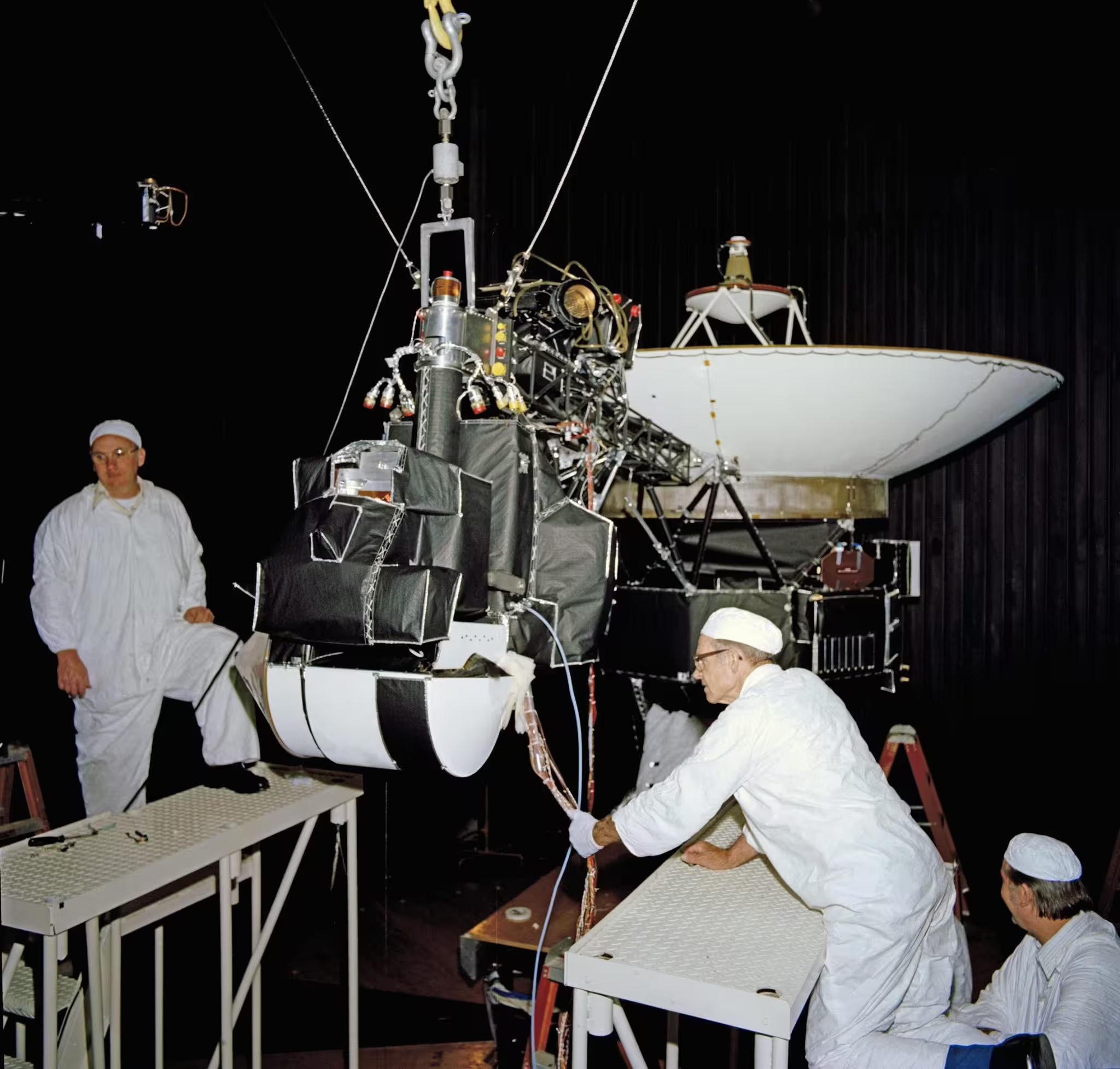
This image, taken on April 27, 1977, shows one of the Voyagers in the 25-Foot Space Simulator thermal vacuum chamber at NASA’s Jet Propulsion Laboratory in Southern California.
How Voyager keeps doing science on a shrinking power budget
Both Voyager probes, launched in 1977, now reside beyond the heliosphere, the vast bubble carved out by the Sun's wind and magnetic field. No other spacecraft has sampled that region directly. To keep instruments running, each Voyager draws electricity from a radioisotope thermoelectric generator, or RTG, which converts heat from decaying plutonium into electrical power. That source steadily wanes, at roughly four watts per year, forcing engineers to prioritize which systems remain active.
Over the decades, mission teams have retired instruments and systems that were essential during planetary flybys but are no longer required for interstellar measurements. Even so, recent years have seen hard choices: two science instruments have already been turned off as teams conserve energy for the most valuable experiments. Heat management is another constraint; electronics need a minimum temperature range to function reliably in the cold of deep space.
To reduce power draw while keeping critical heaters working, engineers carried out a coordinated set of changes on Voyager 1 earlier this year. The operation, informally nicknamed the Big Bang, replaced three higher-power heaters and controllers with lower-power alternatives. Because those devices interact thermally and electrically, the swaps had to happen simultaneously. The procedure mirrors a similar change made on Voyager 2 weeks earlier, and it buys Voyager 1 additional months, potentially preventing an instrument shutdown that might otherwise have been required by summer 2027.
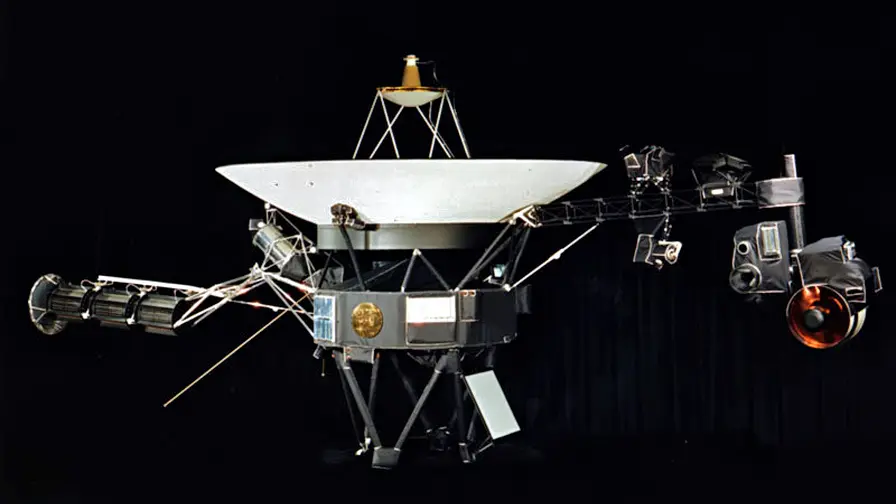
One light-day: a human milestone, not a physical barrier
On November 18, Voyager 1 is scheduled to cross 16.09 billion miles from Earth, roughly 25.89 billion kilometers. At that distance, a radio ping takes 24 hours to reach the spacecraft; its response needs another 24 hours to return. The milestone does not change the probe's environment or operations, but it is a poignant marker of endurance and reach, a measure of how stubbornly a small spacecraft built in the 1970s continues to teach us about space beyond the solar system.
Why does this matter? Because Voyager's instruments still collect data on plasma, magnetic fields, and cosmic-ray particles in a region that few missions can access. Even intermittent readings from an aging probe refine models of how the Sun's influence fades and how interstellar space interacts with our local bubble. Every additional watt conserved, every heater swapped, means more months of unique measurements.
Expert Insight
"Voyager 1 is a priceless scientific platform," said Dr. Elena Marquez, an astrophysicist who studies heliophysics. "Each decision to reconfigure a heater or retire a sensor is a trade-off between immediate data and long-term return. The team's approach—careful, incremental, and conservative—maximizes scientific yield given the mission's physical limits."
Dr. Marquez continued, "We learn not only about the interstellar medium, but also about long-duration spacecraft engineering. Those lessons feed directly into the design of future probes that will operate at extreme distances for decades."
What this means for future exploration
Voyager 1's longevity is a laboratory for technologies that will one day support interstellar precursor missions. Radioisotope power systems remain central to deep-space exploration when sunlight is too faint for solar panels. Fault tolerance, redundant hardware, and the ability to reconfigure systems remotely are also critical lessons. Engineers studying Voyager's aging systems are effectively rehearsing for future missions that must be robust against component degradation, radiation, and decades-long communications delays.
The Deep Space Network's role is equally important. With large antennas in three global locations, the DSN is the backbone that allows a one-way 24-hour command to reach Voyager and a second 24-hour window for reply. Maintaining that infrastructure, and planning for longer latencies as probes travel farther, is part of enabling humanity's long-range ambitions in space.
Conclusion
Voyager 1 is not merely an artifact of 1970s engineering. It is an active scientific instrument and a testbed for the constraints that shape future exploration beyond the solar system. As it approaches the one light-day mark, the mission combines careful engineering work, patient communications, and scientific persistence. Send a message, wait a day, then wait another. In those quiet hours, the oldest interstellar explorer keeps teaching us about the space between the stars.


“The cosmos has always fascinated me. I write about space missions, astronomy, and the technologies pushing humanity beyond Earth.”

Discussion
Leave a Comment
Comments (1)
wow didnt expect Voyager to still be humming after 45+ yrs, kinda moves me. waiting a day for a reply??? wild, nerve wracking but beautiful