
The bow kissed the string and a thin, uncertain note appeared. A beginner's body twitched to correct position. The sound was rough. The head tilted. The brain recalculated.
Scientists have detected measurable changes in brain activity after beginners completed just one violin lesson.
That small scene—awkward movement, a misstroked note, then a tiny improvement—was the laboratory for a new experiment that brings music, craft and portable brain imaging together. Researchers at the University of Nottingham followed 22 novice violin students as they attempted to play a simple melody and recorded their brains while they moved. What they captured was not static data. It was a short story of learning, told in electrical rhythms.
A wooden violin and a helmet that listens
Measuring brain activity during natural movement is notoriously difficult. Traditional scanners demand stillness. They muffle the gestures that matter. The team used a different approach: OPM-MEG, a wearable magnetoencephalography system developed at Nottingham. Sensors sit in a lightweight helmet and stream magnetic signals to a backpack-sized control unit. People can turn, reach and play while their neural activity is recorded with millisecond precision.
There was a snag. Most violins contain metal parts. Metal distorts the tiny magnetic fields produced by neurons and wrecks the measurements. The solution was a marriage of old and new crafts. Alan Kirby, a violinist and instrument maker in Nottingham, removed every metal component from a standard violin and replaced them with handmade wooden alternatives. The result was a functioning instrument tuned to Baroque frequencies that would not corrupt the scanner's signal.
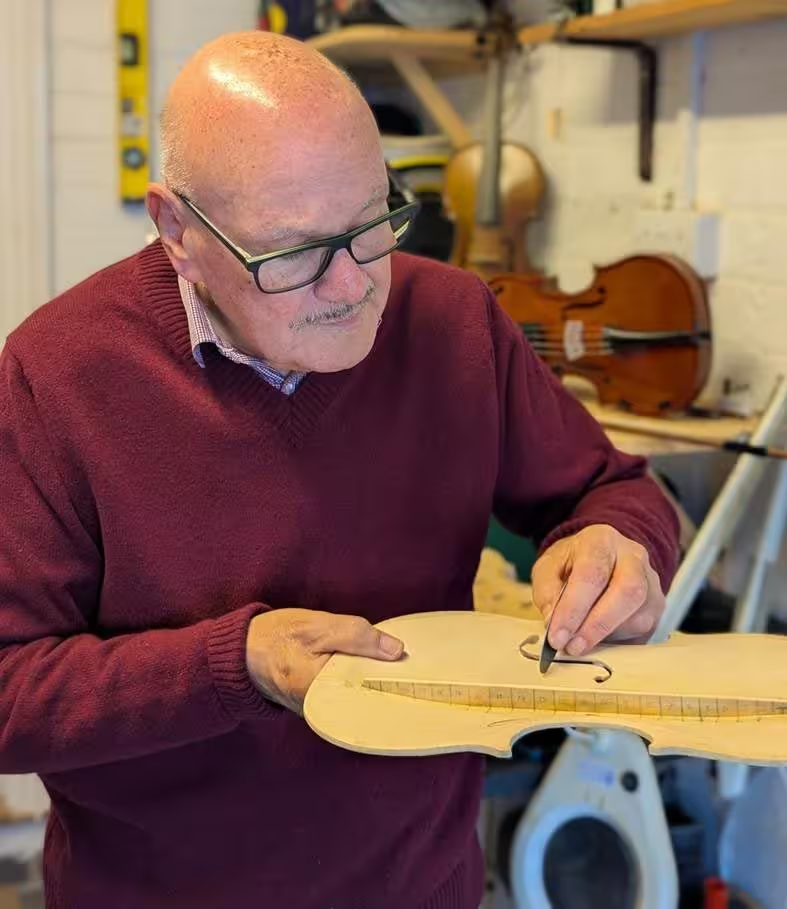
Alan Kirby working on a Violin.
Kirby also taught the participants. Before any lessons, each beginner watched him play "Twinkle Twinkle Little Star" and then tried to reproduce the melody inside the scanner. After that initial recording, they had a short, focused lesson with Kirby and returned for a second scan. Researchers compared brain activity before and after instruction to see how neural patterns shifted when a motor skill begins to take shape.
Listening to predictions in the brain
What were the scientists listening for? Not individual neurons but oscillations, the rhythmic fluctuations that sweep across populations of brain cells. In this experiment, beta-band oscillations—brainwaves roughly in the 13 to 30 hertz range—became the signal of interest. Those waves are linked to motor control and to the brain’s predictions about the outcomes of actions.
When you prepare to play a note, your brain generates an expectation: the timing, the pitch, the sound your action should produce. If reality matches that expectation, the brain receives confirmation. If the sound is surprising, the mismatch becomes data for updating future movements. Beta rhythms appear to carry that feedback about expected and actual outcomes.
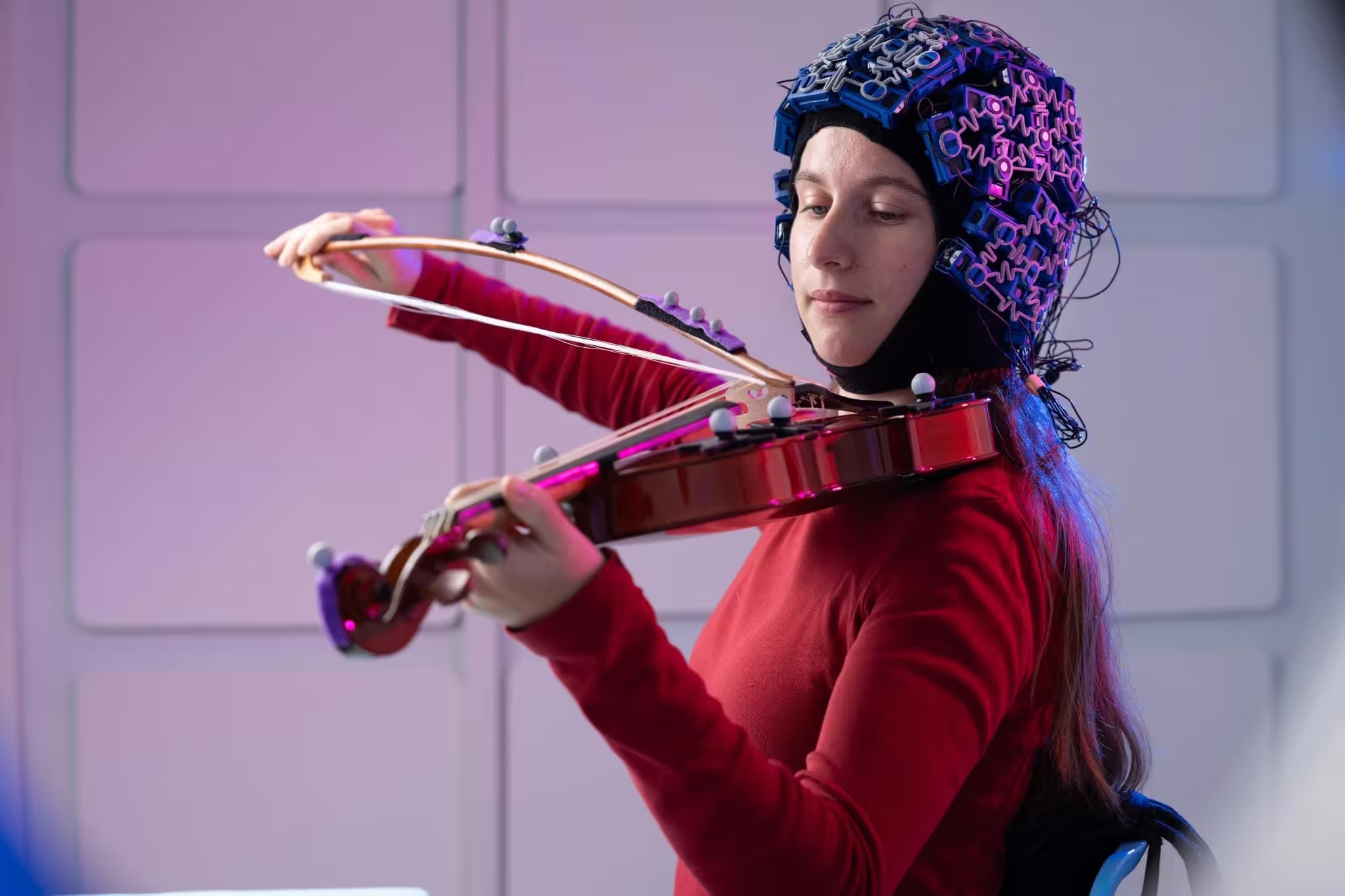

A participant plays the violin while wearing a specialized brain-scanning helmet that allows researchers to monitor neural activity in real time, revealing how the brain adapts as new motor skills are learned.
By tracking beta activity while participants attempted the melody, the team could observe the neural signature of prediction and error processing as it unfolded. The wearable scanner allowed those signatures to be measured while people moved naturally—bowing, fingering and listening—rather than while they lay still in a lab.
Small lesson, measurable change
After just one lesson, the researchers detected measurable shifts in beta-band dynamics. Participants who improved most in accuracy and timing also showed the largest changes in those brain rhythms. The correlation does not prove causation, but it does link observable learning with a quantifiable neural pattern.
Why does this matter beyond the novelty that a few minutes of instruction can change oscillations? Because those same rhythms are implicated in other forms of motor learning and are known to be altered in neurological conditions. Beta oscillations, for instance, appear in studies of Parkinson’s disease, stroke recovery and cognitive decline. Observing how they behave during natural movement opens a new window on both healthy learning and disease-related dysfunction.
The study is also a demonstration of interdisciplinary engineering. Professor Matthew Brookes, who led the OPM-MEG work, described the effort as a blend of physics, design engineering, mathematics and musical skill. Building instruments and headgear that tolerate real-world motion while preserving signal fidelity demanded expertise across fields. The payoff is a platform that can study the brain in action.
The findings suggest practical paths forward. Portable brain imaging could be used to assess rehabilitation strategies, to monitor recovery after injury or to detect the early signatures of neurodegeneration while patients perform everyday tasks. It may also offer a way to quantify how brief training sessions change brain function, providing feedback to teachers and therapists.
Expert Insight
"What surprises people is how quickly the brain updates its models of action and sound," said Dr. Elena Martín, a cognitive neuroscientist not involved with the study. "The beta rhythms act like a running ledger: they mark matches and mismatches between what the brain predicts and what actually happens. Seeing those signals while someone moves is a game changer for studying learning in natural settings."
"This approach lets us ask different questions," Martín added. "For example, can we detect subtle changes in predictive processing that precede clinical symptoms? Or can targeted training shift pathological rhythms toward healthier patterns? Those are testable hypotheses now that the technology exists to measure them during real behavior."
Conclusion
One short violin lesson did more than improve a shaky melody. It left a measurable trace in brain activity, demonstrating that the earliest stages of motor learning register in specific oscillatory patterns. The combination of a metal-free instrument, a skilled teacher-instrument maker, and a wearable MEG system made that discovery possible. Beyond the classroom, the work points toward new ways to study learning and neurological disease in motion.
The experiment is a reminder that small acts—one bow stroke, one corrected finger—can change how the brain organizes action. With wearable neural tools, scientists can now follow that change as it happens, and use the patterns they find to inform therapy, rehabilitation and our basic understanding of the learning brain.

“My work centers on sustainability, energy, and environmental science — examining how innovation can lead to a greener future.”

Discussion
Leave a Comment
Comments (1)
wow, one lesson and brain rhythms change? that's wild. the wooden violin hack is genius, love the blend of craft + tech. makes me wanna learn lol