
Nearly 3,000 exploding stars have begun to redraw our map of cosmic expansion. The light from those blasts, captured and reprocessed with modern techniques, now suggests the mysterious agent pushing the universe apart might not be constant after all.
Type Ia supernovae are the yardsticks astronomers trust. When a white dwarf erupts in a thermonuclear explosion, the peak brightness can be standardized well enough to turn that flash into a cosmic distance marker. Compare how bright a supernova looks with how fast its host galaxy recedes, and you trace how the universe has stretched over time. That very method helped reveal cosmic acceleration in the late 1990s.
Type Ia supernovae are powerful stellar explosions that occur when a white dwarf is pushed into a thermonuclear runaway. Because their brightness can be standardized, astronomers use them as reliable cosmic distance markers to trace how the universe has expanded over time.
Rewinding three decades of observations into one coherent record
An international team led from the University of Queensland has stitched together a single, consistent catalog of 2,884 Type Ia supernovae. Instead of stitching published numbers together as they were, the group reanalyzed older measurements with contemporary models and calibration techniques so that light curves taken by different telescopes can be compared on equal footing.
That reanalysis matters. Telescope detectors change. Photometric systems differ. Dust inside galaxies reddens and dims light in subtly different ways depending on environment and host mass. The team accounted for those effects and even included small distortions from gravitational lensing, where intervening mass bends and slightly magnifies the supernova light during its long journey to Earth.
The result is the clearest reconstruction yet of how expansion has evolved across the recent history of the cosmos. Rather than confirming the simplest version of the standard model, which treats dark energy as an immutable cosmological constant, the updated compilation shows deviations that could point to a time-varying component.
To strengthen the picture, researchers combined the supernova dataset with independent probes, such as the cosmic microwave background and large-scale galaxy distributions. Those cross-checks matter because different methods are sensitive to expansion at different epochs. When independent measures agree, the case for new physics solidifies.
Why this matters for dark energy and fundamental physics
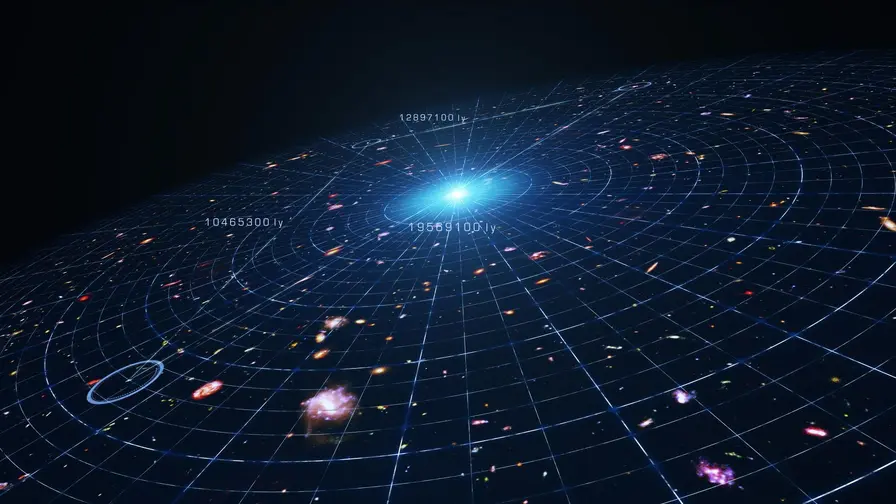
Dark energy is the placeholder name for whatever causes cosmic acceleration. In the concordance cosmology, it is described by the cosmological constant, a simple energy density that does not change with time. If dark energy evolves, our theoretical map of the universe needs revision. The implications ripple outward: model parameters shift, inferred ages and sizes of cosmic structures change, and some theoretical attempts to reconcile gravity with quantum mechanics may gain new footholds.
Two independent lines of evidence are already nudging at the same possibility. The Dark Energy Survey produced early hints in 2024 that dark energy might vary with time. Separately, the Dark Energy Spectroscopic Instrument has reported subtle anomalies in baryon acoustic oscillation measurements, the relic sound waves frozen into the distribution of galaxies, which also suggest departures from a fixed dark energy density. Now this larger supernova compilation finds a deviation of its own, not identical to earlier signals but aligned in spirit: the simplest assumption is being tested.
These tensions are small. They are not yet a smoking gun for a revised cosmic model. But two or more independent probes showing hints of the same behavior is how scientific revolutions begin: persistent, converging anomalies demanding explanation.
What the team did differently
Part of the strength of this project is methodological. Older surveys are treasure troves, but older pipelines miss effects we now understand. The researchers applied modern light-curve fitting, uniform calibration, and consistent corrections for host galaxy properties. They folded in the Dark Energy Survey observations from 2024 and harmonized those results with historical datasets, rather than treating them as isolated chunks.
That harmonization is painstaking work. It requires assessing instrument response, photometric zero points, and sample selection biases. It also means modeling astrophysical nuisances such as interstellar dust and correlations between supernova properties and their galactic environments. Done well, the payoff is a cleaner cosmic signal and smaller systematic uncertainties.
Expert Insight
Dr. Ana Valenti, an observational cosmologist not involved in the compilation, commented: "This catalog is an important step because it treats legacy data the way we treat new data. When you remove artificial differences introduced by instruments and analysis choices, genuine astrophysical trends can emerge. These hints of a changing dark energy parameter are intriguing. They do not prove a new paradigm, but they raise the right questions and point us to where future observations should focus."
Future surveys will press the point. The Dark Energy Bedrock All-Sky Supernova program, known as DEBASS, is delivering large numbers of nearby Type Ia events that improve calibration at low redshift. Combined with deeper surveys reaching farther back in time, astronomers will be able to map any time evolution of dark energy with increasing fidelity.
Conclusion
Recasting nearly 3,000 supernova observations into a single, self-consistent dataset has sharpened the probe astronomers use to track cosmic expansion. The new compilation does not overthrow the standard model, but it widens the aperture on a persistent question: is dark energy constant or dynamic? The answer will shape cosmology and may offer clues about how gravity meshes with quantum theory. More data are coming. The next few years will tell whether these hints harden into a pattern demanding new physics, or fade as statistical fluctuation and refined calibration.

“My work centers on sustainability, energy, and environmental science — examining how innovation can lead to a greener future.”

Discussion
Leave a Comment
Comments (1)
Wow, nearly 3,000 supernovae reprocessed, if dark energy isnt constant... mind blown but also nervous. Needs more checks, stat flukes?