

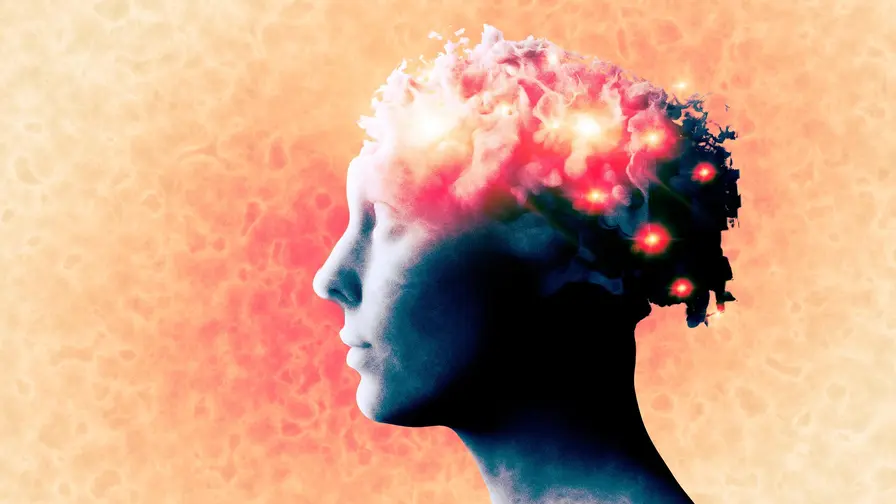
Researchers found that each breath may carry a distinctive neural signature, with changes in inhalation, exhalation, and pauses mirrored in brain activity. The discovery could provide a new framework for studying dangerous conditions in which breathing suddenly fails. Credit: Shutterstock
Pause for a moment. Take a long inhale, then a slow exhale. Did your thoughts shift? Researchers at the University of California San Diego have shown that such small variations are not just felt or imagined; they correspond to measurable changes in the brain’s electrical activity. The surprising detail: it is the exact shape of each breath, not merely its rate, that leaves a discernible imprint on neural signals.
Breath as a waveform, brain as an echo
Most breathing studies reduce respiration to a single number: breaths per minute. That blunt measure misses nuance. The UC San Diego team treated every breath as a waveform, mapping rises and falls in airflow and timing. They then compared those breath shapes against invasive electrical recordings taken directly from the brain. The result was clear. Subtle differences from one breath to the next corresponded with distinct patterns of neural activity across regions tied to cognition, emotion, and memory.
Lead observations came from 16 people undergoing clinical monitoring for treatment-resistant epilepsy. Using simultaneous recordings of nasal airflow and chest and abdominal movement alongside intracranial EEG, the researchers could align the finest details of respiration with the brain’s electrical rhythms. That alignment revealed a rich coupling between respiratory shape and ongoing neural dynamics.

“Every single breath is different,” said Eena Kosik-Rose, the paper’s first author and a PhD student in UC San Diego’s Department of Cognitive Science. “You can pause your breathing for several seconds, take a super deep breath, or have a shallow exhale. What we’re showing is that those differences in the shape of each breath are reflected in the shape of brain activity.”
Why this matters for cognition and emotion
Past research hinted that breathing phase matters. Memory performance can vary depending on whether information is encountered during inhalation or exhalation. Breath control is already used therapeutically to calm anxiety and help with post-traumatic stress. The new study deepens that picture by showing the breath’s fine-grained form maps onto neural patterns, not just the timing of inhalation versus exhalation.
That mapping suggests a mechanism by which simple breathing adjustments could modulate large-scale brain processes. Regions involved in memory, decision making, and emotional regulation appear sensitive to the contour of respiration. The implication is practical: breathing interventions might be tuned with greater precision for cognitive or clinical benefit.
Clinical stakes: sudden breathing failure and early warning
The findings raise urgent questions for conditions where breathing can stop abruptly. One of the study’s coauthors, neurosurgeon Brian Dlouhy at the University of Iowa, studies sudden unexpected death in epilepsy, or SUDEP. Could a breakdown in the normal breath-brain coupling provide an early warning sign before catastrophic failure? Bradley Voytek, a coauthor and chair of UC San Diego’s Department of Cognitive Science, says future work should test whether the relationship becomes disrupted in SUDEP or in sudden infant death syndrome.
It is critical to emphasize what the current paper does and does not show. The results do not demonstrate that breath shapes now predict SUDEP or SIDS. Rather, they establish a reproducible framework that makes those predictive questions tractable. If a reliable change in the coupling pattern precedes collapse, clinicians could one day have a physiological alarm that complements existing monitoring.
Methods and scientific context
Recording electrical activity from the brain with intracranial electrodes provides high temporal and spatial precision, which was essential for detecting pattern-level correspondences with respiration. The researchers used multi-site electrode arrays to capture activity across cortical and subcortical networks, then applied waveform-comparison techniques to align breath shapes with neural signals. This approach builds on a growing literature linking respiratory rhythms to neural oscillations, especially in sensory and limbic areas, but it goes further by analyzing single-breath morphology rather than averaged cycles.
Beyond epilepsy, the basic science matters for any condition in which breathing and brain state interact: sleep apnea, panic disorders, chronic stress, and rehabilitative practices that use breath to retrain autonomic responses. It also informs fundamental neuroscience questions: how peripheral physiological signals entrain or modulate large-scale brain networks.
Expert Insight
“This work reframes respiration from a background rhythm into an active, information-bearing signal,” said Dr. Maya Thompson, a cognitive neuroscientist who studies bodily influences on cognition. “If each inhalation and exhalation sculpts neural dynamics, then breathing becomes a low-cost, high-impact lever for altering brain state. The next step is to test interventions that intentionally reshape breath waveforms and measure downstream effects on memory, attention, and autonomic regulation.”
Conclusion
The UC San Diego study opens a new window on something we do tens of thousands of times in a lifetime without thinking much about it. Each breath has a signature waveform, and that waveform is echoed across the brain’s electrical activity. The discovery does more than deepen scientific understanding; it provides a practical framework for asking whether changes in breath-brain coupling could warn of acute failures, be harnessed in therapy, or be used to fine-tune cognitive performance. The work is an invitation: look closely at each breath and you may find an unrecognized language of the mind.


“My work centers on sustainability, energy, and environmental science — examining how innovation can lead to a greener future.”

Discussion
Leave a Comment
Comments
No comments yet. Be the first.