
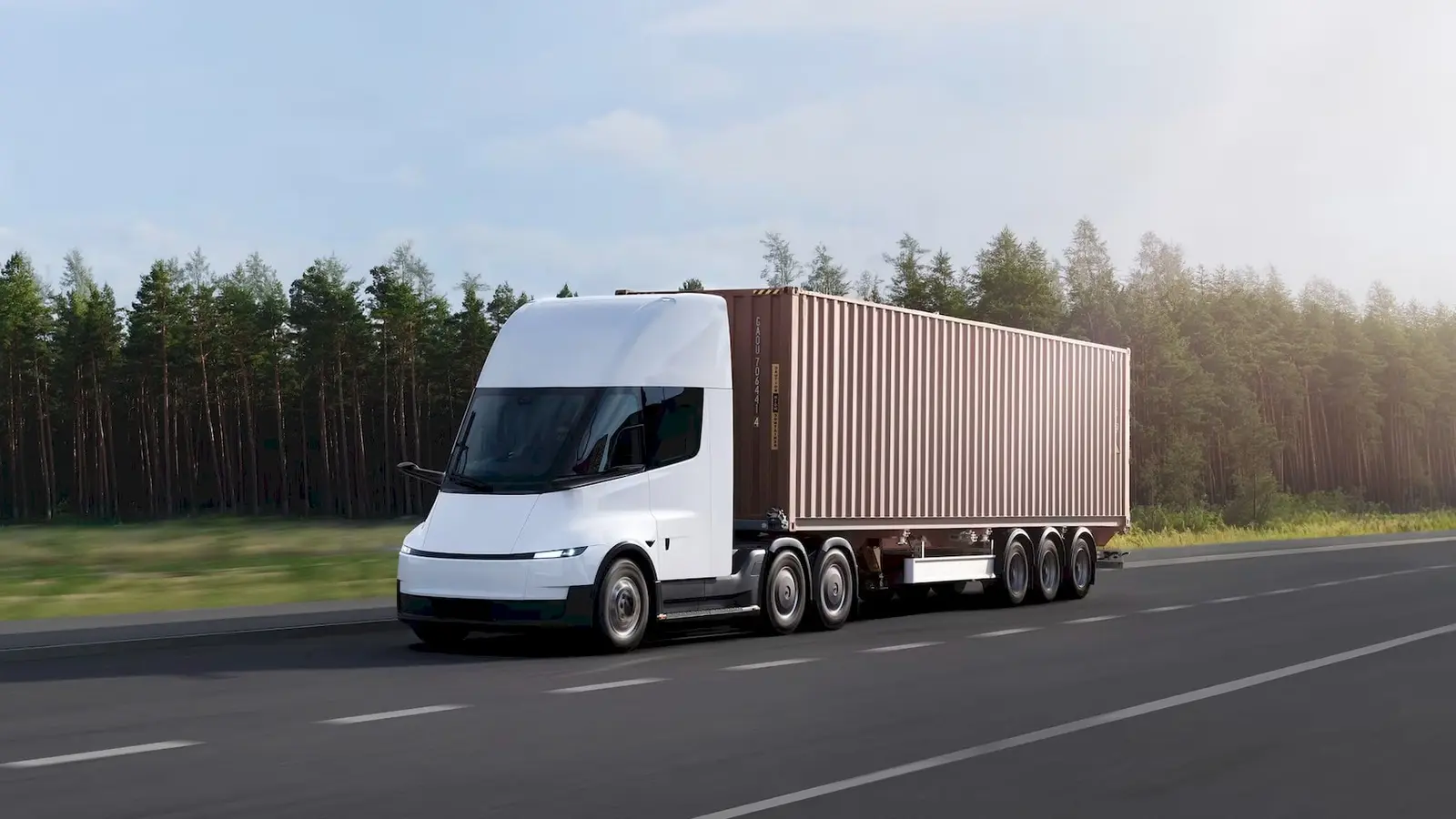
Imagine an electric truck pulling into a European motorway, slimmer at the nose, cameras where mirrors used to be, and a charge stop that revives half your route in the time it takes to grab a coffee. That is Tesla's pitch as it brings the Semi to Europe, but with a familiar twist: the model on the old continent mirrors the US Standard Range variant and is still assembled in the United States.
The headline figures are straightforward and hard to ignore. At a fully loaded 40 tonnes, Tesla says the European-spec Semi will cover up to 550 km on a single charge, averaging roughly 1 kWh per kilometer. It accepts Megacharger power using the MCS 3.2 standard, peaking at about 800 kW, which Tesla claims can recover roughly 60 percent of range in 30 minutes. An on-board electric power take-off delivers up to 25 kW for auxiliary systems, and the truck meets a 40 tonne gross combination weight with a curb weight near 9,100 kg.

Design choices shaped by European rules and real-world efficiency
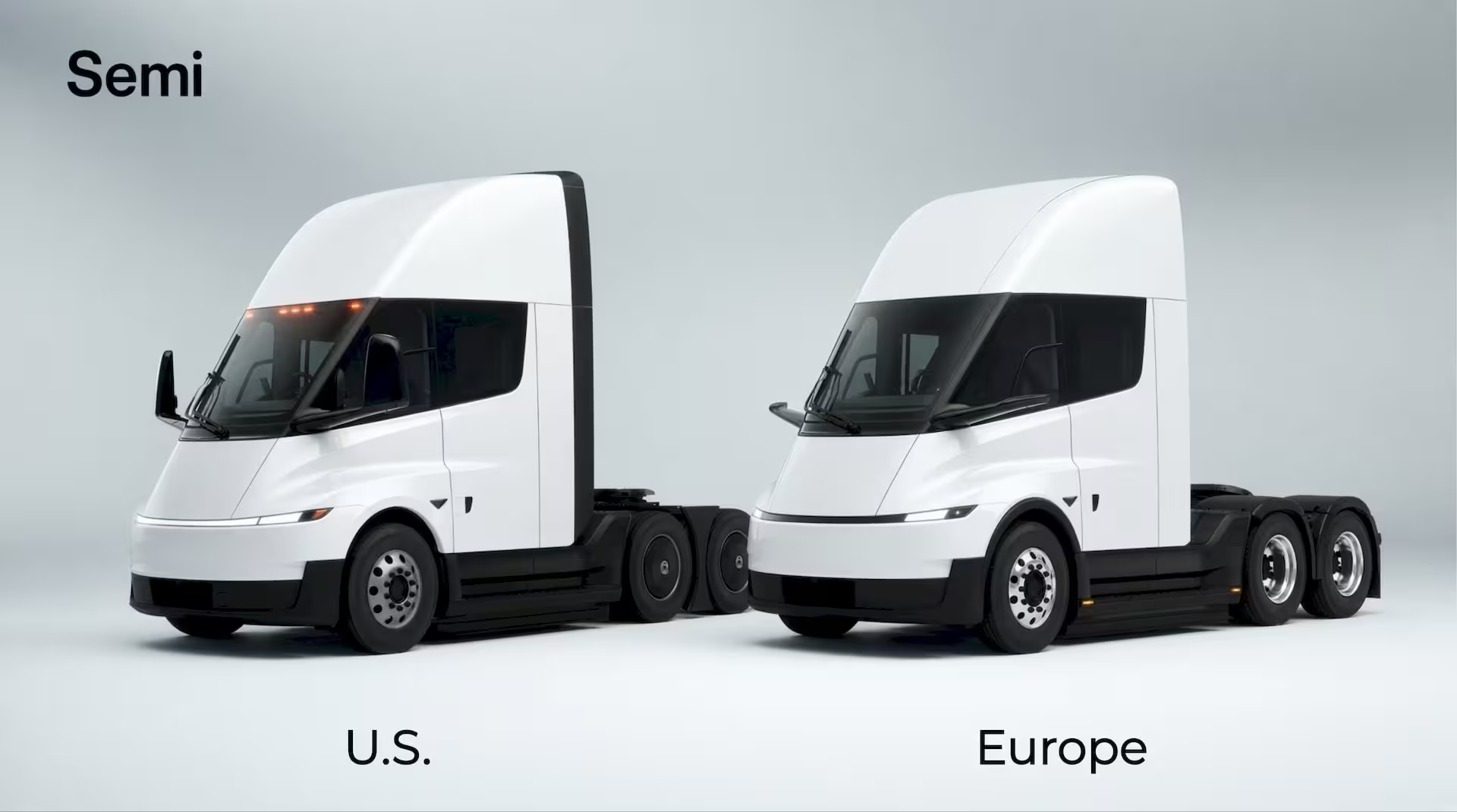
The Semi arriving in Europe looks a little different from the American tractors. The cab is shorter. The long light bar on the roof is gone. The rear black fairing that hugs the chassis on US units is missing too. None of these are stylistic whims. They are practical responses to length limits and loading rules across Europe: the shorter the tractor, the longer the trailer can be and the more cargo you can carry.
Perhaps the most visible change is the swap from physical side mirrors to rear-facing cameras. That trim saves drag and, by Tesla's numbers, helps stretch the range. In the United States, federal safety rules still mandate physical mirrors on many commercial vehicles, so camera-only setups remain a Europe-first advantage for Tesla's Semi.
Tesla has only published full charging numbers for the Long Range US variant, which can hit about 1.2 MW at peak. The European truck's spec sheet matches the US Standard Range in range and consumption, and Tesla's public notes suggest the Standard Range likely tops out at roughly 800 kW charging.
There is a practical arithmetic to this launch. Faster charging and higher efficiency shift a truck's economics — less downtime, lower energy cost per ton-kilometer, and tighter route planning. That is the promise Tesla is selling to fleets that want electric power without throwing away useful payload or schedule flexibility.
Deliveries in Europe begin next year.
Still, arrival does not mean dominance. Europe's market is crowded with established truckmakers already selling battery-powered rigs: Scania, Volvo, MAN, Mercedes-Benz, DAF, and Renault are all fielding EV models designed around regional needs and dealer networks. Tesla's Semi will need to prove itself on uptime, service, and total cost of ownership, not just headline range figures.
Expect more detail at the IAA Transportation show in Hannover, where Tesla will show the truck to a continent that measures value differently. Range and charge speed are vital. So are trailer compatibility, regulatory fit, and the ability to keep vehicles moving day after day.
For fleets, the European Semi reads like a bet on infrastructure plus efficiency: high-power Megachargers, camera-aided aerodynamics, and a chassis trimmed for local rules. For Tesla, it is a test of whether an American-built electric truck can reshape the European haulage market on its own terms.

“Cars are evolving faster than ever. I cover electric vehicles, smart mobility, and the future of transportation worldwide.”

Discussion
Leave a Comment
Comments (2)
Nice specs on paper. US-built with euro tweaks, service and dealer networks win this market. Hope Tesla has local support, spare parts and fast fixes, otherwise range numbers wont matter. we'll see.
Camera mirrors look slick, but is Europe really ready for 800 kW chargers everywhere? Feels optimistic... infrastructure's messy, no?