
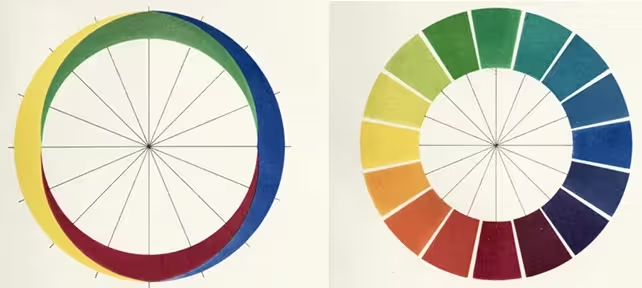
Look at a color wheel for a moment. Orange feels like a clear mix of red and yellow. Purple rarely feels like a blend of red and blue. Why do red, yellow, green and blue occupy a different status in our visual world?
Color in nature, color in the eye
Researchers at the University of California, Berkeley set out to answer that question by connecting three pieces of the puzzle: the palette of colors that actually occur in natural scenes, how the three types of cone photoreceptors in the human eye respond to light, and how the brain might encode those signals efficiently.
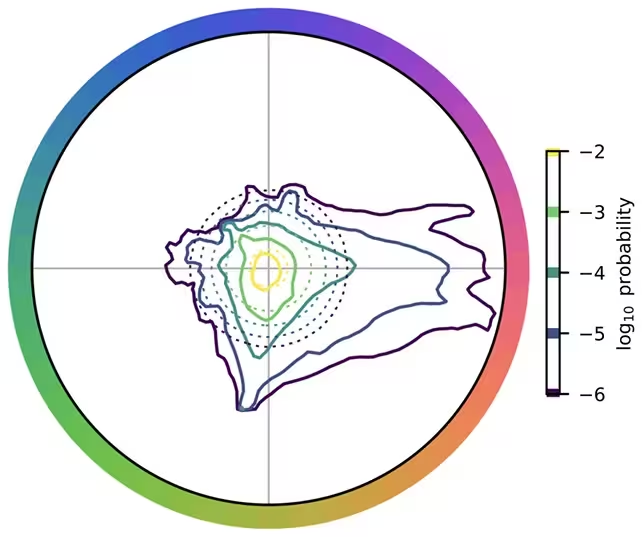
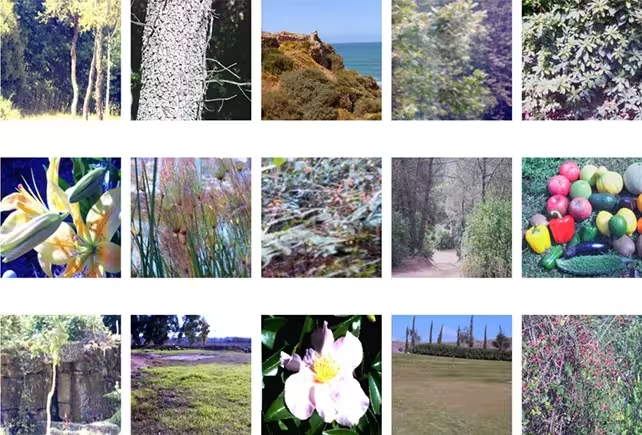
Their starting point was empirical. The team analyzed a large, calibrated dataset of 503 natural images. They simulated the signals that long-, medium- and short-wavelength cones would produce when viewing those scenes. What emerged was not a uniform smear of hues; instead, color space in nature is lumpy. Some chromatic ranges appear far more often than others, with concentrations around tones that map onto what we would call red, yellow-green, and blue.
That uneven distribution matters. If certain color combinations are common in the environment, a sensory system that is tuned to represent them efficiently will use fewer resources while preserving fidelity where it counts.
The mathematics of seeing
To model efficiency in neural coding, the researchers used a technique known as sparse coding. The idea is simple in concept: represent complex sensory inputs using a small number of building blocks. Sparse codes are economical. They let the brain describe a wide variety of signals with limited, reusable components.
Applying sparse coding to the cone responses across the image set produced a striking result. The most compact representation required six basis components. Four of those components corresponded to color axes that line up with red, yellow, green and blue. The remaining two captured luminance extremes, essentially black and white. From these few pieces, the model could reconstruct the broader palette found in nature.
That outcome provides an intuitive reason for Ewald Hering’s nineteenth-century observation that red, yellow, green and blue behave like unique or elemental colors in human perception. When the visual system compresses natural color statistics into a limited set of primitives, the four chromatic components appear as natural building blocks.
Opponency explained
Why do red and green, and blue and yellow, feel like opposites? The sparse coding model sheds light on that too. Components aligned with opposite axes in the model suppress one another when active. In practice, activation toward red tends to inhibit the green component and vice versa. Similarly, blue and yellow occupy opposing channels.

This antagonistic arrangement makes it easy for the visual system to encode contrasts that are meaningful in the environment. It also explains why we rarely perceive a direct blend of two opponent colors as an intermediate hue; they compete rather than combine smoothly.
What this means for neuroscience and technology
On the neuroscience side, the study strengthens an efficient-coding perspective: aspects of perception that once seemed arbitrary may arise from statistical regularities in the world and a brain optimized to represent them. Neither the physical properties of light nor cone sensitivities alone fully explain the prominence of the four elemental hues. When you factor in the statistics of natural scenes and a drive for economical neural representation, the pieces click together.
There are practical implications too. Understanding why these four axes dominate could inform color encoding schemes in imaging, compression algorithms for natural scenes, and the design of displays and cameras that better match human color sensitivity. Computer vision systems that learn from natural color distributions may also gain robustness by adopting analogous sparse representations.
Expert Insight
"The finding elegantly links what we see in the world to what the brain chooses to represent," says Dr. Maya Srinivasan, a visual neuroscientist who studies sensory coding. "It's not that nature forced four colors on us; rather, our visual system evolved—or developed—to describe the most informative dimensions of color using the fewest bits. That economy produces the perceptual phenomena Hering observed over a century ago."
Methods and limitations worth noting
The study depends on the specific image set and the modeling choices. The 503 calibrated images provide breadth, but environments vary—urban scenes, underwater views or extraterrestrial landscapes would shift the statistics. Sparse coding produces an interpretable set of components, but other efficient-coding formulations might yield different bases. Still, the convergence between model outputs and longstanding psychophysical observations gives the approach weight.
Published in the Journal of the Optical Society of America A, the work ties modern computational techniques to classical color theory. It does not overturn earlier findings; it reframes them in a statistical and algorithmic context.
Conclusion

Perception is a compromise between the richness of the world and the limits of neural machinery. The prominence of red, yellow, green and blue in human vision appears less mystical and more pragmatic: these hues serve as efficient building blocks for encoding the colors that matter most in natural environments. When the brain must compress vast sensory input into compact representations, certain color axes emerge naturally as primary.

“The cosmos has always fascinated me. I write about space missions, astronomy, and the technologies pushing humanity beyond Earth.”

Discussion
Leave a Comment
Comments (1)
wow this actually clicks. didnt expect sparse coding + nature stats to explain Hering, mind blown. kinda makes color less mystical, huh