
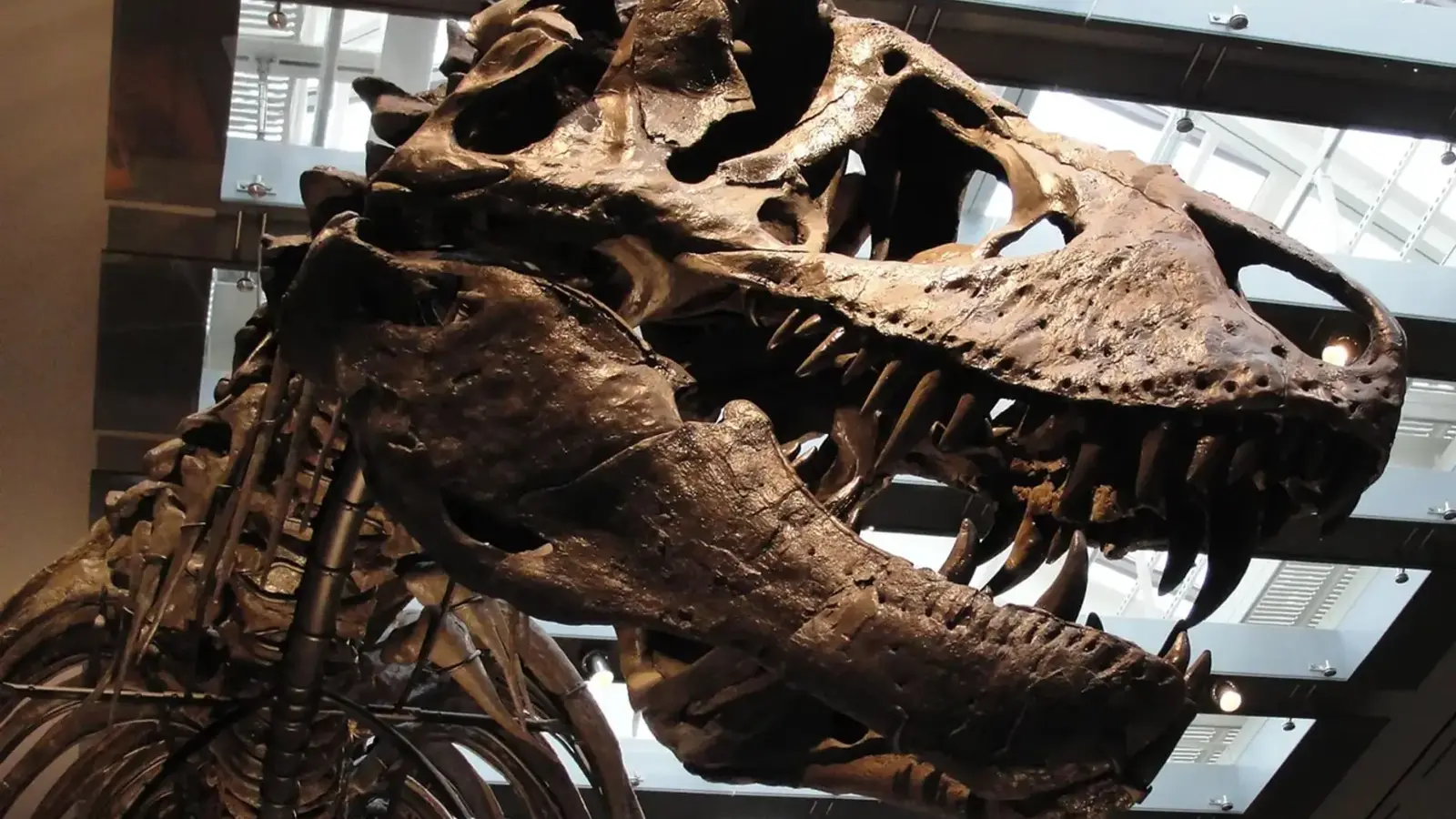
Picture a creature the size of a delivery truck, stalking a landscape 66 million years old. Not sunbasking and sluggish. Instead, one that could run, hunt, and sustain powerful muscles with an internal furnace humming at nearly human temperatures.
That image is what emerges from a new study of fossilized Tyrannosaurus rex teeth. Researchers at the University of California, Los Angeles analyzed chemical traces locked inside tooth enamel and report an average core body temperature of about 36.3 degrees Celsius. Close to what many modern large mammals maintain, and far warmer than the cold-blooded reptiles we often imagine when thinking about dinosaurs.
A thermometer written in enamel
How do you take the temperature of an animal long extinct? You read the chemistry it left behind. Tooth enamel forms in layers during growth and preserves subtle patterns of isotopes. The team used a technique called clumped isotope thermometry, which measures how often certain heavy isotopes bond together in carbonate molecules. Those bond frequencies depend on the temperature at formation, so enamel becomes a tiny molecular thermometer.
UCLA scientists measured enamel from T. rex teeth and, to validate their approach, ran the same tests on fossil crocodile teeth found in the same deposits. Crocodile enamel returned an average temperature near 30.9 degrees Celsius, a figure consistent with modern cold-blooded reptiles. The T. rex readings, by contrast, clustered around 36.3 degrees Celsius. The gap is large enough to suggest fundamentally different physiological strategies for heat management.
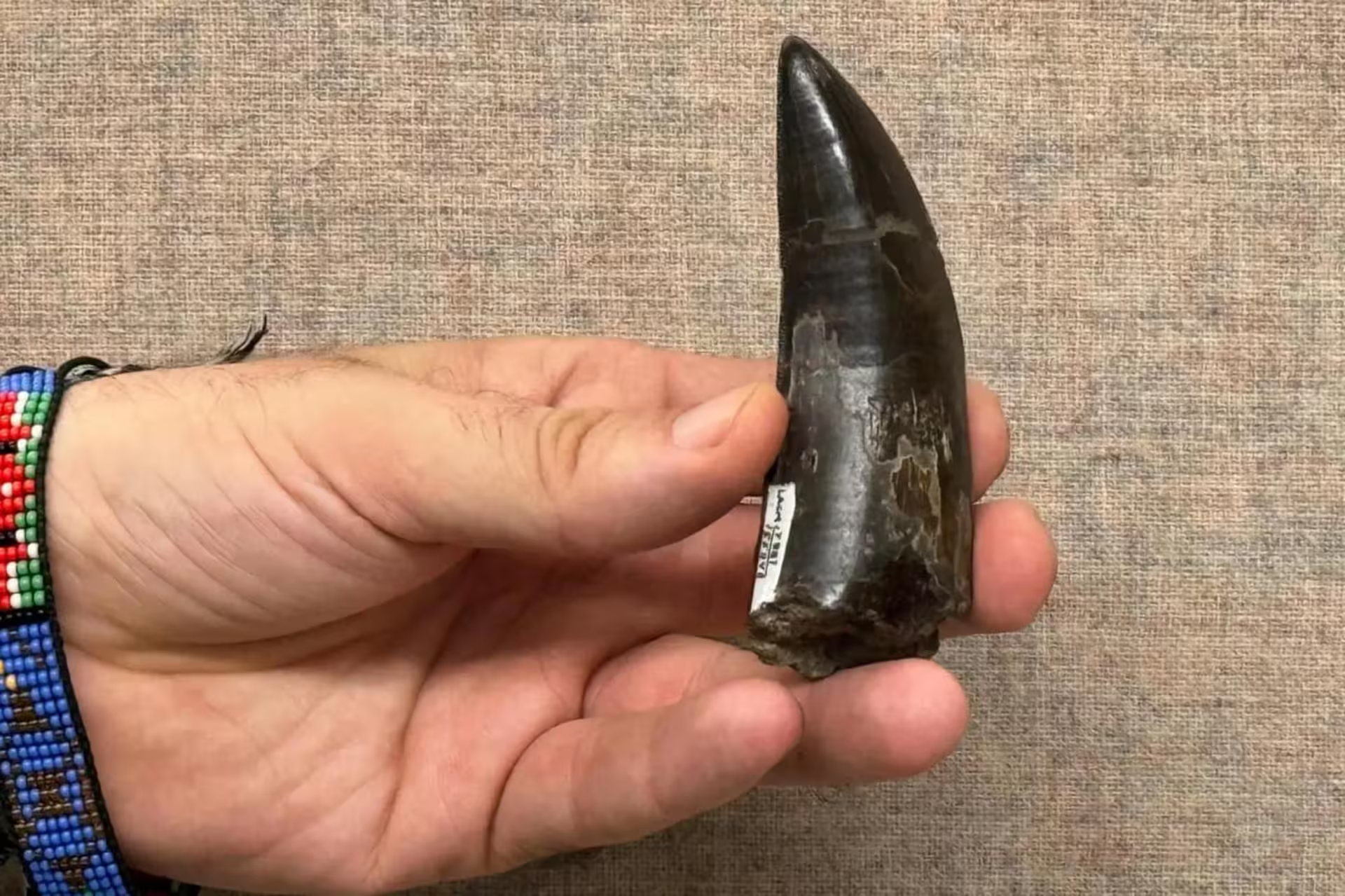
The work appeared in Science Advances and was reported by international news outlets. Photographs released by UCLA show researcher Robert Eagle holding one of the teeth used in the analysis, the very sample that yielded data for these temperature estimates.
What a warm T. rex would mean

A T. rex maintaining a roughly 36-degree body temperature changes how we picture its behavior. Warm-bloodedness, in broad terms, implies a higher basal metabolism. More energy available for sustained activity. Faster recovery after exertion. That helps explain how such a massive predator could be mobile and active across diverse climates, including higher-latitude regions where tracks attributed to tyrannosaur relatives have been found.
But the story is nuanced. The measured temperature sits below many modern birds, which often rest near 40 degrees Celsius, and slightly under typical human body temperature, usually cited around 37 degrees Celsius. It is similar to large mammals such as elephants, which keep cooler internal set points than small, highly endothermic species. In other words, T. rex may have been warm-blooded in the sense of elevating and regulating its body heat, but its physiology did not have to match that of a hummingbird or a small mammal.
Importantly, these results do not imply uniformity across all dinosaurs. Paleontologists increasingly see dinosaurs as a diverse group with multiple metabolic strategies. Some species might have been closer to full endothermy, others partially so, and some might have relied more on environmental heat. This tooth-based thermometer provides a clear data point for T. rex but not a universal rule for every Mesozoic species.
The implications reach beyond idle curiosity. Understanding thermoregulation informs estimates of food intake, growth rates, daily activity budgets, and ecological roles. It also helps explain geographic range. A predator that can internally maintain temperature expands its behavioral window, hunting across seasons and latitudes that would challenge strict ectotherms.
Expert Insight
"These isotope measurements give us a rare direct line to physiology in a long-dead animal," said Dr. Elena Márquez, a paleophysiologist not involved in the study. "They do not erase previous evidence but add a converging piece: T. rex had the metabolic machinery to support active predation. It was warm, but tuned differently than modern birds or small mammals."
Dr. Márquez added that future work should expand sampling across ages, regions, and species to map how metabolic strategies varied across the dinosaur family tree.
Ultimately, the enamel of a single tooth has helped reshape our mental image of one of Earth’s most famous predators. Far from merely being a scaled-up reptile, Tyrannosaurus rex now appears more like a powerful, heat-regulating hunter, living with an internal rhythm closer to that of large warm-blooded animals today.

“My work centers on sustainability, energy, and environmental science — examining how innovation can lead to a greener future.”

Discussion
Leave a Comment
Comments (1)
wow didnt expect T. rex to be near 36°C. Mind blown, kinda imagining warm, fast giants now... wild.