
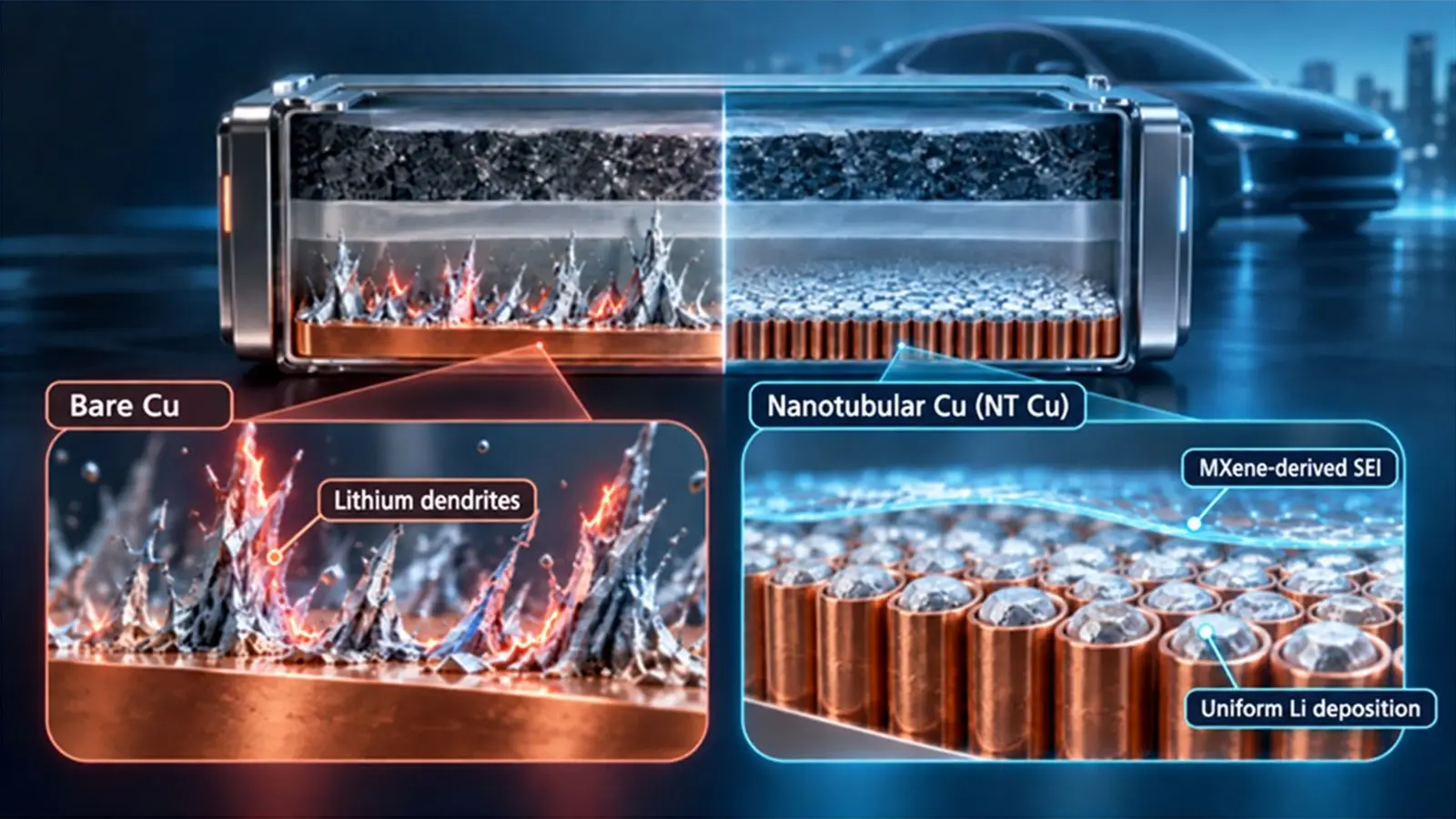
Imagine a battery that sheds weight instead of piling it on to last longer. That is the promise behind anode-free lithium batteries: remove the bulky graphite anode and let lithium plate directly onto a slim copper foil. In theory, you get more energy per kilogram. In practice, you risk sharp, branching lithium spikes called dendrites that short the cell and destroy capacity.
Researchers at the Korea Advanced Institute of Science and Technology have taken a page from semiconductor fabs to tackle that exact problem. By combining microfabrication and surface chemistry tricks, they designed a copper current collector that encourages lithium to deposit evenly and builds a stable protective layer in situ during charge cycles. The result keeps the battery light while fighting the mechanisms that wear it down.
The technique blends two distinct moves: topography and chemistry. First, the team used a precision lithography method adapted from chipmaking to sculpt an array of microscopic tubes on copper foil. Each tube is roughly 300 nanometers across and 150 nanometers tall. That tiny architecture increases the electrode surface area to about four times that of a flat foil, spreading incoming lithium across many more nucleation sites. Instead of concentrating at a few hotspots and forming needlelike dendrites, lithium can plate uniformly across the landscape.
Second, the surface receives an ultrathin coating of MXene, a two-dimensional material only about 10 nanometers thick. The MXene does not act as a finished shield. Rather, it functions like a primer: it adsorbs species from the electrolyte and guides the formation of a protective interphase rich in lithium fluoride. In the team’s LiPF6-based electrolyte, that LiF-dominated layer reduces parasitic reactions between metallic lithium and the liquid electrolyte and helps suppress dendrite growth.
The approach sidesteps common tradeoffs. Previous strategies often add excess lithium or thicker protective films to compensate for losses and instability. That works, but it also erodes the weight and volume gains that make anode-free designs attractive for electric vehicles. The KAIST method aims to improve cycle life without adding bulk, preserving the energy-per-mass advantage.
The researchers combined materials characterization and careful cell testing to validate how their design behaves. They kept samples from air exposure while using X-ray photoelectron spectroscopy, time-of-flight secondary ion mass spectrometry, and transmission electron microscopy to map chemistry and structure at the nanoscale. Those analyses show a uniform protective interphase along the MXene-coated, textured copper. In short, the tiny tubes give lithium more real estate, and the MXene recruits the right chemistry to make that real estate durable.
The team behind the work includes Jinwoo Lee and Hee-Tae Jung of KAIST, together with collaborators from Kyungpook National University and the National NanoFab Center. Lee notes that ultrafine fabrication methods from semiconductor manufacturing can create uniform deposition sites and a stable protective layer without altering the electrolyte formulation or adding excess lithium. He believes this could accelerate commercialization of high-energy anode-free cells.
.avif)
The research team. (top row, from left) Eunji Kim, PhD student (KAIST); Hyunju Jung, PhD student (KAIST); Jinuk Kim, PhD student (KAIST). (bottom row, from left) Jinwoo Lee, Professor (KAIST); Hee-Tae Jung, Professor (KAIST); Yonghee Lee, Professor (Kyungpook National University).

Why this matters for electric vehicles
Range anxiety is still a major barrier to EV adoption. Batteries that hold more energy per unit mass can push ranges higher without enlarging the vehicle or adding heavy packs. Anode-free designs are attractive on that front, but only if they can survive hundreds or thousands of charge cycles without failing. The KAIST approach directly addresses the two failure modes that most commonly end anode-free cells prematurely: dendrite penetration and continuous loss of active lithium through side reactions.
What does that mean in real-world terms? A lighter battery with the same pack volume translates to longer driving range or the ability to use smaller battery packs to meet the same range target. That improves vehicle efficiency and can reduce costs across the supply chain, from raw materials to thermal management.
Technical hurdles and next steps
No advance is a drop-in replacement. Adapting SSL lithography and MXene coatings to large-scale, roll-to-roll foil processing will be a key engineering challenge. Semiconductors operate at small areas with extreme precision; battery manufacturing demands speed and economy at square meters per minute. Scaling the patterned copper and ensuring the MXene layer remains uniform and robust over long production runs are necessary milestones.
There are also questions about compatibility with different electrolytes and cell formats. The reported results use a LiPF6-based system where MXene steers LiF formation. Alternative salts or additives might change interphase chemistry and require tuning of the coating or texturing. Still, the general strategy of pairing precise topography with chemistry-guided interphase formation is broadly applicable.
Expert Insight
"Taking semiconductor-level control into battery electrodes is a powerful idea," says Dr. Maria Alvarez, a battery materials scientist not involved with the study. "It lets you design where lithium arrives and how the surface responds, rather than hoping the interface behaves. The key will be translating that nanoscale control into economically viable manufacturing. If that succeeds, the impact on EV range and pack design could be substantial."
The combination of microtextured copper and a MXene primer offers a promising route to lighter, longer-lived anode-free batteries without adding bulk.

“My work centers on sustainability, energy, and environmental science — examining how innovation can lead to a greener future.”

Discussion
Leave a Comment
Comments
No comments yet. Be the first.