
When people list cancer risk factors, infections rarely make the top of the list. Yet new global estimates show that infectious agents are linked to a surprisingly large share of cancer diagnoses worldwide.
Researchers analyzing worldwide cancer data found that infections were associated with roughly 12 percent of cancers diagnosed in 2024 – about 2.3 million new cases. That means billions of dollars in health costs, but also a clear set of targets for prevention: just five pathogens account for nearly all of those infection-linked cancers.
Which microbes are doing the most damage?
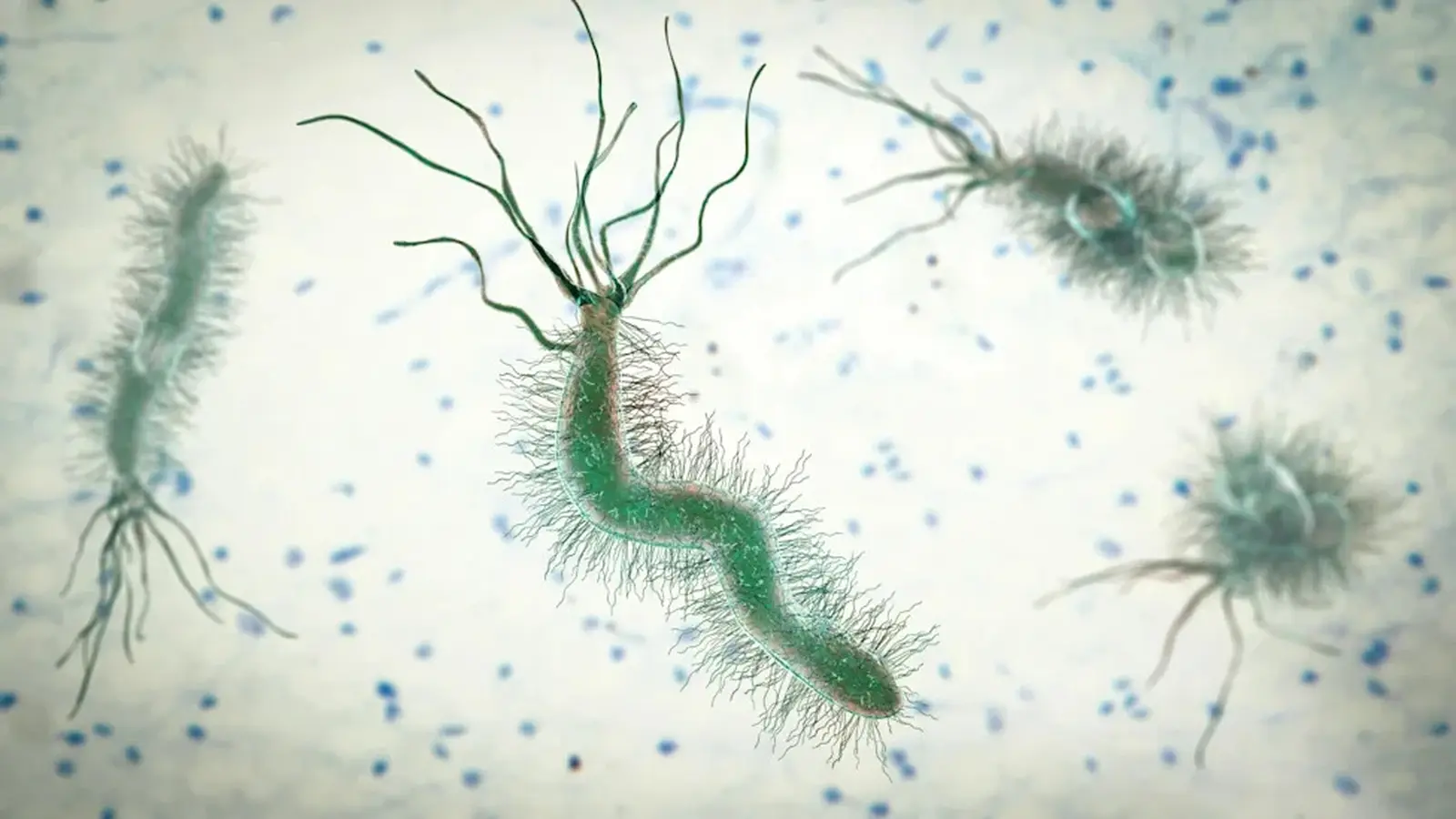
At the top of the list is Helicobacter pylori, a stomach bacterium. It was implicated in about 4 percent of cancers diagnosed in 2024, roughly 760,000 cases. H. pylori colonizes the stomach lining in about half the world’s population. For most carriers it causes no symptoms. For some, however, particular bacterial strains or long-term inflammation lead to ulcers and increase the risk of gastric cancer.
Human papillomavirus, or HPV, is almost equally consequential. HPV was linked to about 4 percent of new cancers in 2024, on the order of 750,000 cases. The virus is best known for its role in cervical cancer, but it also causes cancers of the oropharynx, anus, penis, and other sites.
Three other viruses together account for most of the remainder. Hepatitis B virus (HBV) was associated with about 2 percent of new cancer cases, Epstein-Barr virus (EBV) with 1 percent, and hepatitis C virus (HCV) with less than 1 percent. EBV has become more prominent in recent estimates as stronger evidence links it to multiple cancer types, including certain lymphomas and nasopharyngeal carcinoma.

This pattern matters because unlike some noninfectious risks, many infection-related cancers have clear prevention or treatment tools. Vaccination, screening, antiviral therapies, and safer medical practices can make a measurable difference in cancer incidence.
Prevention and the geography of risk

Why does this matter for global health planning? Because the burden of infection-related cancers is uneven. About three-quarters of these cases occur in low- and middle-income countries, concentrated in eastern Asia, sub-Saharan Africa, and southeast Asia. Eastern Asia alone accounted for roughly 42 percent of the world total in 2024, driven mainly by H. pylori and HBV-related cancers.
Routine vaccination offers a powerful example. HPV vaccines are highly effective at preventing the virus types that cause most cervical cancers, yet coverage remains patchy in many regions and men are often overlooked in vaccination programs despite their risk of HPV-related cancers. Hepatitis B vaccination, when widely implemented, has reduced liver cancer rates in vaccinated cohorts, but gaps persist where delivery or funding is inconsistent.
Other targets are harder. There is no licensed vaccine for H. pylori and developing one has proved difficult. Antibiotic treatment can clear H. pylori in some people, but resistance and the risk of unnecessary antibiotic exposure limit straightforward, large-scale use. For EBV, which infects about 95 percent of adults worldwide and usually causes asymptomatic or mild infections, vaccine development is under way but has not yet reached approval.
Authors of the recent study emphasize that many of the interventions are already known to be cost-effective, but social, financial, and political barriers prevent full rollout where they would do the most good. That gap translates into preventable cancers and inequities in outcomes.
Expert Insight
Dr. Laila Montoya, an infectious-disease epidemiologist and public health adviser, says: "The numbers are sobering but also actionable. When a sizeable proportion of cancers are tied to infections, investments in vaccines, diagnostics, and access to care are investments in cancer prevention. It's not just a medical issue - it is a matter of systems and equity. Addressing those gaps will reduce suffering and save health systems money over time."
Scaling up proven measures would require political commitment, financing, and community engagement. That means improving vaccine delivery, expanding screening programs, ensuring safe injection and blood-transmission practices, and supporting research into vaccines for H. pylori and EBV.
There are also research priorities beyond vaccine development. Better surveillance to map where infection-linked cancers concentrate, improved diagnostic tools to identify high-risk individuals, and therapeutic strategies that combine infection control with standard cancer care will all help lower future cancer burdens.
The takeaway is direct: some cancers are avoidable. By treating infections, vaccinating populations, and closing access gaps, the global community could prevent a substantial slice of future cancer cases. That possibility reframes part of cancer prevention as a public-health problem with clear, evidence-based solutions.

“The cosmos has always fascinated me. I write about space missions, astronomy, and the technologies pushing humanity beyond Earth.”

Discussion
Leave a Comment
Comments (1)
wow, infections = 12% of cancers? didn't expect H pylori to top the list. Vaccines and equity, pls govt act, now.