
Picture a laboratory table: a single serrated tooth mounted on a machine, a slab of clear ballistic gel waiting like a pale carcass, and a camera catching every millimetre of motion. Simple setup. Big implications.
Putting ancient teeth to the test
For decades, reconstructions of meat eating dinosaurs have favored one image: powerful jaws closing, teeth crushing straight down. That image is dramatic. But science prefers proof. Researchers at the University of Reading and the University of Illinois Urbana Champaign decided to test an alternative idea with a very modern toy, nicknamed the DinoSAW. The device drove a replica allosaur tooth into ballistic gel, a synthetic tissue analogue used in forensics and biomechanics, while sensors and high speed cameras recorded the effects.
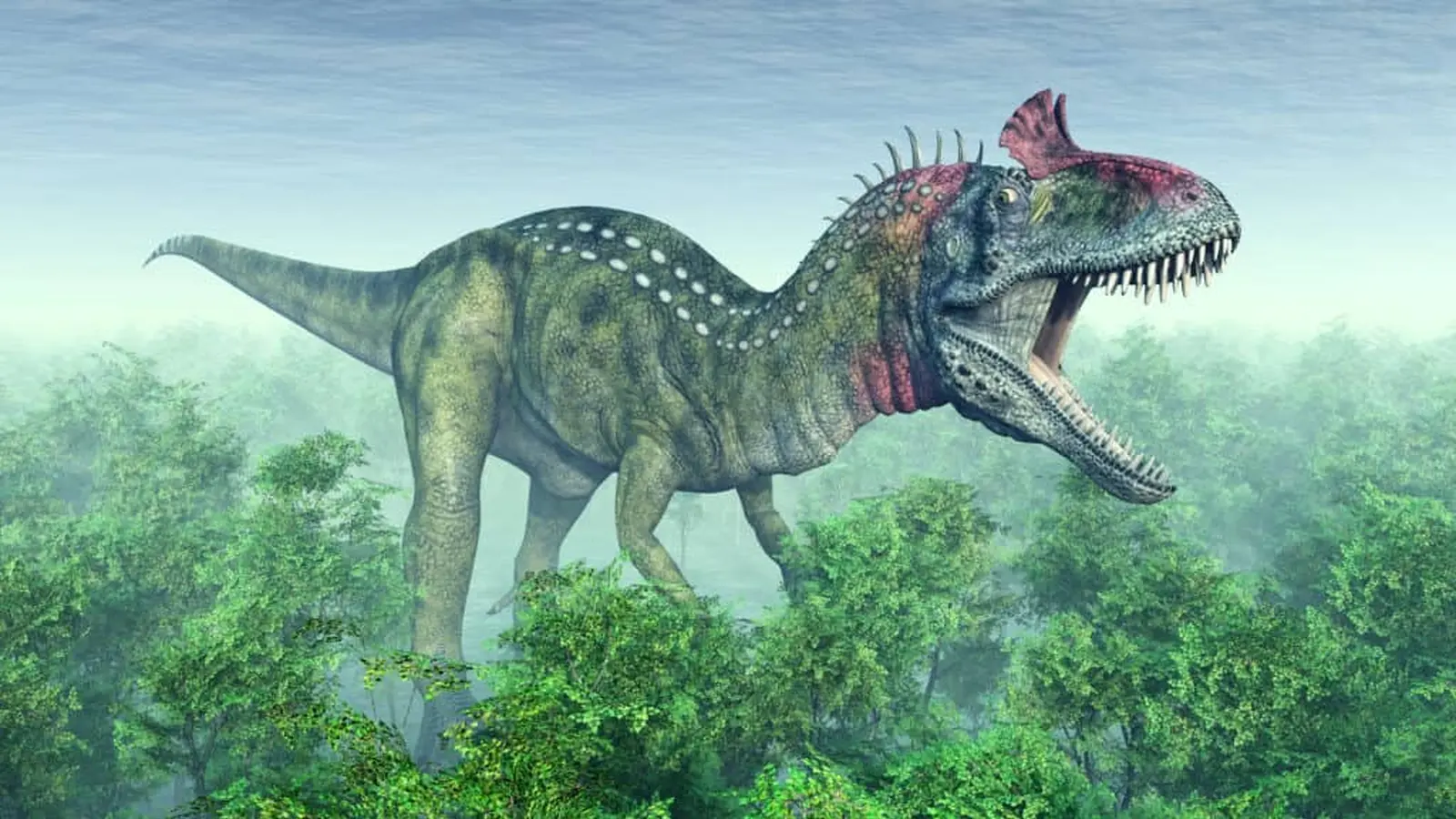
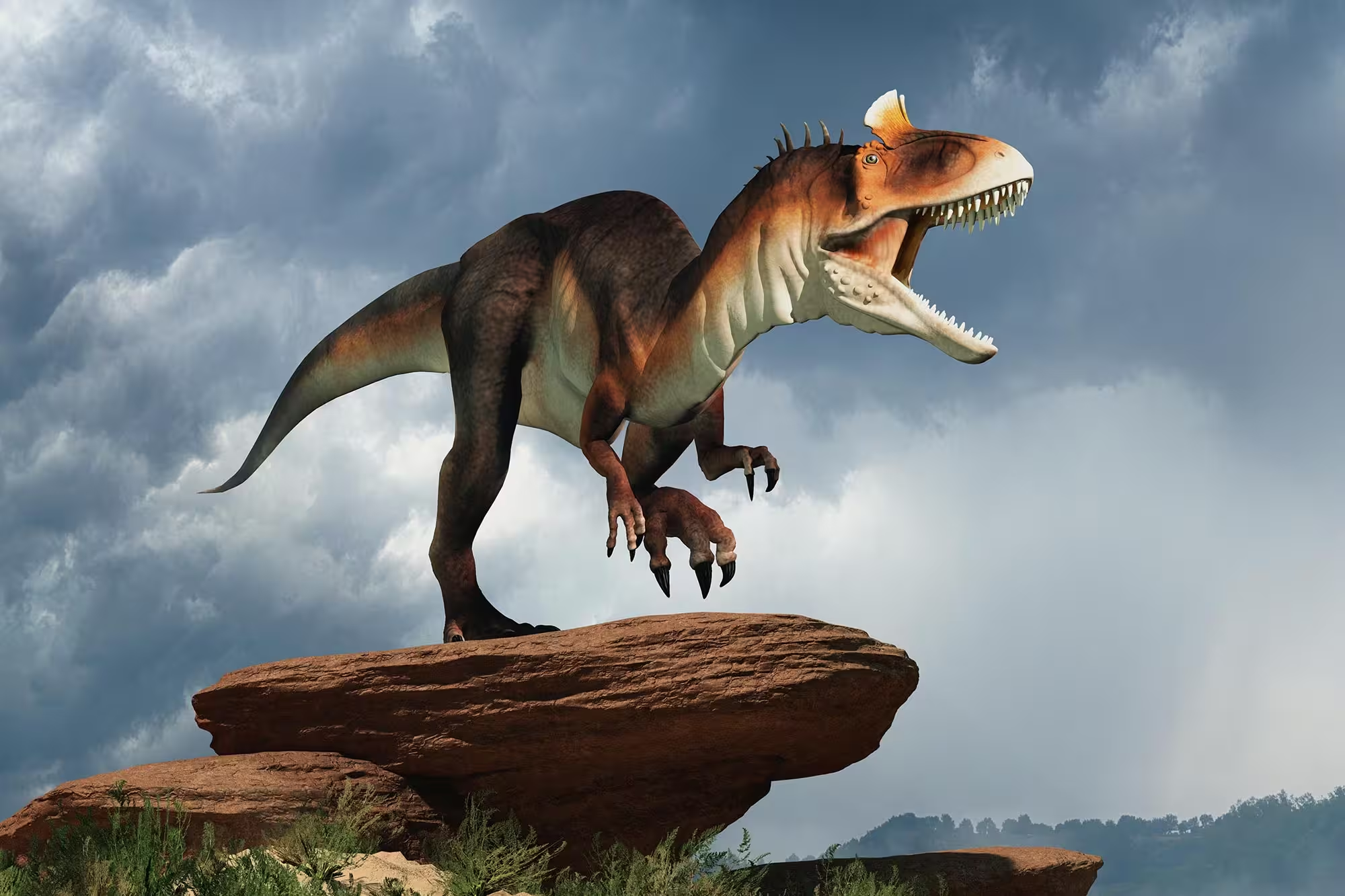
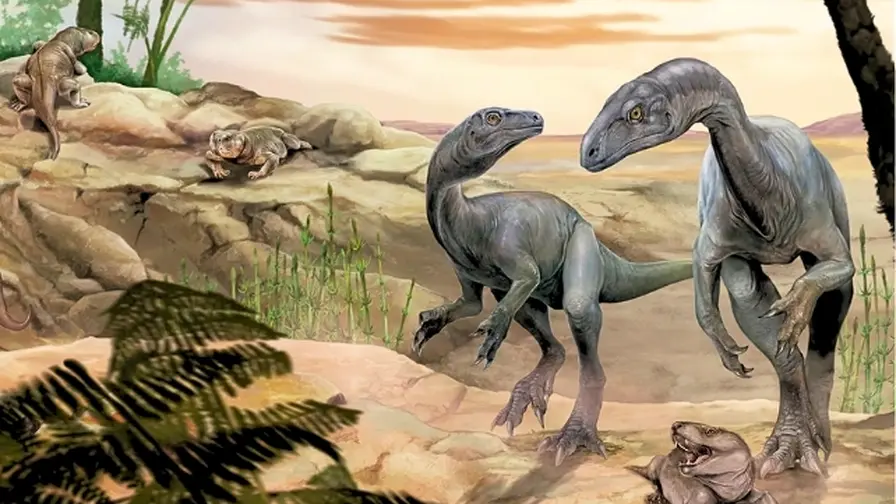
The tooth shape was key. Many theropods, from Allosaurus to Velociraptor and even some Antarctic species like Cryolophosaurus, bore recurved, flattened teeth with serrations along both edges. Those blades look less like pliers and more like a double edged steak knife. To see how those blades performed, the team compared two actions: a straight vertical bite and a diagonal backward pull, the latter mimicking the tearing motion seen in Komodo dragons and birds of prey.
The numbers were telling. Sensors showed an average peak force of about 14 newtons for the diagonal pull, versus 21.4 newtons for the vertical strike. That is roughly a one third reduction in required force when the tooth was drawn backward along its natural curve. High speed imaging under polarized light added depth: vertical strikes produced bright, concentrated hotspots of stress in the gel, while the diagonal pulls spread lower stress levels more evenly through the material.
What the tests reveal about feeding
Why does the diagonal pull cut more efficiently? When the tooth is forced straight down, only the forward serrated edge engages the tissue. Pull the tooth back, along its curve, and both serrated edges can slice. The motion turns a single bite into a slicing stroke, capitalizing on the geometry of the tooth and the mechanics of the neck and body.
That picture aligns with fossil evidence too. Many bones bearing theropod bite marks show grooves and dragged scratches consistent with teeth being raked across flesh and bone, not merely punctured. The experimental results also call into question the long held assumption that theropods bit vertically first and then pulled backward. If the pulling motion alone is sufficient to both pierce and slice, the extra step of biting down first would be wasteful.
Dr Manabu Sakamoto, who led the study, put it plainly: we often imagine dinosaurs crunching straight down. Their teeth tell a different story. Dr Philip Anderson, a co author, emphasized that physics and engineering methods can illuminate behaviours we cannot observe directly. Both voices remind us that function emerges from form and motion together.
Implications for paleobiology and modeling
The findings matter beyond a laboratory curiosity. Biomechanical models of dinosaur skulls and feeding behaviour typically estimate bite forces and stress patterns assuming vertical loads. If theropods habitually used neck driven backward pulls, models must incorporate directional forces and dynamic neck kinematics, not just bite strength. That changes estimates of hunting and scavenging strategies, energetic costs, and even how social feeding or carcass competition might have played out.
There are broader consequences as well. Understanding tooth function helps interpret wear patterns on fossils, guides reconstructions displayed in museums, and informs how we read predator prey interactions in deep time. The DinoSAW approach—combining replica teeth, tissue analogues and stress imaging—offers a framework to test other feeding hypotheses, from the slicing canines of saber toothed cats to the puncture mechanics of marine reptiles.
Expert Insight
"The experiment bridges morphology and behaviour in a direct way," says fictional biomechanist Dr Elena Marquez, a researcher who studies feeding mechanics. "You can see how a small change in tooth curvature or serration alters the whole feeding stroke. It’s not just about raw force. It’s about how an animal directs that force through body parts like the neck and shoulders."
She adds, "These tests let us ask sharper questions of the fossil record. When you find a pattern of dragged marks on bone, you can test whether that pattern is mechanically plausible for a given tooth shape and neck posture. That moves paleontology closer to experimental reality."
Conclusion
The DinoSAW experiments do not claim to reconstruct every feeding event of every theropod. But they do complicate a neat, cinematic myth: that these dinosaurs simply crushed down on prey with brute force. Instead, tooth shape, serration and neck-driven motion likely combined to make tearing efficient. Pulling teeth through flesh was a skillful, economical strategy. In the study of ancient predators, small mechanics yield large stories.

“My work centers on sustainability, energy, and environmental science — examining how innovation can lead to a greener future.”

Discussion
Leave a Comment
Comments
No comments yet. Be the first.