
Picture a planet or a dim stellar corpse slowly collecting particles the universe leaves behind. Over billions of years, an otherwise invisible quarry might pile up at the center, stirring heat or sending ghostlike particles outward. That, in essence, is the idea a team of physicists tested when they turned to worlds and stellar remnants as natural dark matter detectors.
Scientists are turning to planets and dead stars to investigate dark matter particles that may be nearly impossible to detect on Earth.
When a tiny nudge can change everything
Dark matter does not glow, absorb, or emit light, yet it dominates the mass budget of galaxies through its gravity. For decades, experiments have chased candidate particles that might reveal themselves in underground detectors, colliders, or telescopes. Most searches look for fairly energetic interactions: a particle slamming into a nucleus, an ionization track, a photon flash. But what if the particles are slow, or carry only a whisper of electric or magnetic interaction? Those scenarios make laboratory detection maddeningly difficult.
Slow-moving or weakly interacting particles may never impart enough energy inside a human-built detector to produce a measurable signal. A planet or a star is different. These bodies are vast targets with dense interiors. A particle that loses only a little kinetic energy while crossing a giant object might become gravitationally bound, unable to escape. Over cosmic timescales, trapped particles can accumulate to densities that are significant enough to matter physically.
How planets and stars become particle traps
Researchers Alejandro Ibarra, Merlin Reichard, and Gaurav Tomar set out to quantify this capture process. They considered four celestial laboratories: Earth, the Sun, Jupiter, and white dwarfs. Two observational signatures were primary. First, annihilation of accumulated dark matter inside the Sun or Earth could produce neutrinos that escape and reach detectors on or under the surface. Second, trapped particles that annihilate inside non-fusing objects such as Jupiter and white dwarfs would deliver heat, potentially raising their thermal emission beyond what standard models predict.
Neutrinos are uniquely useful. They pass through matter almost without interaction, so a neutrino flux pointing back to the Sun or Earth can be a clean tracer of particle processes deep inside. Instruments such as IceCube at the South Pole and other neutrino observatories are designed to pick up such faint signals. For heating, astronomers can measure the luminosity of Jupiter and of white dwarfs. White dwarfs are compact, slowly cooling embers of former stars; any additional internal heating can stand out against their expected thermal decline.
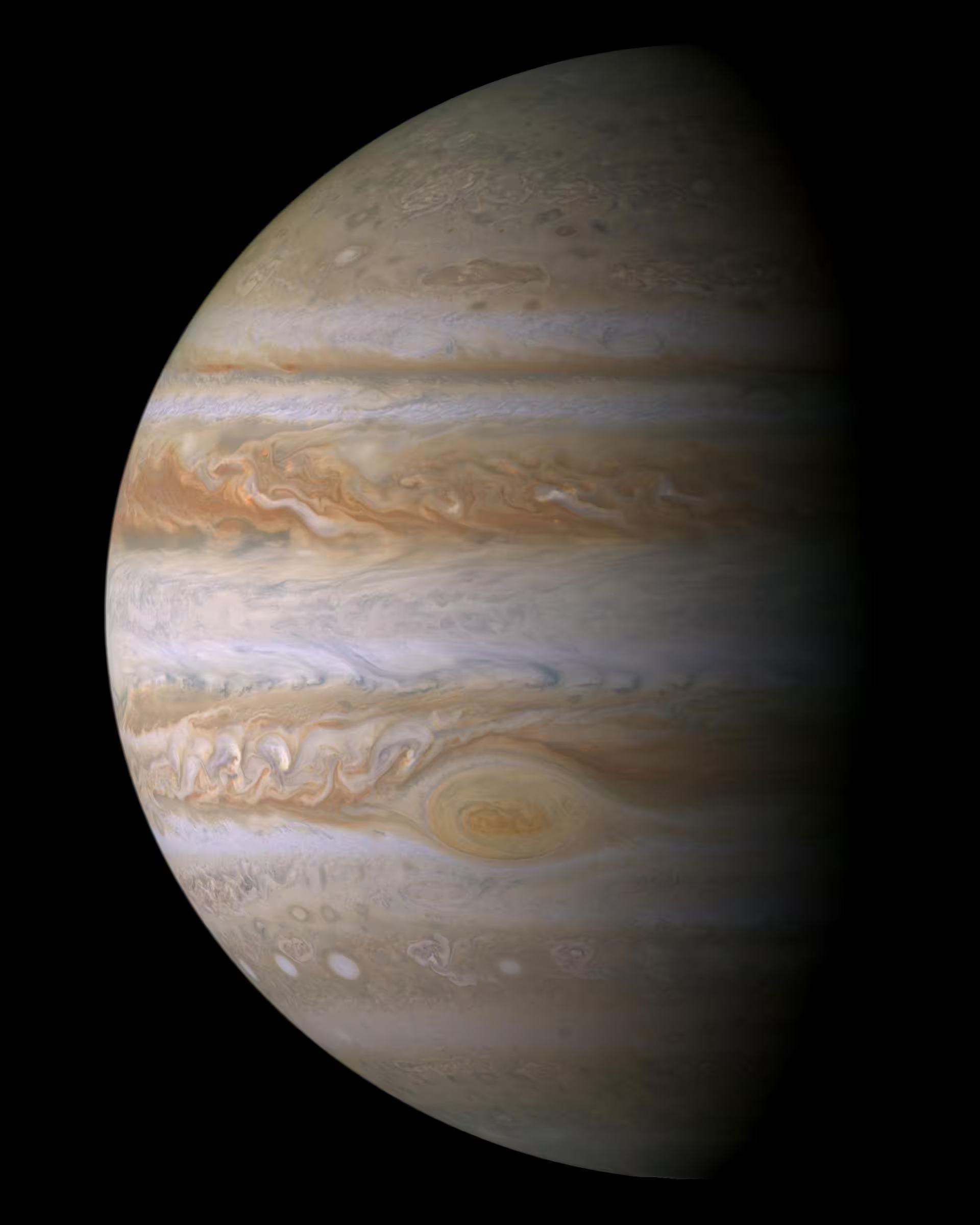
True color mosaic of Jupiter constructed from images taken by the narrow angle camera onboard NASA’s Cassini spacecraft on December 29, 2000.
What the study excluded and why it matters
The team combined capture physics, annihilation channels, and observational limits to exclude swaths of particle properties that had previously been hard to test. Earth provides strong constraints for particles with extremely small electric charges, often called millicharged particles. The reasoning is direct: even a tiny electromagnetic coupling increases the chance of scattering with terrestrial material, which enhances capture and thus the neutrino signal from subsequent annihilation.
White dwarfs play a complementary role. Because these objects are compact and not powered by ongoing nuclear fusion, any unexplained heating can point to new energy sources. The researchers showed that certain electromagnetic interactions of dark matter that would have gone unnoticed in lab experiments would nevertheless produce too much heat in the white dwarfs they modeled. Those combinations of mass and coupling are now disfavored unless local dark matter densities are much lower than assumed.
At the same time, the analysis left important room for uncertainty. The amount of dark matter a planet or star can sweep up depends on the local dark matter density and velocity distribution. In particular, the white dwarfs examined by the team live in the M4 star cluster, where the ambient dark matter density is not measured directly but inferred from models. If those density estimates change, the bounds shift accordingly, expanding or contracting the region of parameter space that remains viable.
The work did not produce a positive detection. Instead, it tightened the net. By exploiting different observational channels and very different types of celestial bodies, the researchers closed off classes of possibilities that terrestrial detectors alone had struggled to rule out. That is progress. Each excluded scenario narrows the field for future searches and refines how we design experiments on Earth and in space.
Looking beyond our backyard
Where do researchers go from here? The study points toward several promising directions. Observers could search for even colder white dwarfs in regions expected to have higher dark matter densities. Colder stars give a higher signal-to-noise ratio for anomalous heating. Exoplanets orbiting dense stellar environments might also act as natural laboratories; some massive exoplanets could be particularly good at capturing and revealing trapped particles.
On the neutrino front, continued operation and upgrades to detectors like IceCube will tighten limits on annihilation channels that produce neutrinos. Meanwhile, laboratory experiments keep pushing sensitivity to lower masses and weaker couplings, complementing the astrophysical approach. Combined, these lines of attack create a cross-checking system: if a particular model survives both astrophysical and terrestrial constraints, it becomes a much more compelling target for direct search campaigns.
Expert Insight
Dr. Lena Morales, an astrophysicist at the University of Cambridge, commented: "Using planets and dead stars as physics experiments is a clever reuse of existing cosmic infrastructure. These objects integrate processes over immense timescales, giving us a window into particle behavior that is otherwise closed. The challenge now is to reduce environmental uncertainties, like local dark matter density, so limits become even more robust."
Conclusion
Turning planets and stellar remnants into probes widens the toolkit for hunting dark matter. The study by Ibarra, Reichard, and Tomar does not solve the mystery, but it reshapes it. By ruling out swaths of parameter space and highlighting where observational uncertainties matter most, their work helps point the next generation of searches. Whether the answer comes from a neutrino detector, a telescope watching a cooling white dwarf, or a laboratory experiment on Earth, the hunt for dark matter just gained a sharper map.


“The cosmos has always fascinated me. I write about space missions, astronomy, and the technologies pushing humanity beyond Earth.”
Discussion
Leave a Comment
Comments
No comments yet. Be the first.