
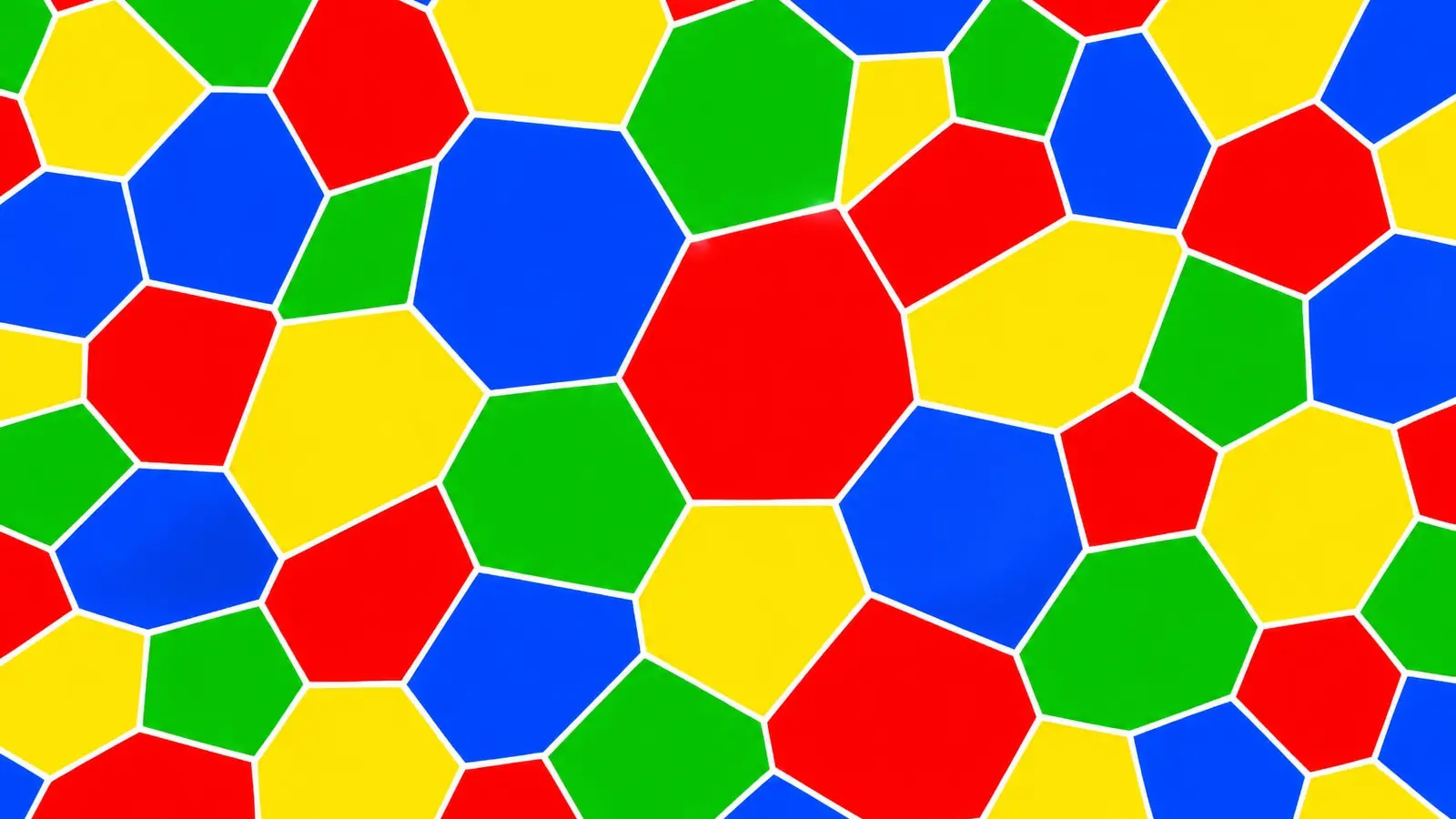
A simple pencil sketch from 1852 still bites at the heels of modern mathematicians. Francis Guthrie, doodling county lines, noticed he never needed more than four colors to ensure adjacent regions differed. That observation became the Four Color Problem, a puzzle that looks innocent on paper but hides deep, stubborn structure.
A colorful Voronoi-inspired diagram illustrates the geometric patterns behind the Four Color Theorem, a mathematical principle with implications far beyond map coloring.
When a proof is not enough
Proving that every flat map can be colored with four colors was a milestone that took well over a century. The landmark computer-assisted proof of 1976 settled the question, and subsequent refinements made the argument more accessible. Yet those proofs did not solve a practical issue: they guaranteed existence but did not give an efficient recipe for assigning colors on large, complicated maps.
That gap is what Mikkel Thorup and his collaborators attacked. Their new algorithm changes the story from theoretical possibility to computational practicality. "The previous proofs showed that it is always possible to color a map using four colors. But they are not very good at actually finding the colors for each individual region on a map. The new algorithm is efficient and provides a much faster way of coloring," says Professor Mikkel Thorup from the Department of Computer Science at the University of Copenhagen.
The breakthrough marks the first significant progress on the algorithmic side in nearly three decades. The team presented the first part of their work at FOCS 26, where it won the Best Paper Award. But the technical advance is best understood when you switch perspective from maps to graphs.
Small handles, big speedups
Mathematicians model a flat map as a planar graph: regions become vertices, shared borders become edges. The coloring problem then asks for a way to assign one of four labels to each vertex so that adjacent vertices get different labels. That formulation is classical, but within those graphs the team found something new and surprising.
Hidden inside every planar graph are configurations called reducible configurations. These are small, local arrangements that you can remove or simplify while maintaining the colorability of the whole graph. Think of them as handles you use to peel the problem apart. "Think of reducible configurations as handles you can grab hold on to start four coloring. We show that graphs do not contain just one handle, but an astonishing number of them. Nobody knew that before," says Professor and co-author Carsten Thomassen from DTU.
Earlier algorithms often located a single reducible configuration and then rebuilt the coloring around it. That approach grows costly as the map enlarges. The new insight is that planar graphs actually brim with these handles. The team designed an algorithm that exploits the abundance of reducible configurations to avoid repetitive, expensive work.
In practical terms, the algorithm moves the problem from quadratic time to linear time. If a map becomes ten times larger, the computation grows roughly tenfold rather than one hundredfold. That is a qualitative change for applications that must color huge graphs quickly.
Why mathematicians keep coming back
The effort behind this advance is not trivial. Thorup, Thomassen, Ken-ichi Kawarabayashi, and Bojan Mohar spent about a decade refining ideas that combine deep graph theory with algorithmic engineering. Thorup admits there is an elemental allure to the problem. "The disease is believing that there must be a simple proof for such a simple statement. I would guess that at least 1,000 mathematicians have caught the four-color disease, spending months trying to make it work but never quite succeeding. It is the disease people have suffered from since 1852," he says. He adds a human touch to the obsession: "Because mathematicians are slightly crazy. Most of what mathematicians work on consists of very nerdy questions. We become obsessed with this type of problem because it challenges the human intellect. And if we find the answer, we will probably also find answers to other mathematical puzzles."
Behind those words is a constructive program. The algorithm does not merely assert existence. It provides a tangible method to find four-colorings far more efficiently than previous approaches.
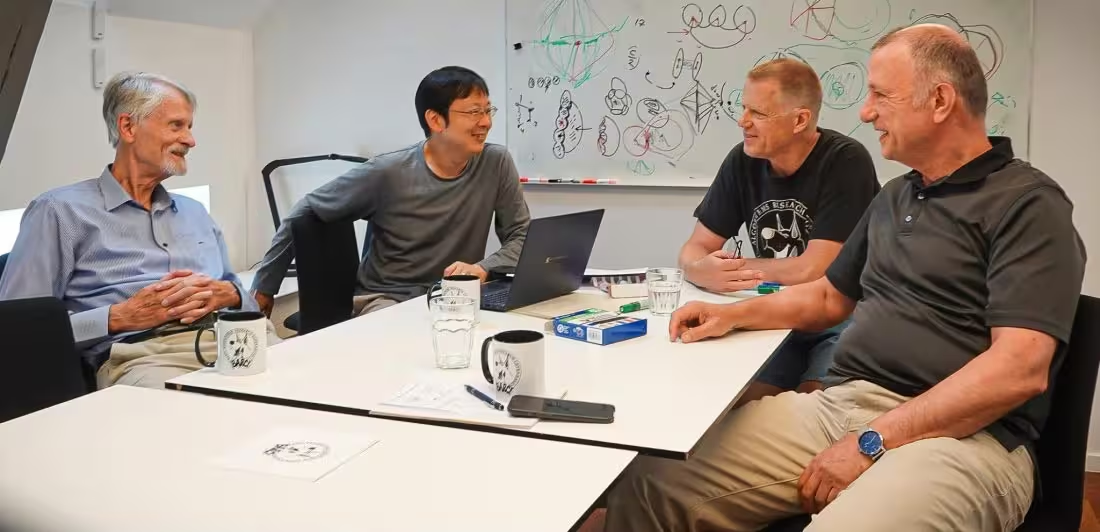
The Professors Carsten Thomassen, Ken-ichi Kawarabayashi, Mikkel Thorup and Bojan Mohar meeting at the University of Copenhagen, September 2026.
Beyond ordinary maps
The implications extend well beyond cartography. Planar graphs are a model for networks in electronics, computer graphics, and geographic information systems. More importantly, the researchers believe the strategy scales to surfaces that are not flat. Imagine coloring graphs drawn on a torus, a surface with a hole, or more exotic topologies that model real systems. The abundance of reducible structures suggests similar techniques could accelerate coloring problems on those surfaces too.
This matters because graph coloring is a building block in many computational tasks. Register allocation in compilers, frequency assignment in wireless networks, and pattern separations in image segmentation all rely on variants of coloring problems. Any algorithmic speedup in a fundamental case can cascade into practical performance gains across fields.

PhD students and co-authors Yuta Inoue and Atsuyuki Miyashita, University of Tokyo.
Expert Insight
Dr. Lena Ortiz, a computational topologist at the Massachusetts Institute of Technology, comments: "What distinguishes this work is not only the theoretical improvement but the shift in algorithmic mindset. By locating many local simplifications at once, the team avoids repeating the same heavy lifting as graphs grow. That strategy often transfers to other combinatorial problems, so I expect to see follow-up results in graph drawing and manifold discretizations."
Her assessment highlights a common pattern in mathematics: a modest-seeming advance in one theorem often unlocks broader methods applicable elsewhere.
Conclusion
The Four Color Theorem has migrated from curiosity to cornerstone and from proof to procedure. By revealing a previously hidden profusion of reducible configurations and turning that knowledge into a linear-time algorithm, Thorup and colleagues have moved the problem into the realm of practical computation. The work restores the balance between existence and construction and opens doors toward faster algorithms on more complex surfaces.
For a question that started with a map and a pencil, the journey now reaches into algorithms, topology, and applied computation. The four-color disease may be contagious, but it looks productive when it strikes the right minds.

“The cosmos has always fascinated me. I write about space missions, astronomy, and the technologies pushing humanity beyond Earth.”

Discussion
Leave a Comment
Comments (1)
A century to prove it and another 50 years to speed it up... math really plays the long game huh