
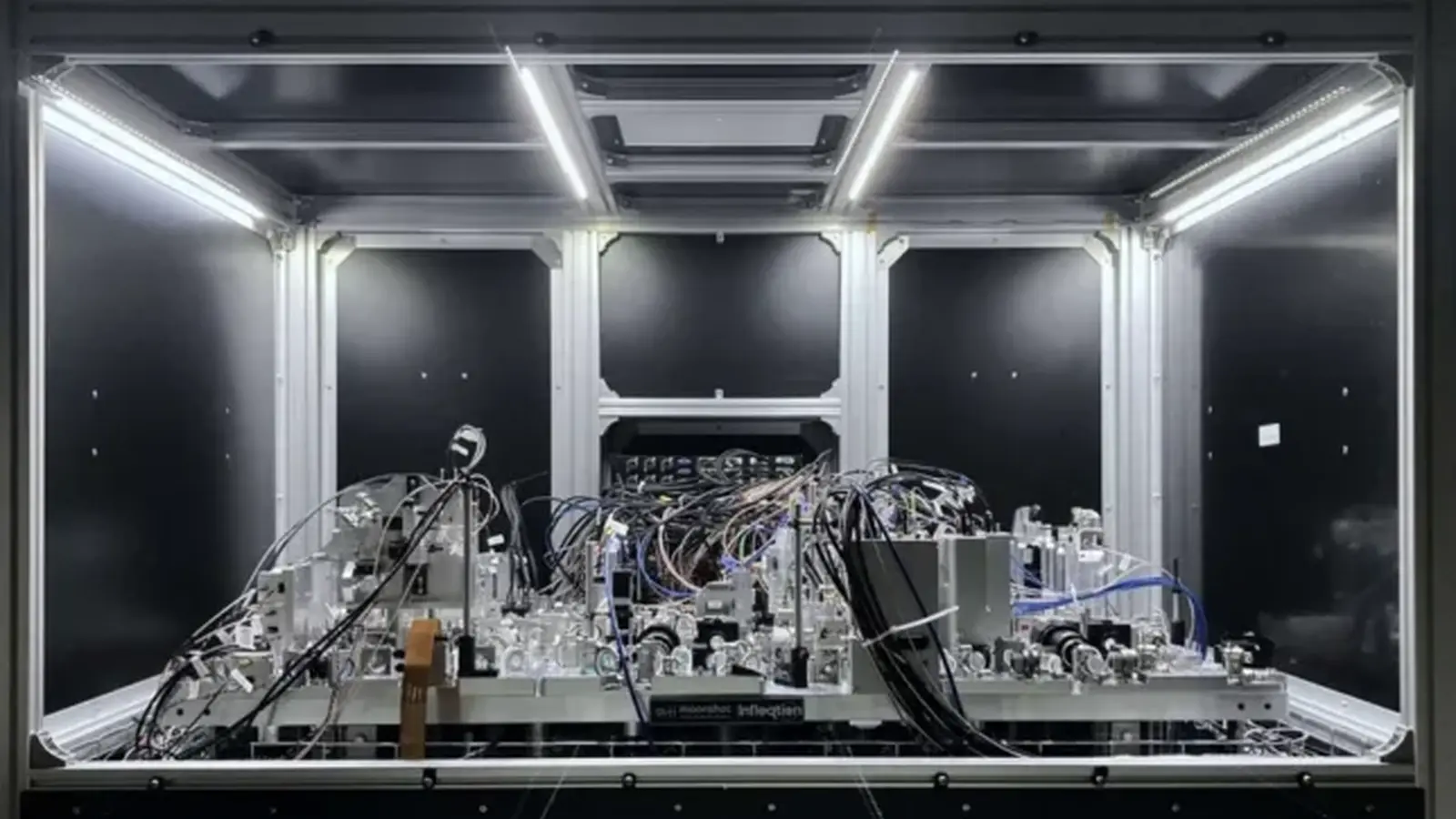
According to Live Science, Japanese researchers have switched on Shunkai, a full-stack neutral-atom quantum computer, and plan to scale the system to 10,000 qubits by March 2031. Shunkai is presented as Japan's first full-stack system of this type, meaning it combines software, control layers, and hardware to accept user inputs and deliver outputs.
The full-stack design is intended to make the device more immediately usable in research settings. In theory, having integrated software and control layers allows researchers to run experiments and algorithms without assembling separate control infrastructures. The Shunkai team says it will open access to external users and other researchers over the coming years.
Kenji Omori, project leader and professor of photomolecular sciences at the Institute of Molecular Science, said researchers' use of Shunkai could generate ripple effects across industry, academia, and government worldwide. The development team also intends to integrate Shunkai into an existing shared supercomputing center and to build a hybrid processing facility they call a Quantum-GPU centre.

How Shunkai fits into current quantum technology
Quantum computers operate under quantum physics rather than classical rules. The basic information units are qubits, which can take the form of superconducting circuits, trapped ions, or photons. Qubits can exist in state 1, state 0, or a superposition of both states at once, a property that underpins quantum processing.
Qubits are highly fragile. Small environmental disturbances can destabilize them or erase the information they hold, so achieving high accuracy remains a major challenge. Error rates in qubits are thought to be on the order of one error per thousand operations, while classical computing bits typically show error rates around one per billion or one per trillion operations. Much current research focuses on quantum error correction, which introduces redundancy in how information is encoded across qubits to reduce the risk that small errors will destroy an entire computation.
The general strategy in the field is first to build higher-quality qubits and then to increase the number of qubits in a system so that quantum machines can eventually compete with the fastest classical supercomputers.
Shunkai, named for the 17th-century Japanese astronomer Harumi Shibukawa, addresses some of these limitations by using neutral atoms as qubits rather than ultracold superconducting circuits. The neutral atoms are trapped and held in place using optical tweezers, a technique that arranges and manipulates individual atoms with tightly focused laser beams.

“I love exploring gadgets, apps, and trends that redefine how we connect, work, and play in a digital world.”

Discussion
Leave a Comment
Comments
No comments yet. Be the first.