

Commuters and early-risers across the eastern United States glanced upward Thursday morning to find the sky painted with an otherworldly glow. Sunlight caught the Falcon 9’s expanding exhaust at high altitude and the plume bloomed into a luminous cloud that many likened to a drifting jellyfish. The sight was brief. It was unforgettable.
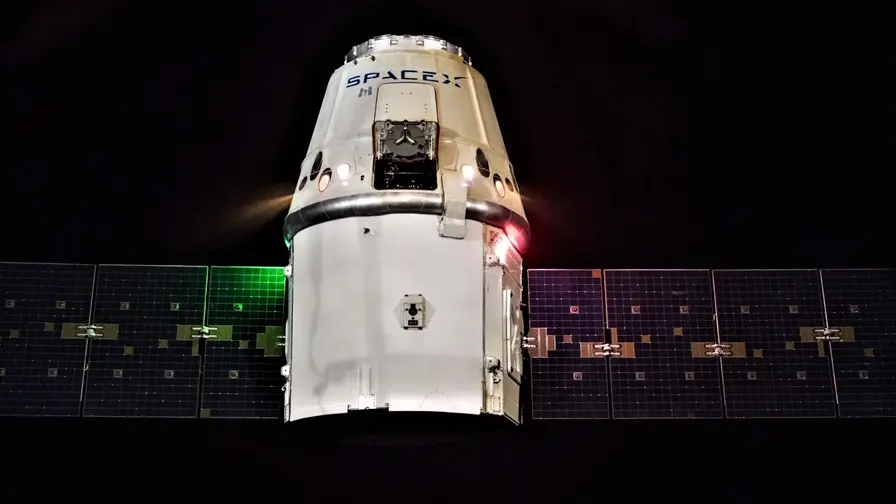
The launch took place at 6:33 a.m. EDT from Space Launch Complex 40 at Cape Canaveral Space Force Station in Florida. This flight was SpaceX’s 35th commercial resupply mission for NASA, ferrying supply pallets, hardware and a suite of science investigations to the International Space Station aboard the Dragon spacecraft. Visibility was unusually broad because of the timing: near-sunrise lighting at high altitude often turns ordinary exhaust plumes into dramatic, reflective displays.
A sky that doubled as a laboratory
The jellyfish effect is straightforward physics dressed in spectacle. At altitude, engine exhaust expands into thinner air. When a launch occurs close to sunrise or sunset, sunlight can still reach those high, translucent clouds while the ground stays dim. The result: a glowing halo and a trailing veil of illuminated vapor that fans out like a bioluminescent creature in slow motion. Short-lived, yes. But visible to millions.
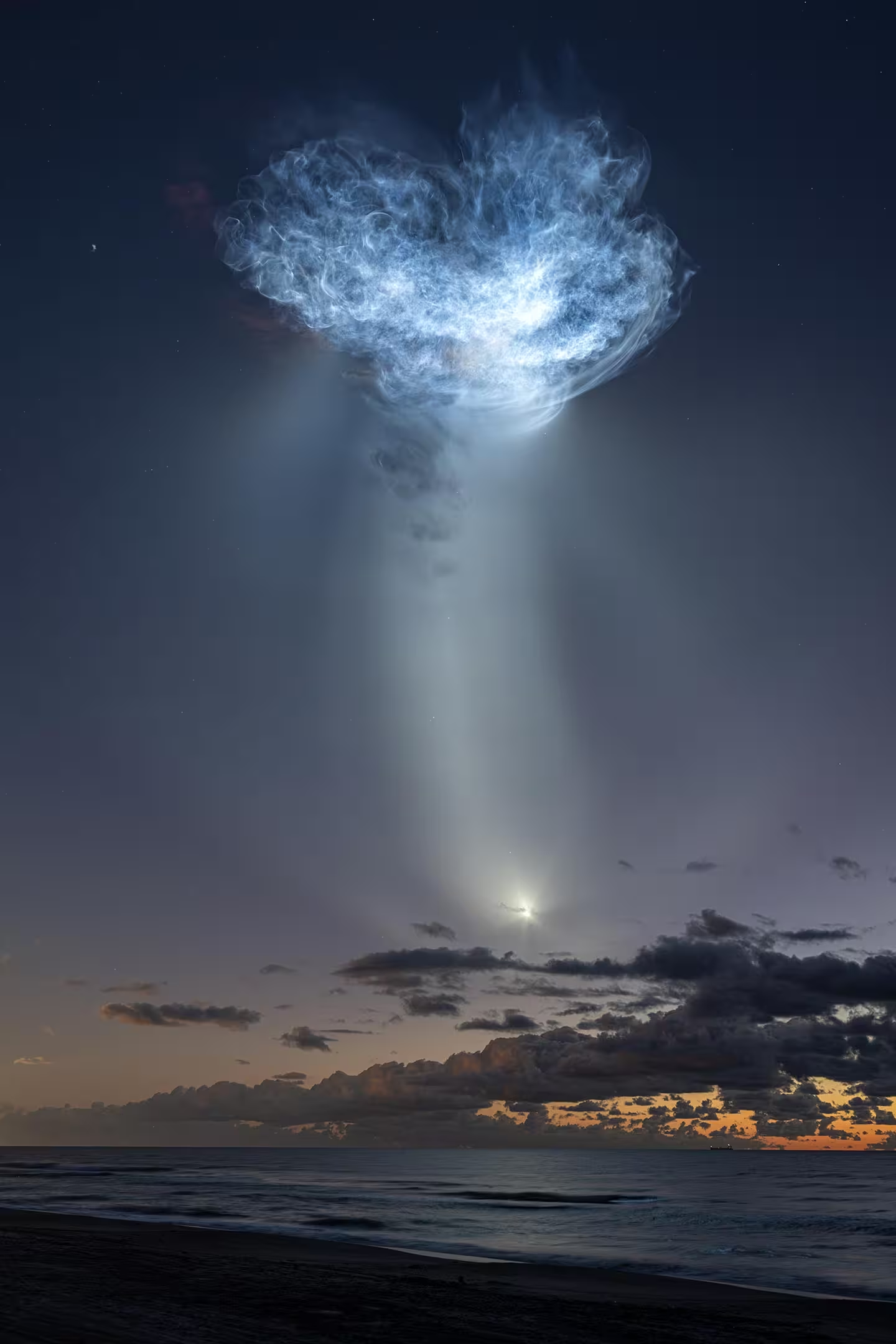
A SpaceX Falcon 9 rocket produced a spectacular glowing “jellyfish” across the morning sky, creating an extraordinary light show visible across the eastern United States. Beyond the dazzling display, the mission carried experiments to the International Space Station that could help scientists restore vision, improve drug testing, and uncover new treatments for brain diseases.
This mission’s cargo matters more than the momentary light show. Among the payloads was the final set of International Space Station Roll-Out Solar Arrays, known as IROSAs. These new panels will be installed on the station later this fall to boost the platform’s power generation, supporting more science and longer operations in low Earth orbit.
Also on board: equipment to manufacture artificial retinas in microgravity, a promising line of research that could one day lead to therapies for degenerative eye conditions on Earth. Microgravity gives cells a different environment to grow in, sometimes forming structures that are hard to replicate in dishes. Another investigation will produce 3D heart tissue models to improve drug testing and reduce reliance on animal models—an important step toward safer, more predictive pharmacology for astronauts and patients alike.
Additional experiments will study how novel glass materials form without the influence of gravity, potentially revealing manufacturing pathways for purer or differently structured materials. Researchers will also send up brain organoids, miniature lab-grown brain tissues that can help scientists study disease mechanisms for conditions such as Alzheimer’s, Parkinson’s and multiple sclerosis.
Visually arresting and scientifically purposeful, the launch captured two truths about modern spaceflight: it can inspire the public in an instant, and it can quietly deliver months or years of laboratory work that may change lives. The jellyfish faded. The experiments remain onboard, beginning their long journey of discovery in orbit.

“The cosmos has always fascinated me. I write about space missions, astronomy, and the technologies pushing humanity beyond Earth.”

Discussion
Leave a Comment
Comments
No comments yet. Be the first.