

The moment you try to make many qubits work together, precision starts to fray. Small phase shifts creep in. Tiny errors multiply. Yet a team at RIKEN and collaborators have found a pragmatic way to keep silicon spin qubits accurate even when several are driven at once—a step that nudges silicon-based quantum processors closer to practical scale.
Silicon-based quantum computers could benefit from a breakthrough in controlling multiple qubits without sacrificing precision.
Why parallel control matters
Quantum bits, or qubits, do things classical bits never could: they hold superpositions and entangle, letting computers explore many possibilities simultaneously. But the advantage vanishes if the operations that manipulate those qubits are unreliable. Real quantum tasks demand many gates running in parallel. That’s where control architecture becomes decisive—especially when you want to build on silicon, the material that underpins modern microelectronics.
Silicon spin qubits encode information in the spin of an electron confined in a silicon device. Engineers nudge those spins with microwave pulses to perform quantum gates. The obvious scaling trick is to share control lines among multiple qubits rather than provide a separate, expensive line to each one. Shared lines save wiring, reduce chip complexity, and align with semiconductor manufacturing practices—but they also introduce cross effects that can derail fidelity when several qubits are driven simultaneously.
How the team tackled the problem
Working with five silicon spin qubits addressed through a single microwave feed, the researchers first pushed device design and pulse shaping to extreme precision. Individually, each qubit achieved single-qubit gate fidelities well above 99.99 percent, with the top performer nudging 99.999 percent. Those numbers already sit in the range required for many fault-tolerant strategies.
But numbers change when qubits operate together. With two or three qubits driven at once, the team’s calibration protocol kept fidelities above 99.99 percent. Drive all five simultaneously and fidelities dropped to around 99.9 percent—still close to the practical thresholds for error-corrected computing, but indicating new error channels to address.
The primary culprit proved to be the AC Stark shift: the microwave control fields slightly alter the effective energy levels of nearby qubits, nudging their quantum phase away from the intended value. Phase matters because quantum operations depend on the precise alignment of wave-like components in a qubit’s state. Left uncompensated, these shifts produce incorrect gate outcomes.
Pairwise calibration: a simple, scalable fix
Rather than calibrating every possible multi-qubit combination—an approach that becomes infeasible as qubit counts grow—the team developed a pairwise compensation scheme. Yi-Hsien Wu, who led the experiment during his doctoral work, explained that the method measures the phase shifts induced between pairs of qubits and builds a correction map from those pairwise interactions.
Think of it as tuning duets instead of every possible chorus. Correct each pair, and the ensemble stays in tune without measuring every permutation. The result: robust parallel control with far fewer calibration steps, making the shared-line strategy more practical for larger arrays.

"By addressing a key source of control errors through pairwise calibration," says Leon Camenzind, who supervised the experiments, "our study supports the use of shared control lines as a practical approach to scaling up quantum processors."
Seigo Tarucha, project lead for the related JST Moonshot effort, adds that reliable parallel control is a core milestone on the road toward a fault-tolerant silicon quantum computer.
Remaining limits and paths forward
Not all errors came from phase shifts. The team identified drive-induced decoherence as another contributor: delivering more microwave power to drive several qubits simultaneously increases unwanted interactions with the environment, shortening coherence times. That effect is distinct from the AC Stark phase shift and will require hardware and design improvements to mitigate.
Possible remedies include refined device geometry, better isolation of control lines, pulse shaping that minimizes off-resonant excitation, and materials or cooling strategies that reduce susceptibility to drive noise. Each option trades complexity against performance, but the pairwise calibration reduces the software-side burden significantly.
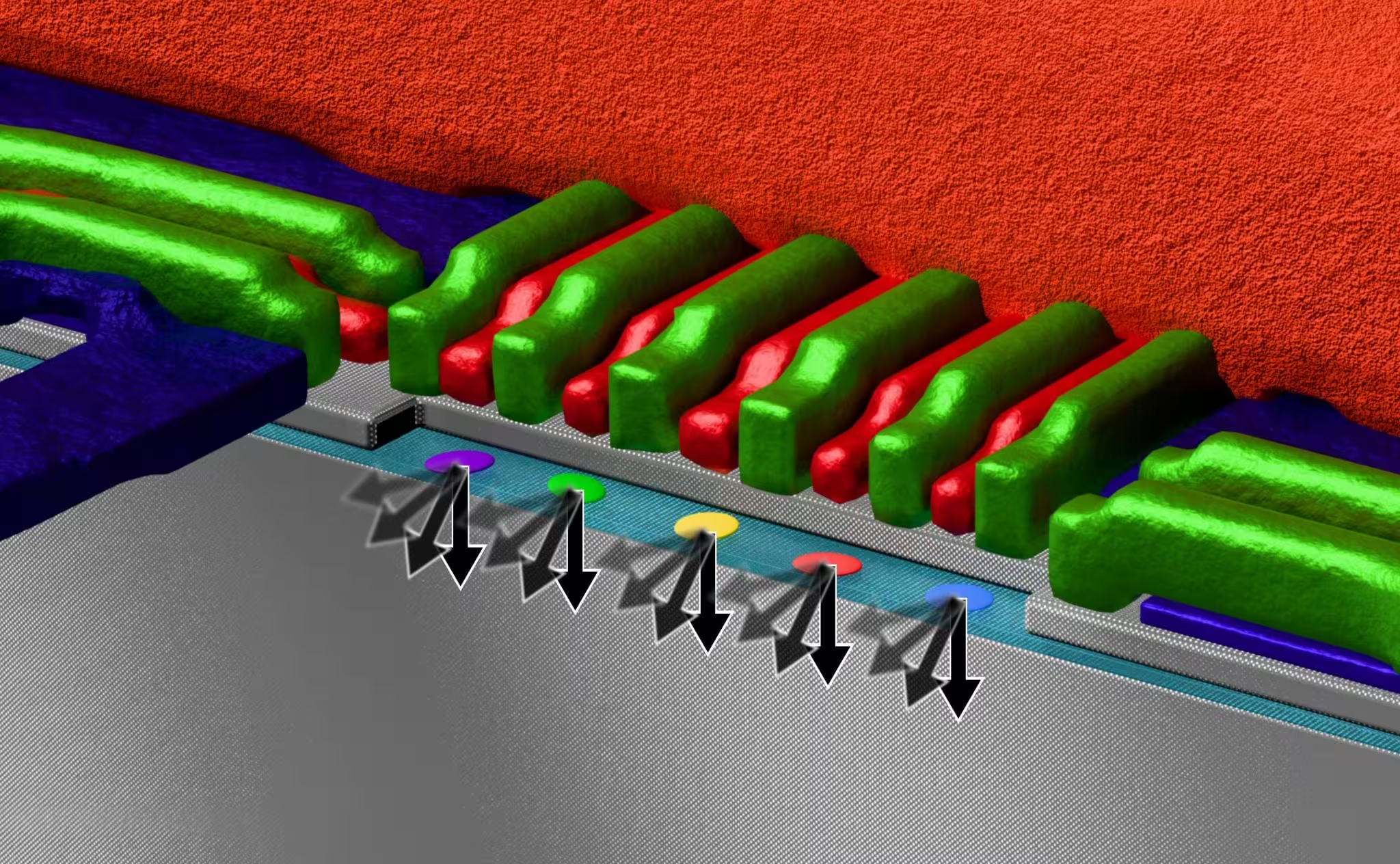
Rendered illustration of five silicon spin qubits controlled in parallel through a shared microwave line.
Expert Insight
Dr. Maya Rodriguez, a quantum systems engineer with long experience in qubit control, commented: "What makes this work compelling is its balance between practicality and performance. Shared control lines are not a theoretical curiosity; they are an engineering necessity if we want million-qubit devices. A pairwise calibration strategy buys you scalability without demanding an explosion of calibration time."
She adds that while decoherence driven by stronger control fields remains a hard limit, incremental gains in pulse engineering and device layout tend to compound: small improvements in coherence and control fidelity today open the door to more sophisticated error-correction layers tomorrow.
Conclusion
The RIKEN team's experiment demonstrates that silicon spin qubits can retain exceptionally high single-qubit fidelity even under parallel drive, and that a targeted, pairwise calibration protocol can compensate a major source of error—the AC Stark shift. The remaining challenges, notably drive-induced decoherence, point to hardware and materials improvements. Together these advances keep silicon on the shortlist for scalable quantum processors that leverage existing semiconductor manufacturing know-how.


“The cosmos has always fascinated me. I write about space missions, astronomy, and the technologies pushing humanity beyond Earth.”

Discussion
Leave a Comment
Comments
No comments yet. Be the first.