
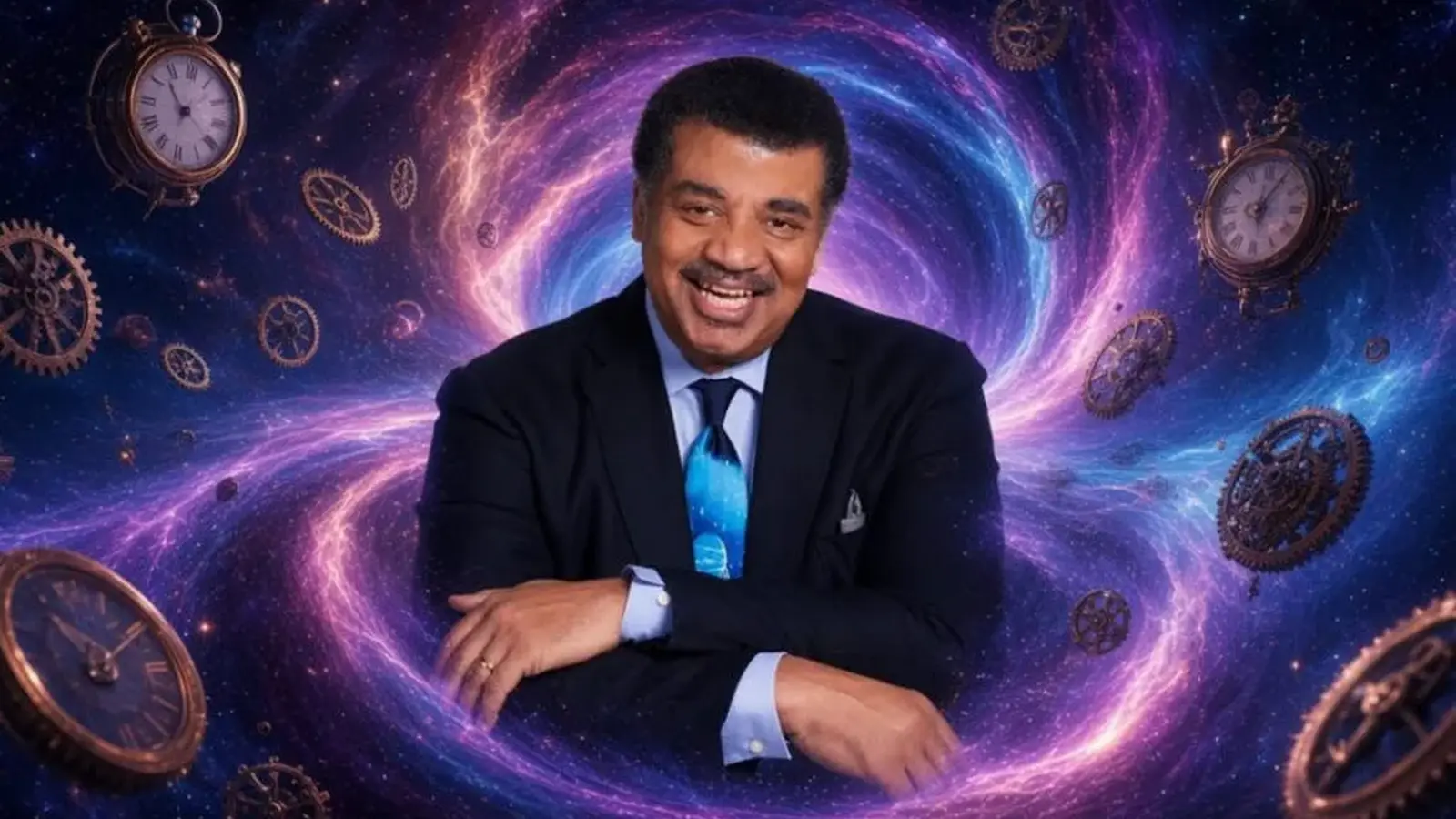
Could you ever visit tomorrow like you hop on a bus? The short answer from Neil deGrasse Tyson: yes—to a degree. But the part that excites science fiction fans remains out of reach: going back.
Time travel to the future is predicted by physics; travel to the past is not.
From a spicy web show to a hard physics lesson
The conversation that sparked headlines happened on Hot Ones Game Night, where Tyson faced off with host Joe Santagato. Asked bluntly whether humans will ever travel in time, Tyson first answered flatly no. Then, pressed on his certainty, he clarified the nuance: physics allows travel into the future, not into the past.
That distinction rests on well-tested ideas from Einstein. Special relativity shows that clocks run slower for objects moving near light speed compared with stationary observers. This is the essence of time dilation. Move fast enough for long enough, and you will age less than people who stayed behind—effectively arriving in their future when you return.
Think of the classic twin paradox: one twin flies on a high-speed journey and returns younger than the sibling who stayed on Earth. It sounds like fiction. It is, however, a measurable prediction confirmed by particle experiments and precise atomic clocks on jet flights. Gravity makes matters even richer: general relativity predicts clocks tick differently in stronger gravitational fields, so climbing a mountain or orbiting Earth changes your personal time slightly.

What physics allows—and forbids
So why can't we go to the past? The reasons are both technical and conceptual. Backward time travel tends to break causality—the rule that effects follow causes. Models that permit closed timelike curves, the mathematics behind loops into the past, either require exotic matter or produce paradoxes that challenge consistent histories.
Popular movies imagine shortcuts through wormholes or advanced machines that flip time like a switch. Tyson points out that cinematic liberties gloss over the enormous theoretical and engineering barriers. Wormholes are speculative and, if they exist, likely unstable. They would demand negative energy densities or other physics we have not observed. Even if one could be stabilized, the causal puzzles remain.
Practically speaking, time travel to the future is limited. Achieving significant time dilation requires velocities or gravitational potentials far beyond current technology. Sending an astronaut to age decades less than people on Earth would need sustained speeds approaching light or proximity to extreme gravity—conditions we cannot yet engineer safely.
Implications and the cultural conversation
Tyson’s exchange also touched on the human side of scientific fame, as he ranked colleagues like Stephen Hawking and Carl Sagan in intelligence—acknowledging Hawking as unparalleled and placing Sagan and others with warmth and respect. The moment blended pop culture, personality, and a sober physics lesson, which is why it resonated.
For science communicators and the interested public, the takeaway is nuanced: relativity makes certain kinds of time travel a real, measurable effect. It is not the time-machine fantasy of novels. The future is visitable in principle; the past, for now, stays in stories.
Conclusion
Time dilation is not magic. It is a consequence of the geometry of spacetime, tested and precise. Until new physics or technologies emerge, humanity’s path through time will remain forward-facing—steady, inexorable, and full of things to discover.

“The cosmos has always fascinated me. I write about space missions, astronomy, and the technologies pushing humanity beyond Earth.”

Discussion
Leave a Comment
Comments (1)
Wait so future travel is real but only tiny clock tricks? sounds cool, but where's the tech roadmap, anyone? feels like scifi with footnotes, hmm