
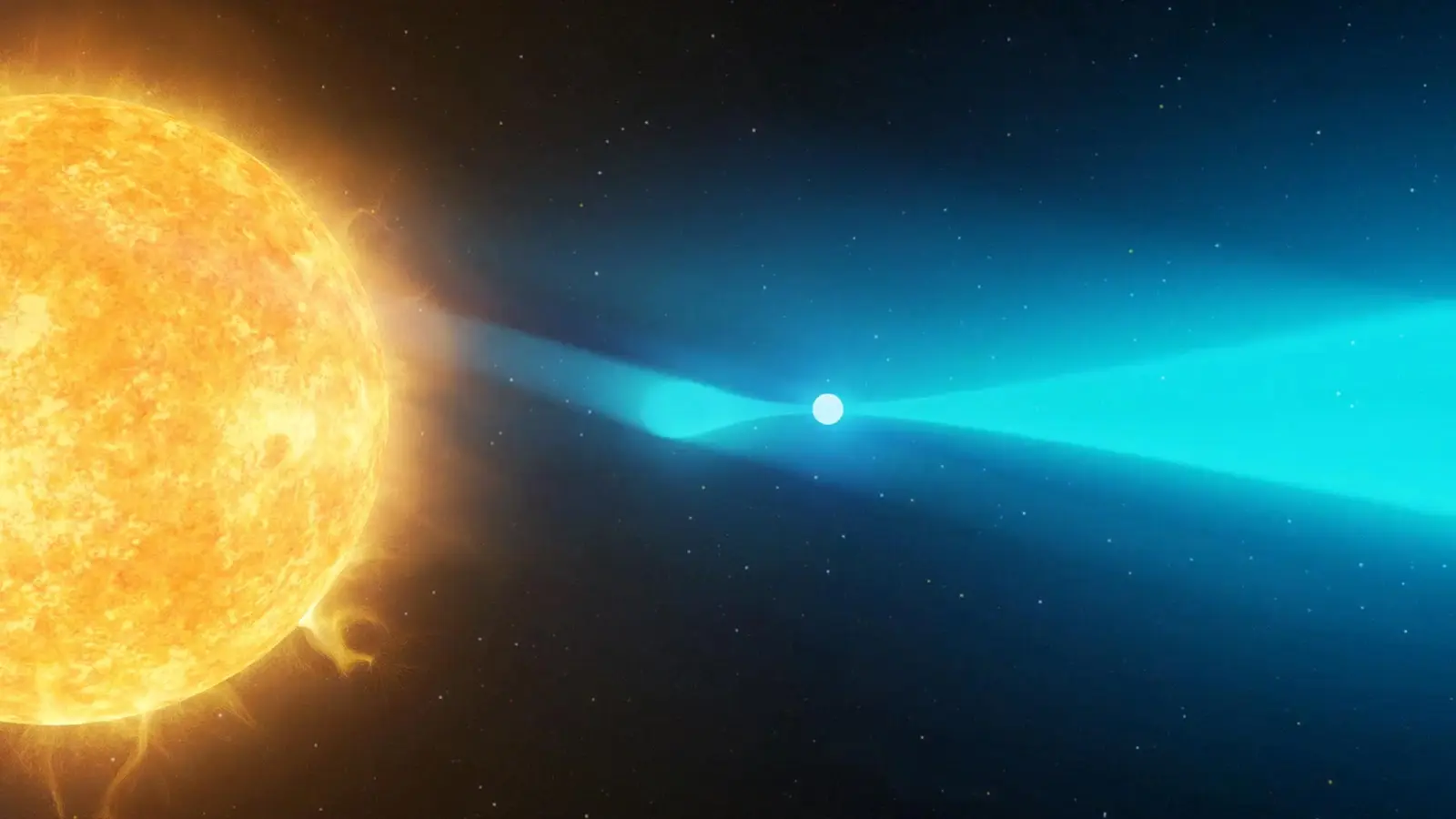
A tiny, dead star that spins every eight minutes has offered astronomers a rare way to eavesdrop on magnetic storms more than 5,000 light-years away. It sounds like science fiction, but radio telescopes are showing how compact remnants can act like cosmic flashlights, carving beams through a companion star's atmosphere and leaving fingerprints in the signals we detect on Earth.
A dead star spinning every eight minutes has led astronomers to a mysterious cosmic partnership, revealing strange radio pulses and enormous stellar storms more than 5,000 light-years away.
The system, catalogued as GPM J071507−114153, contains a white dwarf paired with a star similar to our Sun. What makes this pair extraordinary is not just the white dwarf's frantic spin, but the radio pulses that switch on and off over minutes or hours. These pulses belong to a rare family of sources called long-period transients, or LPTs. Since the first such object was discovered in 2021, astronomers have found only about a dozen, and each one has raised more questions than answers.
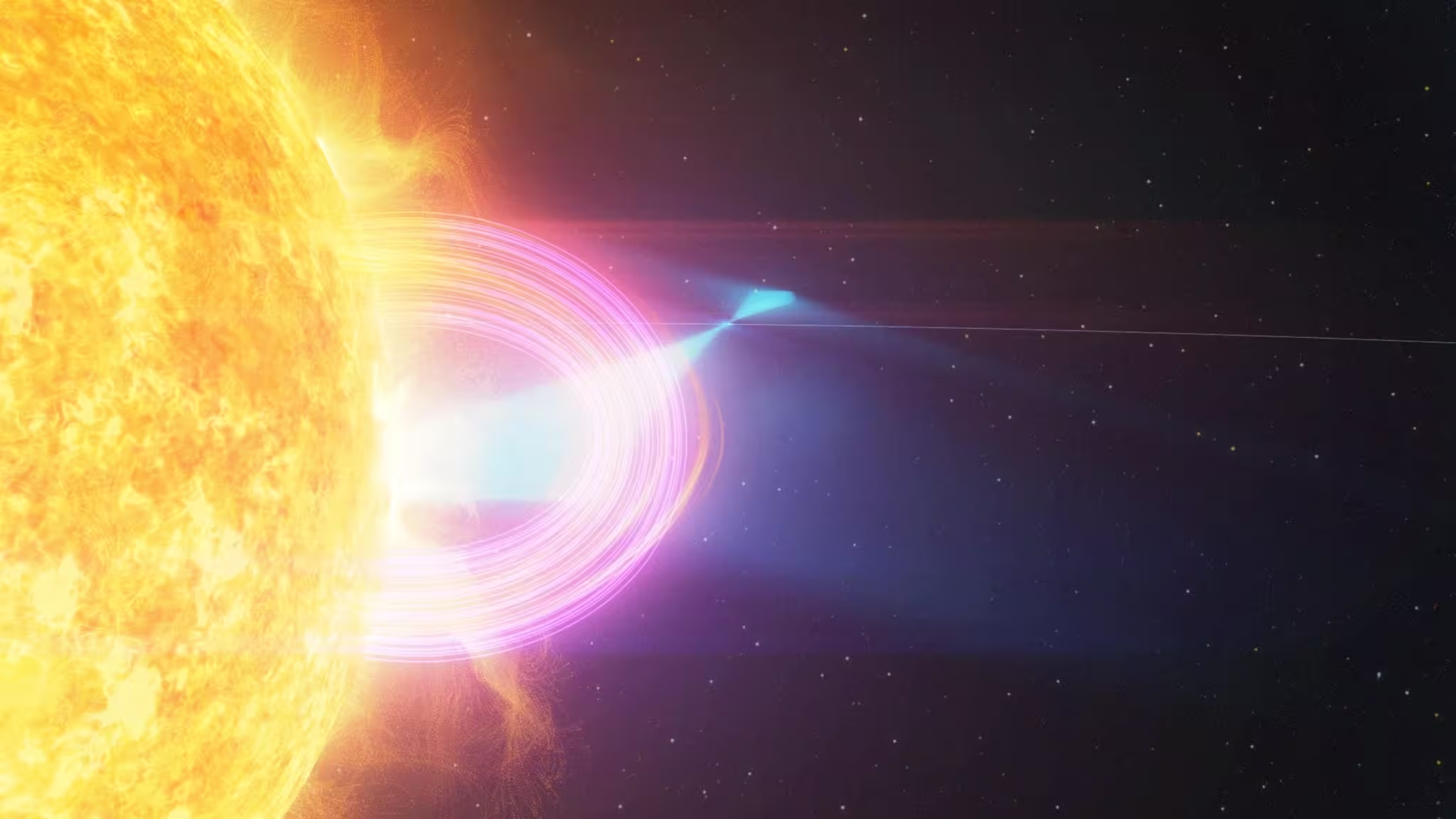
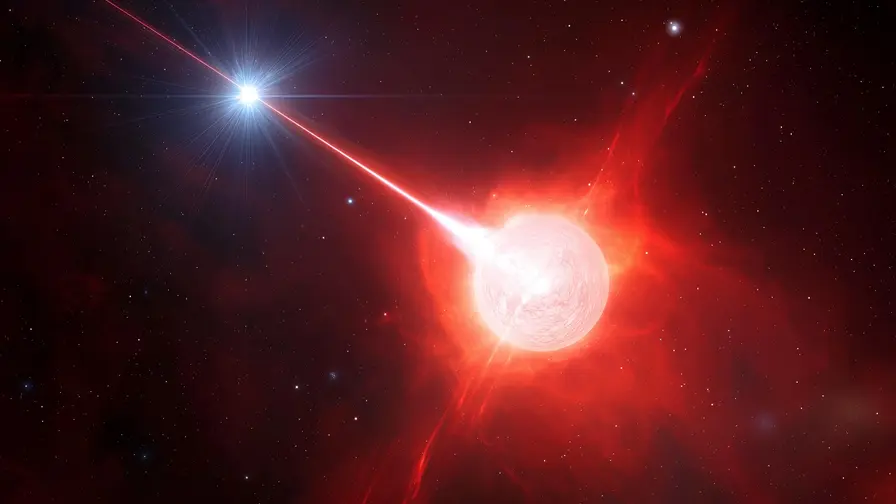
The beams from the white dwarf pass through the other star’s atmosphere, revealing clues about its behavior.
Unmasking the pulsing source
Radio telescopes often find transient signals that refuse to behave. They blink. They wander across the sky. Here, the breakthrough came when the pulses were sharp enough to track motion. By following the timing of the radio flashes, researchers could detect the white dwarf moving in its orbit around the sun-like companion. That movement pins the origin of the pulses to a region very close to, or on, the white dwarf itself.
"This is the first time the pulses are clear enough to see the white dwarf moving in its orbit around its companion, so we know that the pulsations are coming from a region close to the white dwarf, or possibly even from the white dwarf itself," said Dr Sam McSweeney, lead author of the study and a commissioning scientist with the Square Kilometre Array Observatory. The observation transforms speculation into a testable scenario: the compact star is the engine, and its beams sweep through the companion's environment.
Scientists at the Curtin University node at the International Centre for Radio Astronomy Research (ICRAR) have linked mysterious radio pulses to an unusual pairing of stars, a dead star that spins every eight minutes, and a star similar to our own Sun.

Producing that clarity required a lot of telescope time and serious computing. The team processed more than 100 hours of radio observations using the Pawsey Supercomputing Research Centre to extract the timing and Doppler shifts embedded in the pulses. Those shifts reveal orbital motion, and they allowed the team to distinguish the white dwarf's contribution from any activity occurring on the companion star.
Stellar storms mapped across the galaxy
There was a surprise beyond orbital dynamics. As the white dwarf's beam crossed the companion's atmosphere, it passed behind a region with a strong magnetic field, likely a stellar prominence, a large loop of plasma erupting from the star. The interaction imprinted additional structures on the radio signal, effectively exposing magnetic activity on a distant star the way a probe would reveal the inner workings of a weather system.
"As a bonus, we also saw the white dwarf moving behind a region with a strong magnetic field, most likely a 'stellar prominence', which is a large loop of plasma erupting from a star’s surface," explained Associate Professor Natasha Hurley-Walker, a co-author on the paper. "It’s amazing that by using radio wavelengths we can detect the storms on a star over 5000 light-years away."
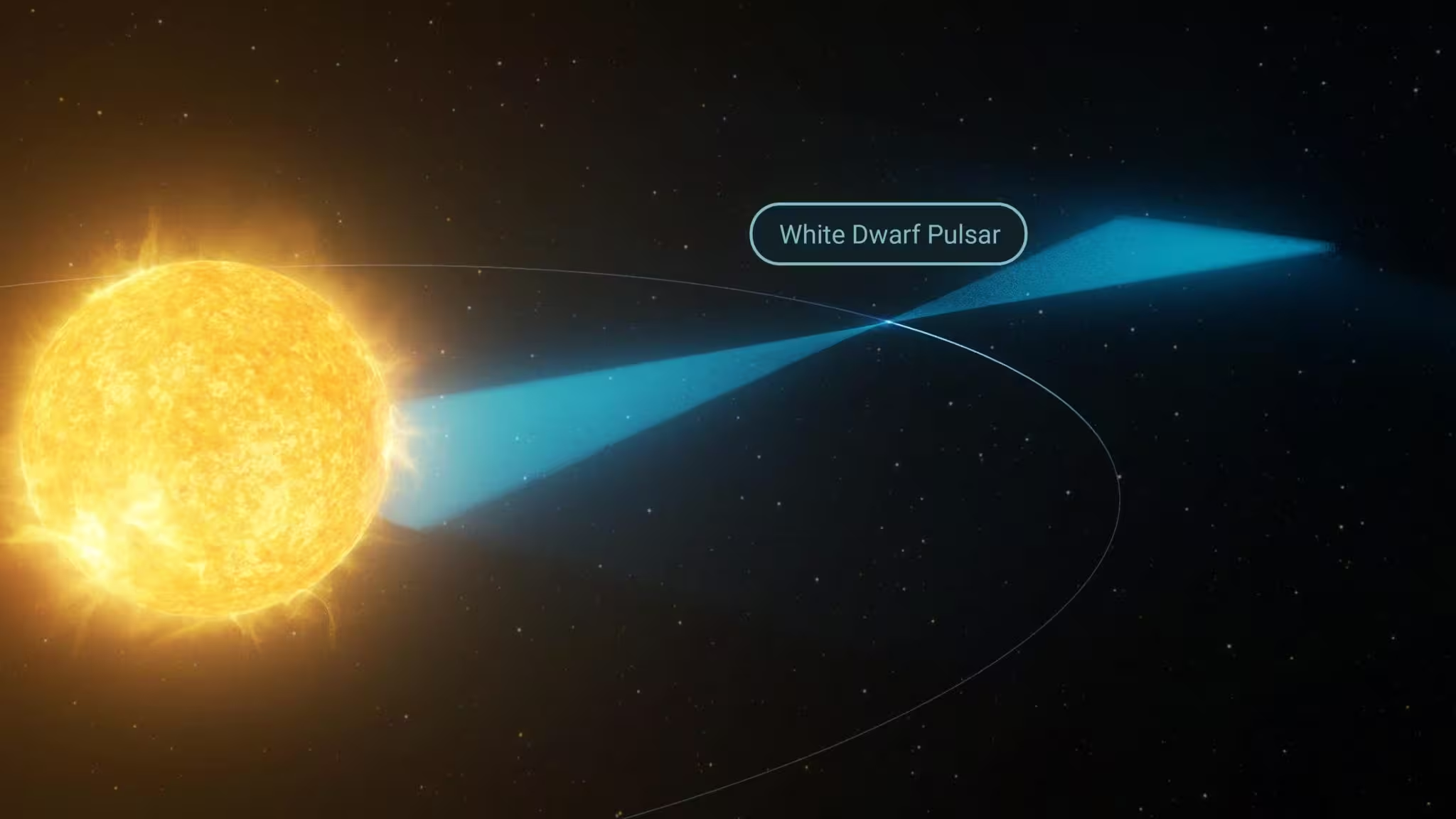
The unusual system consists of a small and highly energetic white dwarf pulsar, orbiting a much larger star similar to our Sun.
Detecting flares and prominences on a sun-like star at such distances opens a new window on stellar magnetism. Traditional optical observations can reveal flares when they brighten the star, but radio observations are sensitive to charged particles and magnetic fields, letting astronomers probe the geometry and strength of the activity. That makes radio surveys a powerful complement to optical and X-ray monitoring when trying to understand how stars—and their potential exoplanets—experience space weather.
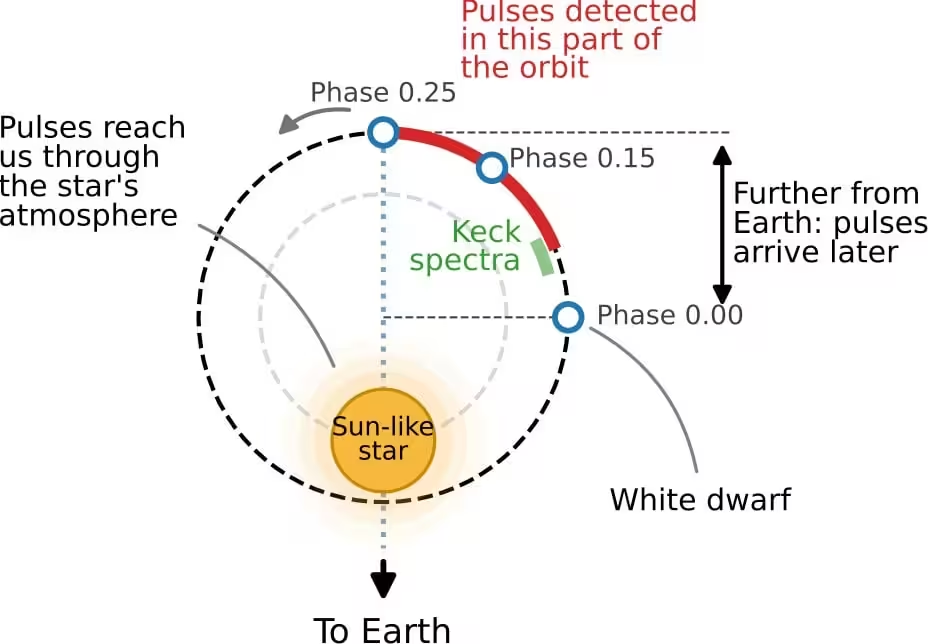
A diagram of the GPM J071507−114153 system, showing how the arrangement of the star system affects the pulses detected from the sky.
Finding this system required the cooperation of several cutting-edge facilities. The initial detection came from the Murchison Widefield Array, a survey instrument that scans vast swaths of the Milky Way. After the MWA flagged the transient signals, the team used MeerKAT in South Africa to localize the source precisely. Optical follow-up with the W. M. Keck Observatory on Maunakea confirmed a G-type companion, matching the broad classification of our own Sun.
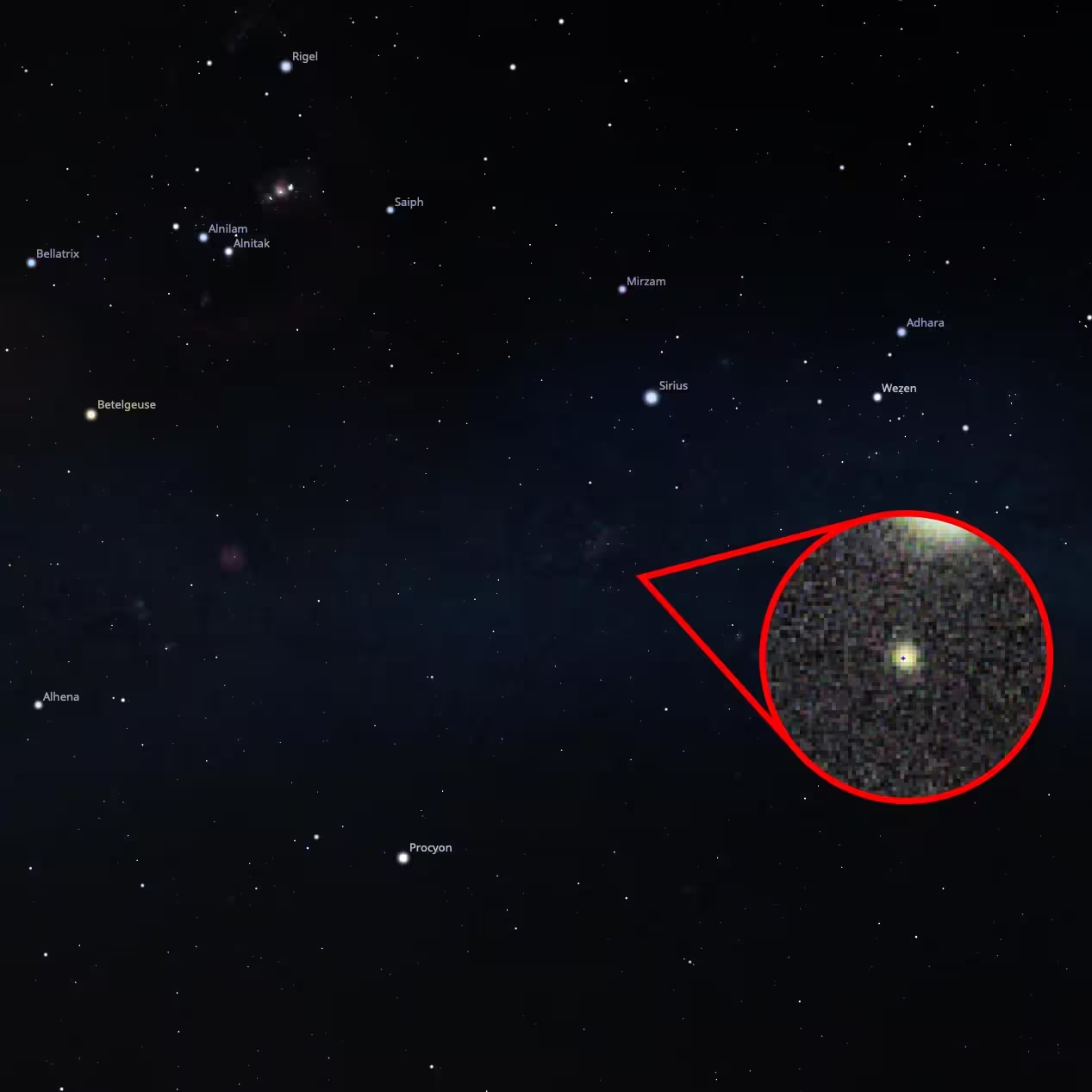
The GPM J071507−114153 system contains a sun-like star, but is too distant to be seen with the naked eye.
Both the MWA and MeerKAT are precursors to the Square Kilometre Array Observatory telescopes being built in Australia and South Africa. If precursors are already yielding discoveries, the extended sensitivity and resolution of SKA-Low and SKA-Mid promise many more finds. We can expect not only a larger census of LPTs, but also richer data on the magnetic environments shaping these signals.
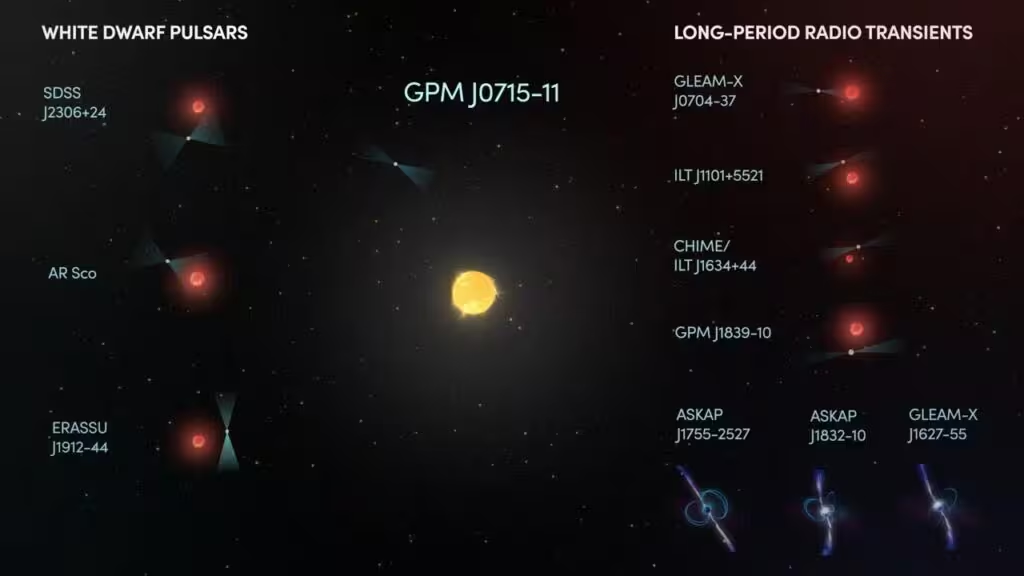
The new discovery joins a growing collection of known Long Period Transients (LPTs), and helps bridge the gap between LPTs and White Dwarf pulsars.
Expert Insight
"This system is a rare laboratory for studying how compact objects interact with ordinary stars," said Dr Maya Chen, an astrophysicist who was not part of the study but has worked on radio transients. "When a white dwarf's beam cuts through a star's magnetosphere, the radio emission carries detailed information about field structure and particle populations. It's like getting both the pulse timing and a magnetic CAT scan at once. With next-generation arrays, we'll be able to apply this approach to many more systems."
Conclusion

GPM J071507−114153 shows that white dwarfs paired with sun-like stars can produce long, structured radio pulses and reveal remote magnetic storms. The discovery narrows down the origins of some mysterious transients, and it demonstrates a technique for studying stellar magnetism across the galaxy. As surveys expand and the SKA comes online, astronomers will likely fill in the missing links between different classes of radio transients, and learn how compact remnants influence, and illuminate, the space weather of faraway suns.

“My work centers on sustainability, energy, and environmental science — examining how innovation can lead to a greener future.”

Discussion
Leave a Comment
Comments
No comments yet. Be the first.