
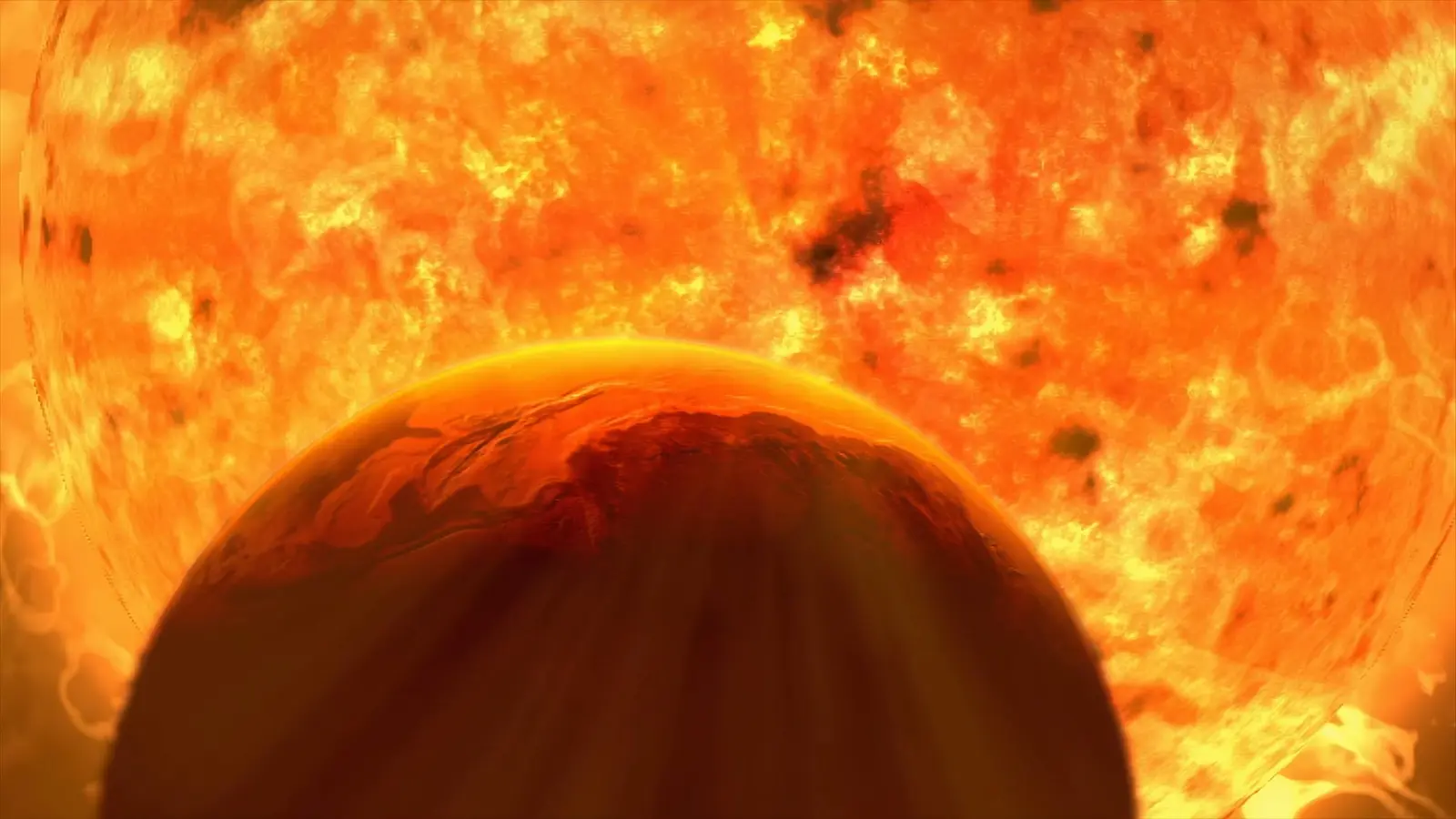
Glass shards orbiting a corpse. That is one way to picture the discovery astronomers have just made around a white dwarf called J1328-1450: two distinct rings of planetary rubble circling a dead star, separated by a sharp, unexpected gap. The pattern is not only beautiful; it carries a message about what happens to planetary systems when their stars die.
What astronomers found and why it matters
Using the European Southern Observatory’s Very Large Telescope in Chile, a team led by Nicola Gentile Fusillo detected a pair of concentric gaseous rings around J1328-1450. The instrument that revealed the structure, X-Shooter, picked up spectral fingerprints that show the rings are made of vaporized planetary material. Instead of a single, flat disc — the familiar signage of a disrupted planetary system — this white dwarf hosts two stable rings with a clean gap between them.
The implication is striking: something is shepherding that debris into two lanes. The researchers propose there are at least two surviving planetesimals — one small, likely asteroid-sized object close in, and a larger body further out, perhaps comparable to Pluto or the Moon. Those survivors would act like traffic cops, clearing and sustaining the empty region between the rings as they orbit the star.
Why should we care? Because white dwarfs are the final stage of stars like our Sun. In a few billion years, the Sun will swell into a red giant, eject its outer layers, and collapse to a white dwarf. Whatever configuration J1328-1450 shows today could be a late-era echo of processes that will one day reshape our own Solar System.
Clues hidden in the chemical soup
The rings are not identical. Spectroscopy reveals calcium, oxygen, magnesium and iron — the usual suspects in rocky planets — but the balance of those elements differs between the two rings. The inner ring is rich in magnesium gas while the outer ring has much less. That compositional split suggests two possibilities: either the debris comes from two distinct parent bodies with different makeups, or the material represents different layers of a single body that was torn apart (for example, crustal material separated from metallic core fragments).
This chemical fingerprinting is a form of planetary archaeology. It lets astronomers reconstruct, in broad strokes, the geology of long-dead worlds: were they differentiated (with separate core, mantle and crust), or were they primitive and undifferentiated? Each answer traces back to formation histories and thermal evolution — stories that once belonged to intact planets and now survive only as gas and dust.
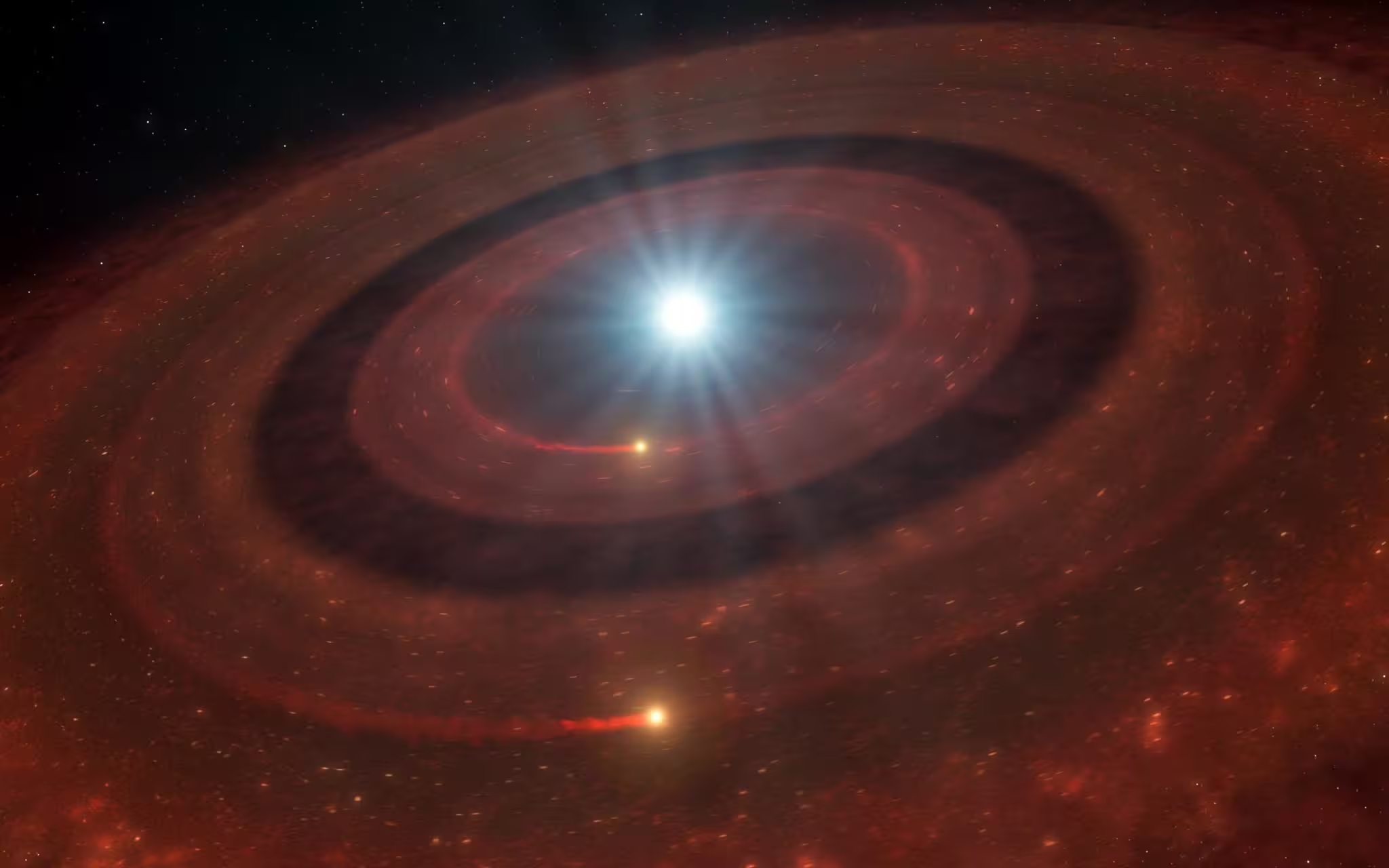
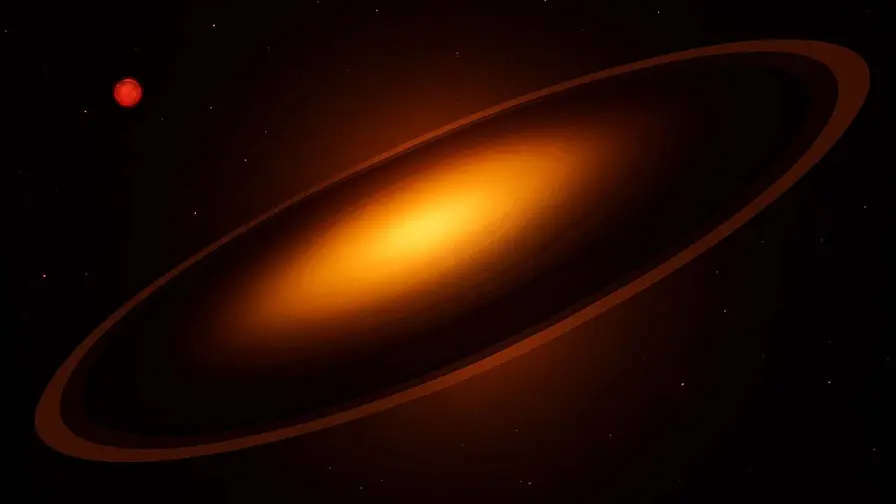
This illustration shows a debris disc around the white dwarf J1328−1450 – the dead core of a star similar to our Sun that expelled its outer layers at the end of its lifetime. The star was suspected to have a planetary system that was vaporized into rubble as the star died, and this debris ended up arranged in a disc like the one shown here.
How such a double-ring system could form
The lifecycle of a Sun-like star explains the first phase. As the star runs out of nuclear fuel, it expands into a red giant and can swallow nearby planets. Bodies that avoid engulfment may be destabilized by shifting gravitational balances and later collide or be shredded by tidal forces when they stray too close to the newly exposed stellar core. The wreckage settles into orbit, gradually forming discs of material.
What remains puzzling is why two separate, stable rings persist rather than diffusing into one. The simplest, and currently favored, explanation invokes shepherding bodies: surviving planetesimals on neighboring orbits that trap debris via resonant gravitational forces. Think of shepherd moons that sculpt Saturn’s rings: their gravity corrals particles into lanes and keeps gaps clear. Here the shepherds are likely far smaller than planets we usually imagine, but they can still exert long-term control over the debris.
Observationally, this system is rare. Most white dwarfs with circumstellar debris show single-disc signatures in their spectra. Detecting a double gaseous disc takes sensitive instruments and a favorable orientation. The VLT’s X-Shooter provided the necessary resolution to tease apart the separate gas components and confirm the gap’s stability.
Expert Insight
"The discovery is a vivid reminder that planetary systems do not simply vanish when their stars die," says Dr. Elena Márquez, a planetary scientist at the University of Barcelona. "Some bodies survive in altered form and continue to shape the dynamical landscape. If anything, these remnants allow us to study planets at a late evolutionary stage we could never otherwise reach."
She adds, "Spectral differences between the rings are a goldmine. They let us infer differentiation and collisional history without sample returns or probes — effectively reading a planet’s autopsy report from light years away."
Broader implications and next steps
Beyond the immediate drama of two rings, the finding informs models of planetary survival and destruction. The stability of the gap constrains the mass and orbit of the putative shepherds, meaning follow-up observations could pin down whether one of them is indeed moon-sized or closer to a small dwarf planet. If confirmed, that would be the clearest evidence to date that reasonably large bodies can survive a star’s death and remain dynamically important.
Future observations in different wavelength bands, higher-resolution spectroscopy, and time-series monitoring will be the logical next steps. Changes in emission lines over months or years could reveal orbital motion, collisions, or further fragmentation. Instruments on upcoming ground-based telescopes and space missions will help test whether double-ring architectures are a rare oddity or an undercounted outcome of stellar evolution.
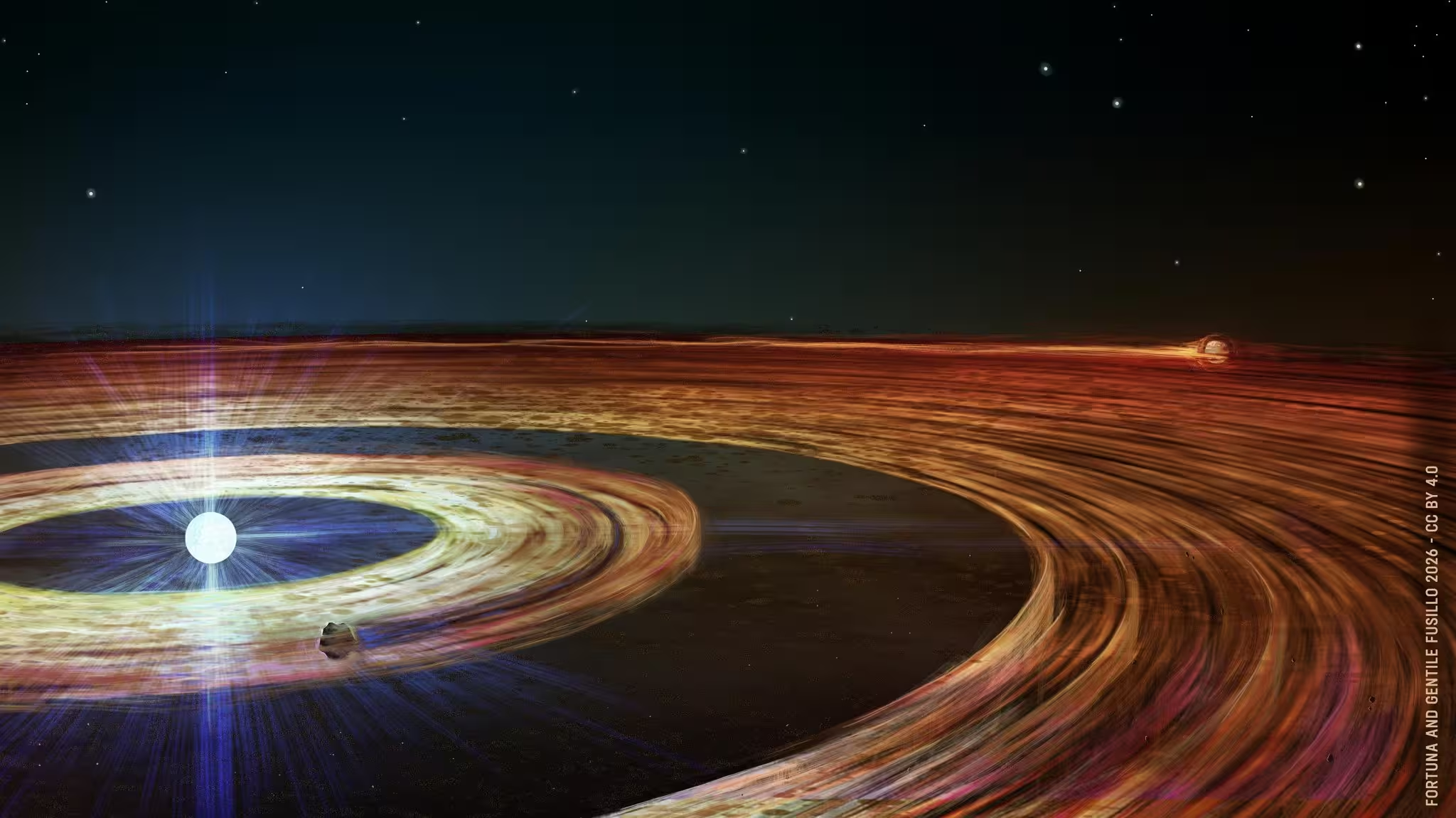
This illustration depicts a disc of planetary debris surrounding the white dwarf J1328−1450, the remains of a Sun-like star that shed its outer layers as it died. The star may once have hosted planets that were destroyed during its final stages, leaving behind vaporized material that formed the disc shown here.
There are also philosophical ripples. The Solar System’s long-term fate is not a single violent tableau but a complex aftermath in which some structures dissolve while others persist and even rearrange. Earth could be swallowed; other objects may survive and later act as sculptors of dust and gas. What we see around J1328-1450 is a preview — messy, beautiful, and scientifically rich — of planetary systems in their late stages.
Observations like these turn distant light into a narrative: of formation, of destruction, and of the stubborn persistence of structure in an otherwise chaotic ending.

J1328-1450’s twin rings teach us that a stellar death can leave behind an organized, long-lived architecture rather than mere chaos. The discovery opens a new window onto the endgame of planetary systems and gives astronomers a living laboratory to study the chemical and dynamical remnants of worlds long gone.

“My work centers on sustainability, energy, and environmental science — examining how innovation can lead to a greener future.”

Discussion
Leave a Comment
Comments (3)
Feels a bit overhyped, tbh. Cool that moonlet shepherding could work, but need multi-epoch obs to prove orbital motion. if that pans out, neat.
Wait… is this even true? Could the spectra be misread, or is there really a shepherd body clearing the gap? hmmm
wow, that image of glass shards orbiting a corpse really hit me. eerie and beautiful, like cosmic archaeology. kinda poetic, no?