
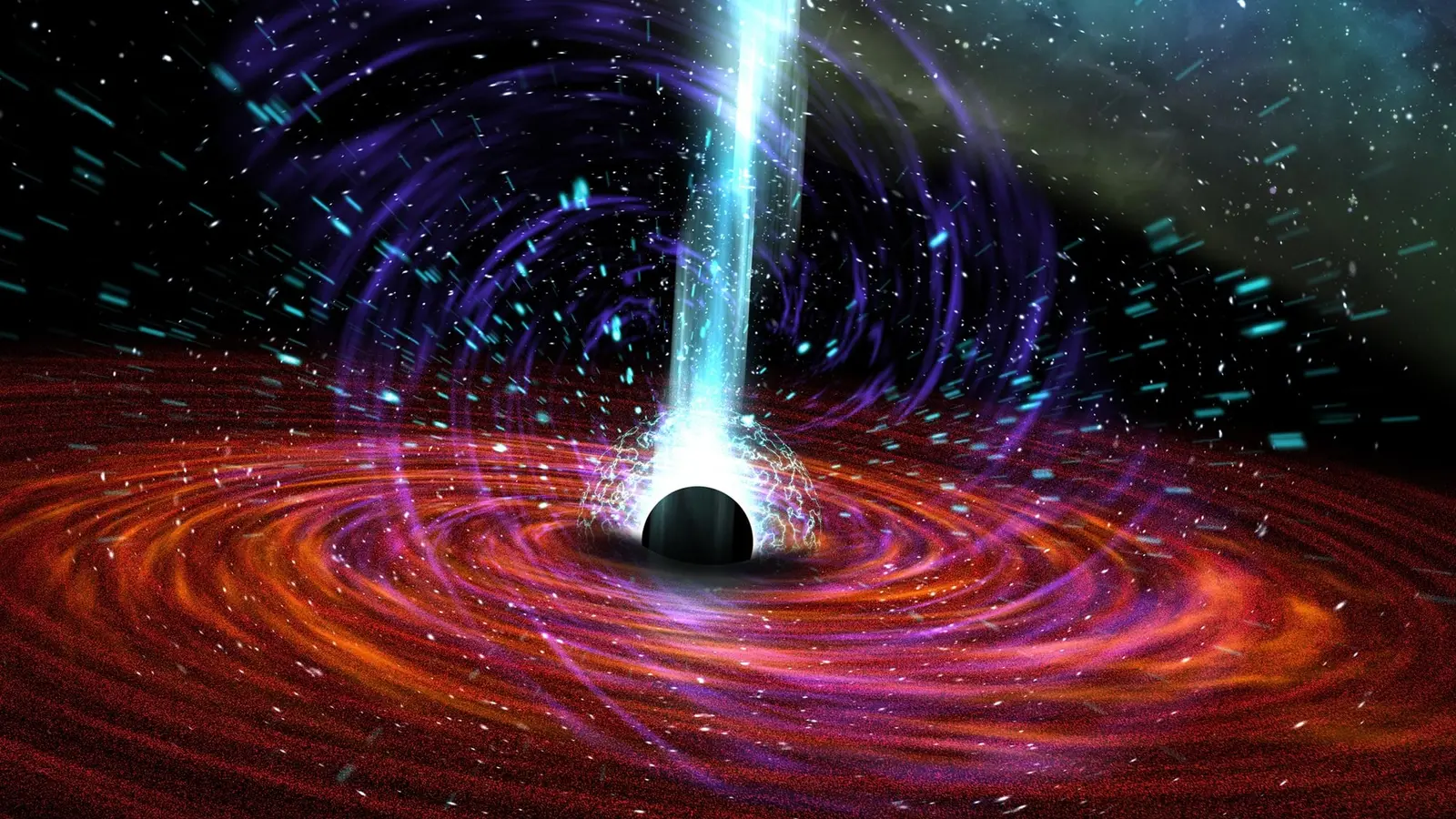
Imagine a region so hot that atoms lose their identity, yet so confined that magnetic fields can be twisted like elastic bands. Close to some supermassive black holes, that is precisely what astronomers are finding: a compact, superheated plasma that seems to help launch jets moving at nearly the speed of light.
For decades, the coexistence of two extreme behaviors has puzzled researchers. Some black holes gorge on gas, building bright, cold accretion disks. At the same time, those same systems sometimes power narrow, razor-bright jets of plasma that stream into intergalactic space. Standard theory suggests these states are hard to reconcile. A thin, cold disk should choke off the magnetic structures thought necessary for a powerful jet. Yet nature often refuses to be tidy.
New coordinated observations of the active galaxy 3C 120 offer a plausible way out of that contradiction. By marrying sharp X-ray spectroscopy with ultra-high-resolution radio imaging, researchers have traced a transition region where a cold disk gives way to a hot, turbulent flow. That inner, superheated zone appears to be the birthplace of the jet.
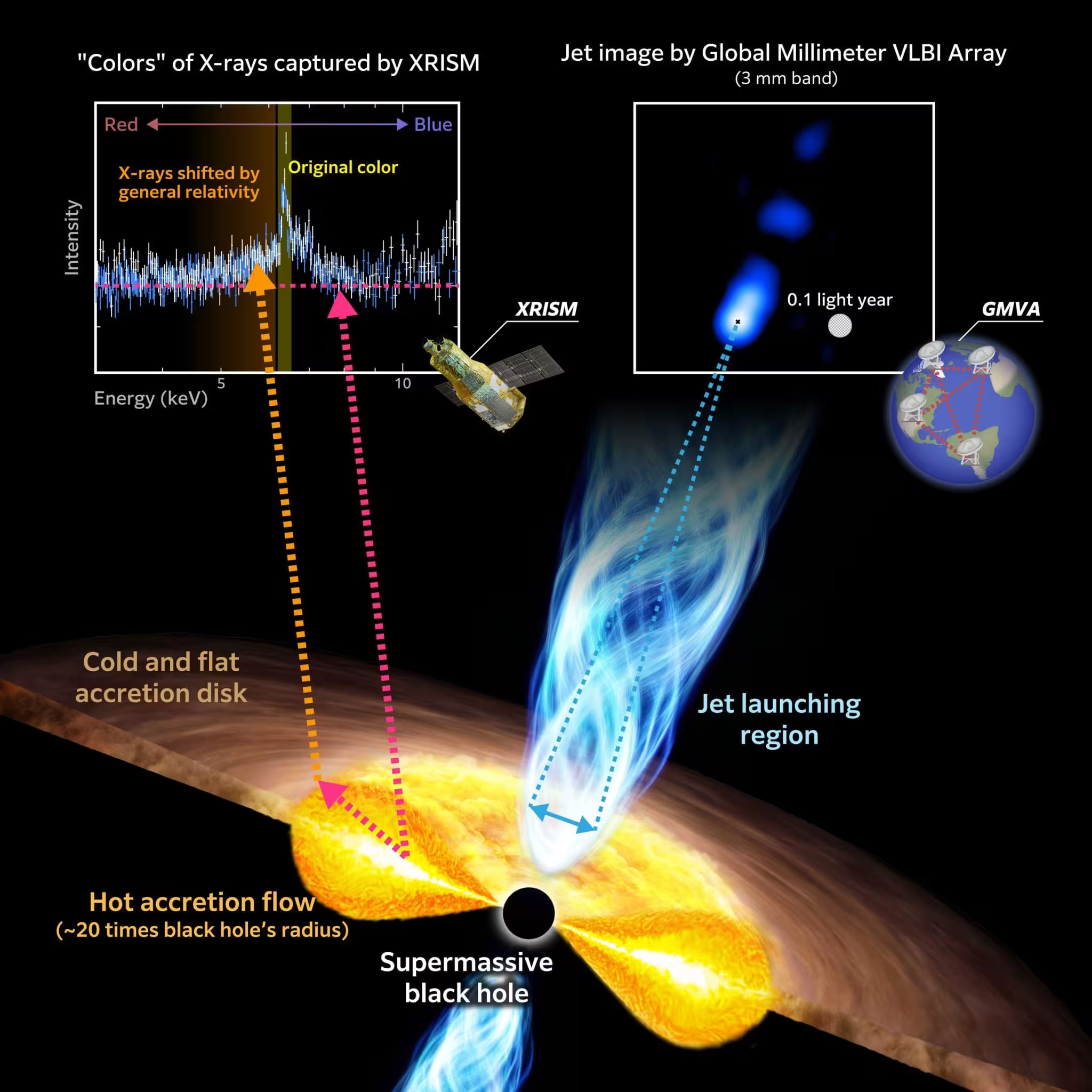
The “color” of X-rays from the vicinity of the black hole, precisely measured by the X-ray astronomical satellite XRISM. The wavelengths are stretched, and the colors are changed due to general relativistic effects. (Top Right) An image of the jet obtained by the Global Millimeter VLBI Array at a wavelength of 3 mm. (Bottom) An artist’s impression of the environment around a rapidly feeding supermassive black hole. The cold, flat accretion disk truncates at roughly 20 times the black hole’s radius, transitioning into a hot accretion flow inside of which the jet is launched.
The “color” of X-rays from the vicinity of the black hole, precisely measured by the X-ray astronomical satellite XRISM. The wavelengths are stretched, and the colors are changed due to general relativistic effects. (Top Right) An image of the jet obtained by the Global Millimeter VLBI Array at a wavelength of 3 mm. (Bottom) An artist’s impression of the environment around a rapidly feeding supermassive black hole. The cold, flat accretion disk truncates at roughly 20 times the black hole’s radius, transitioning into a hot accretion flow inside of which the jet is launched. Credit: Tohoku University
A superheated inner zone revealed
The study focused on the central engine of 3C 120, a well known active galaxy. Using data from the X-Ray Imaging and Spectroscopy Mission, XRISM, scientists examined the profile of iron emission lines produced by material orbiting close to the black hole. Gravity near the event horizon shifts and broadens these X-ray features, imprinting a signature that reveals how far inward the cold, dense disk extends. The result was striking: the thin, cold disk does not reach all the way to the black hole. Instead, its inner edge appears to lie at about 20 times the black hole’s radius.
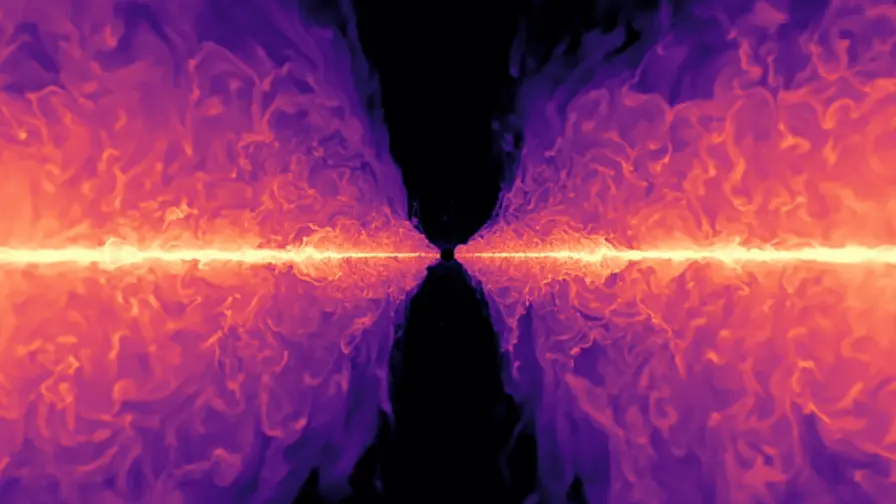
Inside that radius, the environment changes dramatically. The disk is replaced by a hot accretion flow, a volume of plasma heated to hundreds of millions of degrees. In such a regime electrons and ions are decoupled, pressure becomes dominated by thermal motion and magnetic turbulence can flourish. Heat. Chaos. Motion. All the ingredients for reorganizing magnetic fields are present.
How do we know the disk is truncated? The iron line acts like a clock and a ruler at once. Its shape encodes orbital velocities, gravitational redshift, and relativistic beaming. By fitting the line with models that include Einstein’s general relativity, the team inferred a clear departure from a continuous cold disk. That departure is the smoking gun for an inner hot flow.
Where the jet takes shape
X-ray diagnostics tell half the story. The other half comes from radio telescopes that can resolve structures mere light-days across in a galaxy millions of light-years away. The Global Millimeter VLBI Array, the Very Long Baseline Array and the East Asian VLBI Network were combined to image the jet at millimeter wavelengths. This very long baseline interferometry traces the jet down to surprisingly small scales and connects its narrow, accelerating spine to the region identified as the hot accretion flow.
What emerges is a coherent picture. The jet’s collimation and initial narrowing line up with the edge of the cold disk and the start of the hot flow. In other words, the launching site appears embedded within the superheated plasma rather than anchored in a cold, thin disk. That location is crucial because hot flows can sustain stronger, more vertically extended magnetic fields than do thin disks.
Magnetic fields are the likely piston. Twisted and amplified, they can tap rotational energy from the black hole itself or from the inner accretion flow and channel that energy into a focused, relativistic outflow. This is broadly consistent with mechanisms proposed in theoretical work, including the magnetic extraction of spin energy, but the observations stop short of proving the engine’s exact wiring. They do, however, demonstrate that the physical conditions needed for such magnetic engines are present in 3C 120.
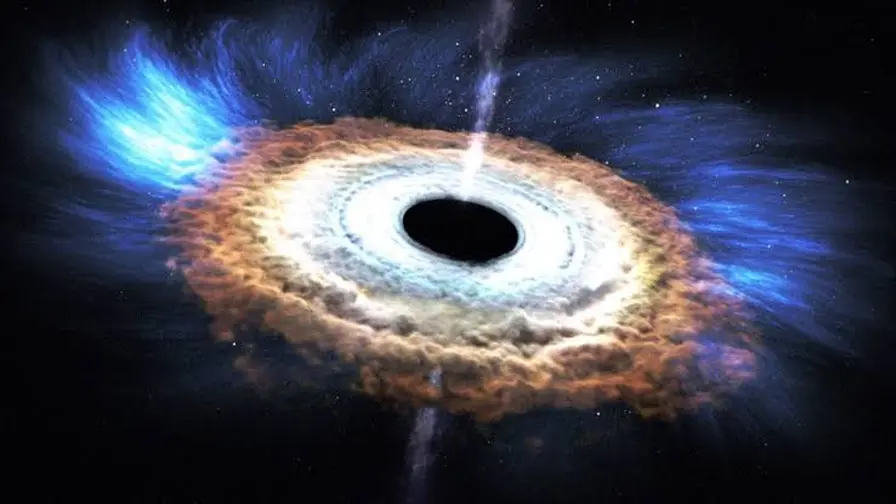
That matters because it offers a natural explanation for a stubborn observational fact: some black holes can eat rapidly and still drive intense jets. If the inner region transitions to a hot plasma that permits large-scale magnetic structures, accretion and jet production can coexist.
Testing the idea across the population
The team behind this result is not pausing for celebration. Coordinated campaigns are underway to repeat the XRISM plus VLBI approach on other systems, including a more massive black hole where timescales and gravitational scales differ. Parallel efforts will compare these empirical maps to magnetohydrodynamic simulations, which can follow how plasma and fields behave in strong gravity.
Why is this agenda important beyond academic curiosity? Jets influence their host galaxies. They heat and displace gas, regulate star formation, and sculpt the circumgalactic medium. Understanding how jets are launched therefore connects microphysics near horizons to the macroscopic evolution of galaxies and clusters.
Expert Insight
Dr. Maya Santos, an astrophysicist who studies black hole accretion at the University of Cambridge, commented on the findings: "These observations are a rare, direct link between the X-ray emitting plasma and the millimeter-scale jet. Seeing the cold disk truncate where the hot flow and jet begin gives us an observational foothold to test jet-launching models. It does not yet tell us every detail, but it narrows the options and points theory in a productive direction."
Conclusion

The emerging picture from 3C 120 is both elegant and practical. A truncated cold disk, replaced inwardly by a superheated plasma, creates a physical environment where magnetic fields can be amplified and organized to launch a relativistic jet. This arrangement reconciles rapid accretion with powerful outflows and offers a template to examine other active galaxies.
With XRISM continuing to deliver high-fidelity X-ray spectra and global radio arrays sharpening their views of jets, astronomers now have the tools to test whether 3C 120 is an archetype or an outlier. Either answer will reshape our understanding of how black holes feed and how they influence the Universe around them.

“The cosmos has always fascinated me. I write about space missions, astronomy, and the technologies pushing humanity beyond Earth.”

Discussion
Leave a Comment
Comments
No comments yet. Be the first.