
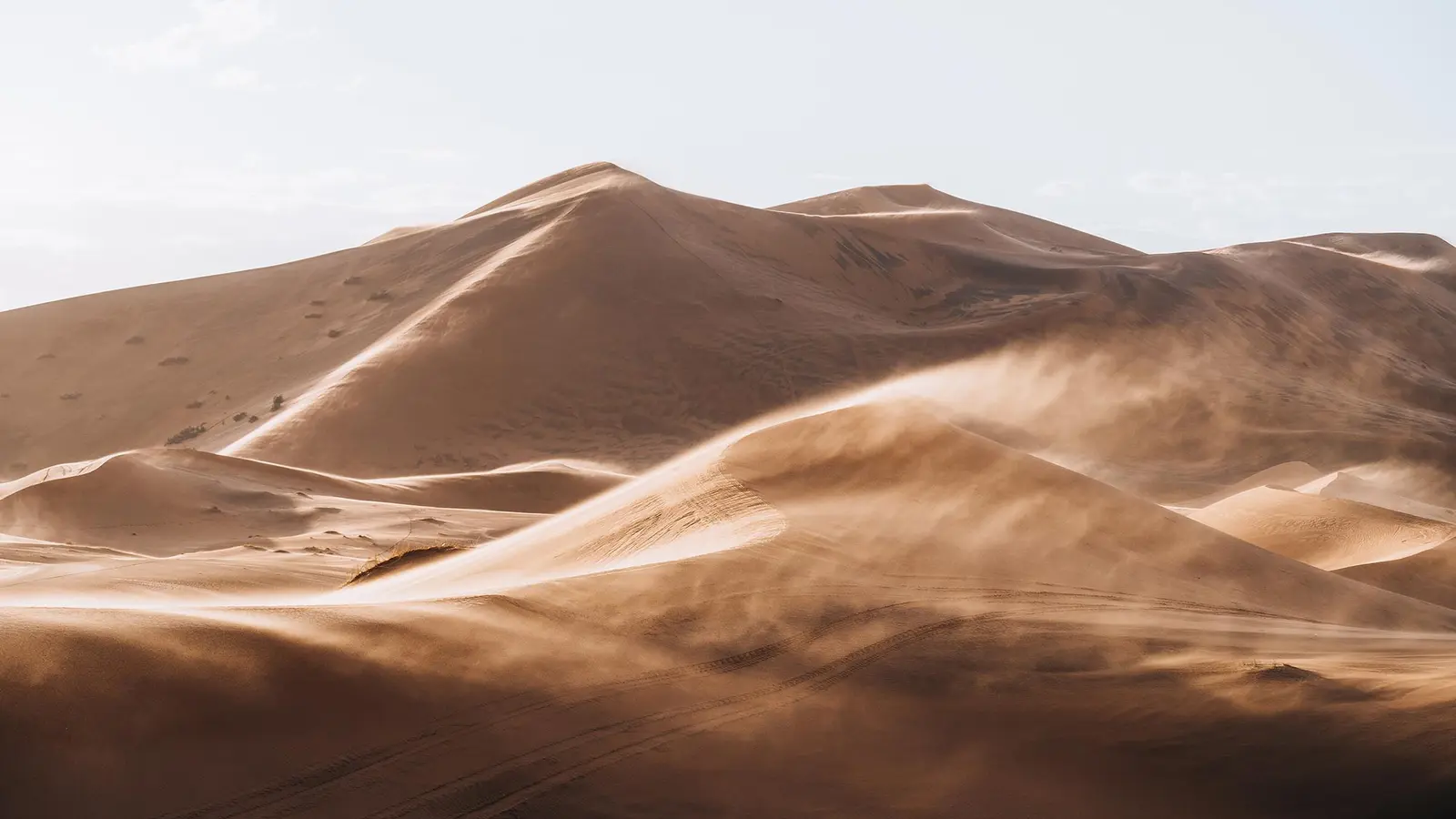
Hold a handful of desert sand and you might be gripping a record of ancient storms. Tiny grains—each a few hundred micrometers across—carry clues about the air that once rushed over them. New research shows that grain size and the winds that sculpt dunes are more tightly linked than scientists suspected, offering a practical method to estimate wind speeds from sediment preserved for billions of years.
How a grain of sand becomes a weather archive
Dunes tell us direction. Patterns reveal persistence. But speed has been the missing variable. Scientists at Stanford set out to change that. They analyzed decades of wind records and matched them to measured sand sizes across dozens of dune fields, then compared those Earth-based relationships with observations from Mars. The result: dune-building winds are typically only a bit stronger than the minimum needed to nudge grains into motion. That modest excess, repeated over time, does most of the work in moving sand and building dunes.
The physical idea is simple in principle. Larger grains require stronger gusts to move. Smaller grains move at lower wind speeds. If a dune field receives many winds barely above the movement threshold, the sediments that dominate that landscape will reflect that threshold. Over long stretches, the median grain size becomes an indirect measure of the wind strengths that mattered most for shaping the surface.
Testing the idea across deserts and planets
To test the hypothesis, the team led by Colin Marvin examined 30 years of wind observations and sand samples from 24 dune fields worldwide, from Utah’s Coral Pink to Namibia’s ancient horsehair landscapes. At each site they identified which wind speed transported the most sand cumulatively. Across the diverse environments, that dominant transport speed tracked closely with median grain size and sat only slightly above the critical threshold required to initiate motion.
Hundred-meter-tall longitudinal dunes spaced approximately 2 kilometers apart in the Namib Sand Sea near Sossusvlei, Namibia, in October 2025.
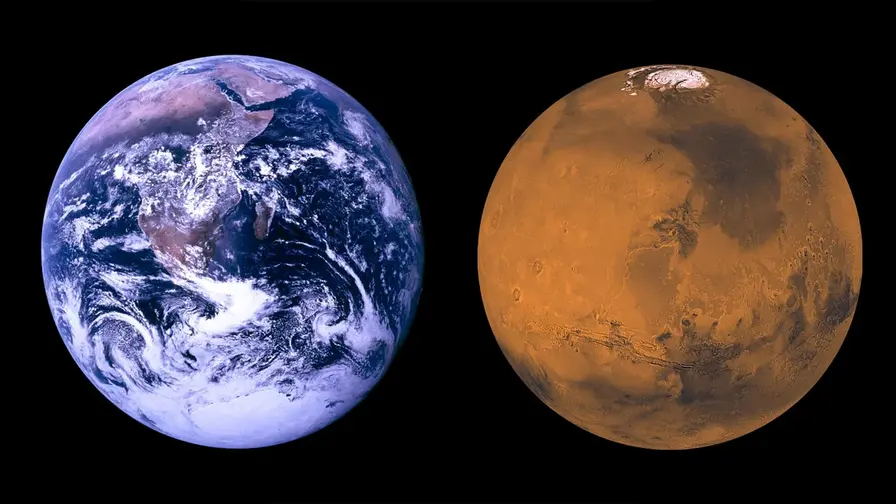
Then came the Martian test. Measurements from a Martian dune field show the same relationship between grain size and the winds that do the bulk of the transport, despite Mars’s thin air, lower gravity, and different sediment properties. That similarity points to a basic, cross-planetary process: when loose sediment is abundant and strong winds are progressively rarer, dunes record the modestly above-threshold winds most of all.
"Since then, nobody’s really looked at this idea, even though it’s really powerful because it tells you something about the environmental conditions that formed the dune fields that we see on not just Earth and Mars, but on a variety of other planetary bodies," Marvin said, reflecting on the trajectory from hypothesis to empirical test. Mathieu Lapôtre, senior author and associate professor at Stanford’s Doerr School of Sustainability, added, "It works for modern dunes and for sandstones dating back three billion years." The study was published November 16 in Proceedings of the National Academy of Sciences and received support from a National Science Foundation CAREER grant.
What this means for paleoclimate and planetary science
The practical implications are immediate. Sedimentary rocks preserve grain size distributions far longer than the atmospheric conditions that made them. If median grain size reliably encodes dominant transport winds, geologists gain a new lever to estimate paleo-wind regimes. That helps test models of atmospheric circulation during intervals when Earth’s atmosphere differed strongly from today—times of higher greenhouse gas concentrations, different continental arrangements, or even extreme volcanic episodes.
On Mars, where direct measurements are scarce and ancient climates are hotly debated, this relationship offers a fresh constraint. It lets researchers use preserved dunes and sandstones to infer not just wind direction or frequency but the characteristic strengths of winds that were common when those sediments were mobile. In other words: the rock record can now speak more precisely about the winds that once blew on other worlds.
Expert Insight
"This is the kind of work that tightens the link between field observations and planetary models," said Dr. Aisha Banerjee, a planetary scientist at the University of Oxford who was not involved in the study. "It gives numerical teeth to what used to be qualitative. Grain size is a simple measurement. Using it to infer dominant wind speeds makes paleoclimatic reconstruction more quantitative and testable."
Banerjee emphasized that the method depends on an environment where sediment supply is ample and extreme winds are rare. "Where those conditions don’t hold, caution is necessary. But where they do, this becomes an elegant, low-tech proxy with high scientific payoff," she added.
Conclusion
Sand grain size is proving to be more than a trivial detail of desert scenery. It is a readable imprint left by the winds that shaped dunes, preserved across geological time and across planetary boundaries. By linking grain size to the winds that do most of the transporting—those just above the threshold of motion—researchers open a new path to reconstructing ancient wind regimes on Earth and Mars. That path will help refine climate models, test ideas about ancient atmospheres, and deepen our understanding of how planetary surfaces and atmospheres have co-evolved.

“The cosmos has always fascinated me. I write about space missions, astronomy, and the technologies pushing humanity beyond Earth.”

Discussion
Leave a Comment
Comments (2)
Interesting idea but is median grain size really reliable when sediment supply varies? If supply isn't abundant, what then? Mars data sounds cool but maybe noisy, tbh.
wow didn't expect sand to be a time capsule. kinda gives dunes a voice, eerie but cool. if rocks can whisper wind speeds… mind blown