
A pattern emerged slowly, across hospitals and continents: infants born with profound brain abnormalities, seizures that began before they reached a month old, and families left with questions that no test could answer. For some parents, the tragedy repeated. For clinicians, the cause remained hidden until a multinational genetic detective story brought clarity.
How five families sketched the outline of a new disease
Researchers first noticed a common thread when genomic clinics in Saudi Arabia flagged several unrelated infants who shared strikingly similar brain imaging and severe neurologic symptoms. Collaboration widened the search. Cases from Europe and North America matched the pattern. The unifying signal was a change in the same gene, VPS25.
When rare disorders are at stake, a single family rarely tells the whole story. Pull enough cases together and the invisible becomes visible. Professor Fowzan Alkuraya, the clinical genetics lead on the study, explained that linking clinical records with genomic databases across borders revealed a pattern that individual clinics could not see alone. That global stitchwork turned isolated tragedies into a recognizable syndrome.
What VPS25 does, and how its disruption damages the developing brain
VPS25 is not a household name, but in every nerve cell it helps manage how cellular cargo is sorted and dispatched. Cells package proteins and other molecules into tiny membrane-bound vesicles. These vesicles ferry material within cells and send messages to neighboring cells. Lab experiments at King Abdullah University of Science and Technology showed that mutations in VPS25 alter both the number and the contents of those vesicles, producing missing or malformed protein cargo critically involved in nerve-cell maintenance.
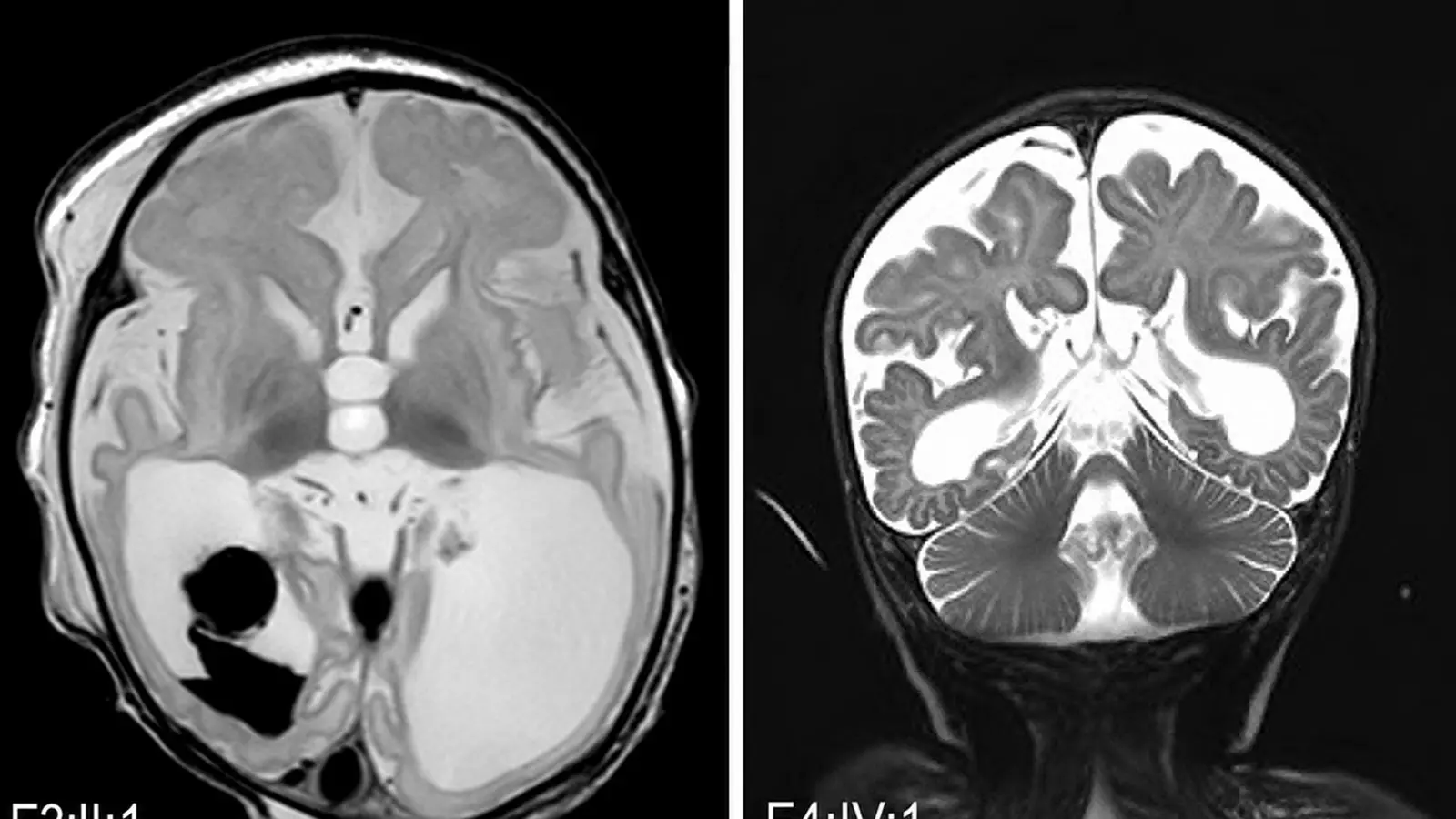
Imaging from the affected infants revealed consistent structural abnormalities. Ultrasounds and MRI scans displayed missing or underdeveloped corpus callosums, the main bridge between the brain’s hemispheres, and enlarged fluid-filled spaces called ventricles. Those features align with disruptions in early brain wiring and cell survival, a plausible consequence when essential cellular sorting systems fail.
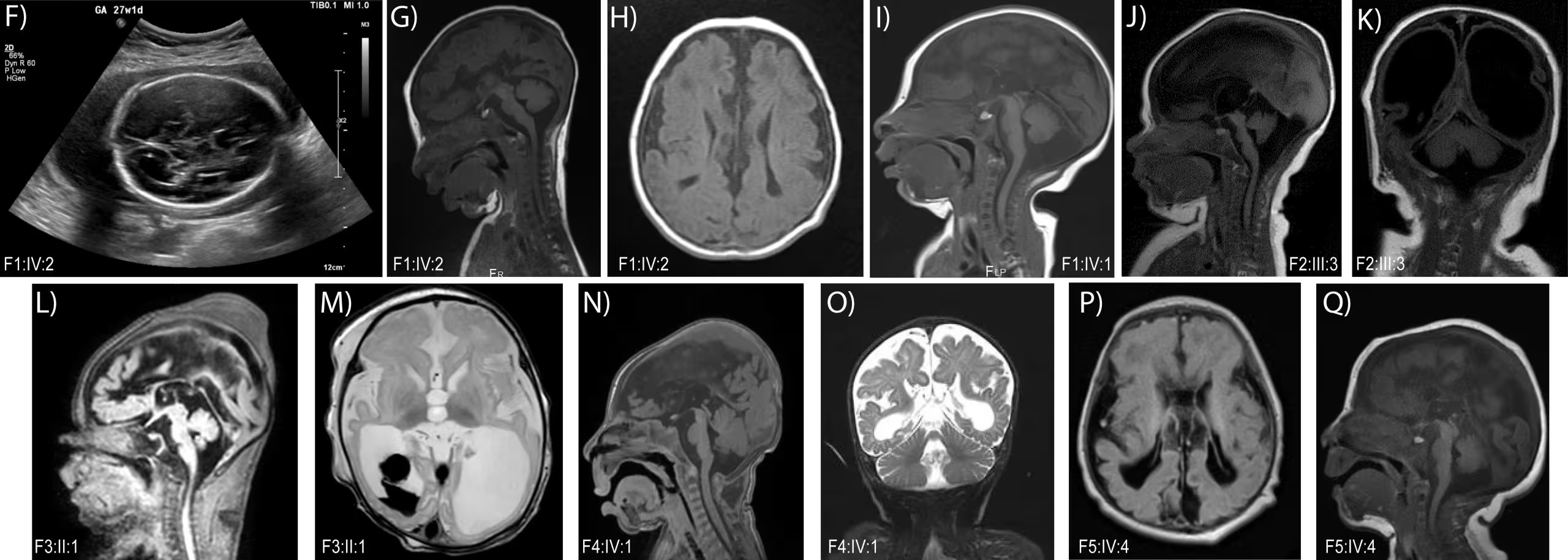
Brain imaging of children from the five families with VPS25-related disease. The pregnancy ultrasound and MRI scans show the brain abnormalities shared across the families, including a missing corpus callosum (the band of fibres connecting the two halves of the brain) and enlarged fluid-filled spaces (ventricles).
Clinical implications: answers for families and tools for clinicians
For parents who have lost children with unexplained neurologic disease, a genetic diagnosis does more than name the cause. It can guide reproductive decisions, focus prenatal testing, and shape counseling about recurrence risk. Professor Jasmeen Merzaban, co-lead on the project at KAUST, noted that recognizing VPS25 as disease-associated enables clinicians worldwide to test for the gene during pregnancy when similar brain abnormalities appear on ultrasound.
Adding VPS25 to diagnostic gene panels expands the clinician’s toolkit when confronted with severe prenatal brain malformations. Early genetic detection can shorten the diagnostic odyssey, spare families repeated rounds of inconclusive testing, and improve counseling for future pregnancies.
Key features clinicians should watch for
- Severe prenatal or neonatal onset neurologic symptoms
- Agenesis or hypogenesis of the corpus callosum
- Ventriculomegaly or enlarged ventricles on prenatal imaging
- Recurrent unexplained infant loss in the same family
Laboratory work ties these imaging signs to a cellular mechanism. When the protein-sorting pathway is disturbed, neurons may fail to receive protective factors or to clear damaged components efficiently. Over days and weeks in utero, that cellular dysfunction can translate into structural malformations we now see on MRI.
Expert Insight
'Discoveries like this are what make genomics truly transformative for families,' says Dr Maria Alvarez, a clinical neurogeneticist not involved in the study. 'Identifying a single gene that explains a constellation of prenatal findings turns uncertainty into actionable information. It also opens a path for researchers to model the disease and explore whether interventions might ever be possible.' Dr Alvarez adds that expanding international genomic networks will be essential to find more families and to map the full range of outcomes linked to VPS25 changes.
What comes next: research and hope
Identifying VPS25 is the first step, not the finish line. Scientists now want to find additional affected families, refine the range of clinical outcomes, and determine how different mutations shape severity. Functional studies in neurons and model organisms can clarify whether the vesicle defects are the only pathogenic mechanism or part of a broader disruption of cellular trafficking.
Those investigations matter because understanding mechanism is the prerequisite for any therapeutic approach. For now, the immediate benefit is diagnostic and prognostic: families gain explanations and clinicians gain a new gene to test when confronted with severe antenatal brain malformations.
Conclusion
The VPS25 story underlines a wider truth in modern medicine. Rare diseases reveal themselves only when clinicians share data, when geneticists connect dots across borders, and when laboratory scientists turn genomic signals into cellular narratives. For the families involved in this study, that collaboration has turned mystery into knowledge. For the medical community, it has added a critical entry to the list of genes to consider when newborns present with devastating, early-onset brain disease.

“My work centers on sustainability, energy, and environmental science — examining how innovation can lead to a greener future.”

Discussion
Leave a Comment
Comments
No comments yet. Be the first.