

Imagine throwing a monkey wrench into a finely tuned engine so the gears lock and the machine grinds to a halt. That is the idea behind a new experimental strategy that hijacks cancer's own machinery and uses it against the tumor.
The University of Michigan Rogel Cancer Center team has designed a small molecule that does not simply inhibit cancer-promoting proteins. Instead, it glues them together in an unnatural pairing that renders both ineffective. In preclinical studies the approach produced strong, lasting responses in prostate tumors that had stopped responding to standard therapies.
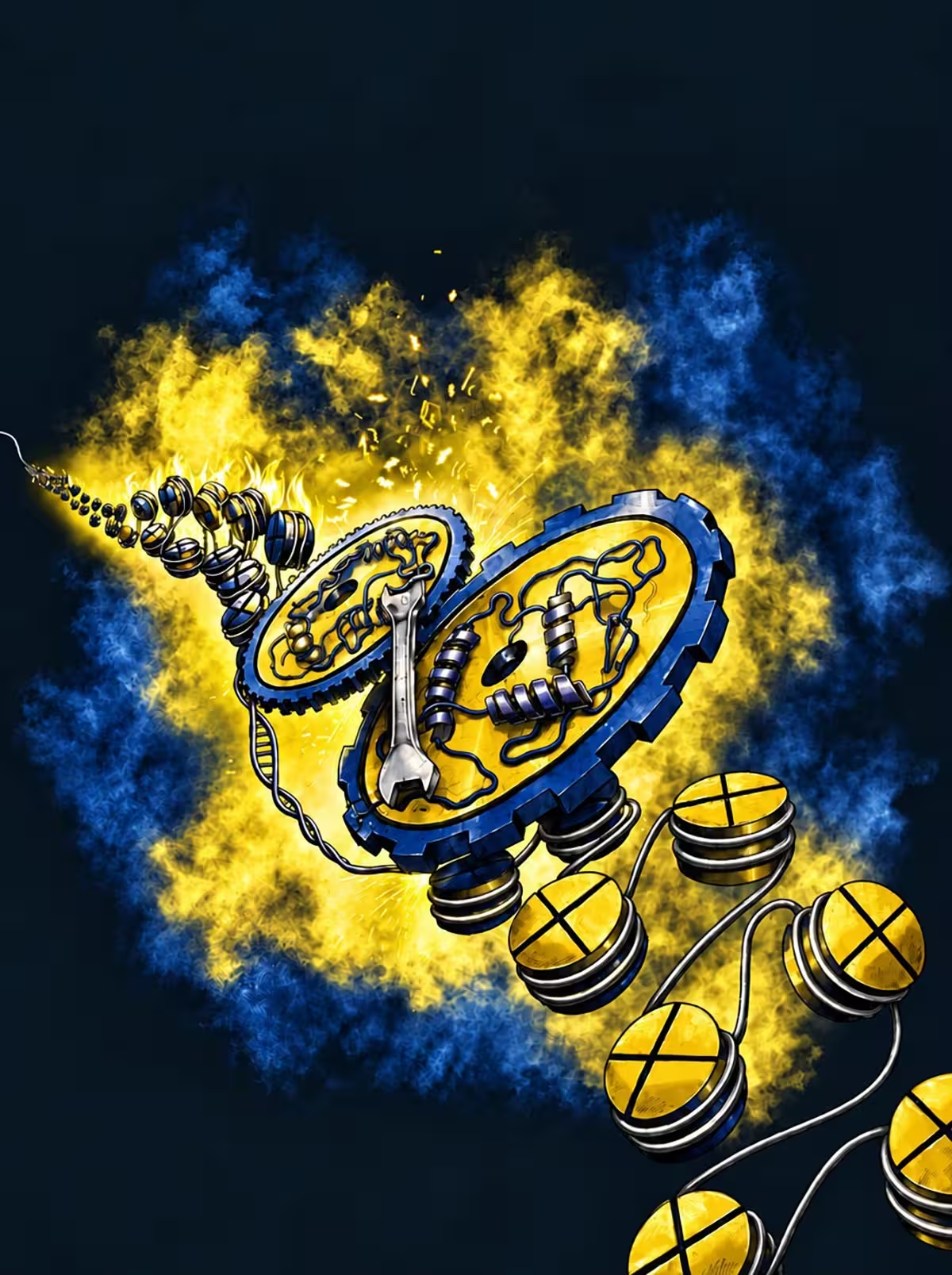
The gears represent the androgen receptor (AR) and p300, which are linked together in a non-native interaction by the monkey wrench, representing DALTAC-1. This leads to inhibition of oncogenic AR transcription and suppression of prostate tumor growth.
How DALTAC works
Most oncology drugs block a protein or a signaling node. The molecule developed at Michigan takes a different route: it forces two cancer-promoting proteins to form a stable, abnormal complex that prevents them from carrying out their usual job of turning on tumor-driving genes. The team calls this class of compounds DALTAC, short for domain-alteration chimeras.
At the center of the work are two players: the androgen receptor, a transcription factor that drives prostate cancer progression, and p300, a chromatin-modifying coactivator that helps AR switch on genes. Bring them together in the wrong geometry and those gene programs falter. The result is not only a dual shutdown of oncogenic signaling but, importantly, selective killing of tumor cells while sparing normal tissues that do not depend on this abnormal interaction.
These molecules are built like a two-headed key: two inhibitor modules joined by a short, carefully designed linker. That linker is everything. It controls how the two protein partners meet, and by altering that encounter the compound converts a functional complex into a dead-end assembly. The strategy builds on the broader field of chemically induced proximity, a toolkit that already includes PROTACs, which target proteins for degradation, and TCIP approaches that reshape transcriptional regulation.
In laboratory experiments the DALTAC compounds outperformed the simple combination of separate AR and p300 inhibitors. They were more potent against prostate cancer cell lines and three-dimensional organoids derived from patient tissue, and in mouse models the optimized compound produced durable tumor regressions. According to the investigators, the lead molecule showed roughly a 1,000-fold increase in potency against tumor cells compared with administering the two inhibitors separately, while minimizing harm to noncancerous cells.

The chemistry team also optimized these molecules for oral bioavailability, an essential step if the goal is a pill patients can take rather than a drug that must be infused.

'Our molecule behaves like a molecular brace,' said Arul M. Chinnaiyan, MD, PhD, noting that the abnormal tethering traps AR and p300 in an inactive configuration. Shaomeng Wang, PhD, added that the approach shuts down two oncogenic signaling routes simultaneously and that the collaboration between cancer biology and medicinal chemistry was critical to the result.
These experiments remain preclinical. The researchers emphasize that human trials have not yet begun, and careful safety and pharmacology studies are underway to identify a candidate suitable for clinical testing.
Why this matters and what comes next
The implications extend beyond prostate cancer. Many disease processes depend on transient or context-specific protein partnerships. If a small molecule can be designed to force two proteins into a dysfunctional alliance, similar tactics might be applied to other oncogenic drivers where direct inhibition has failed or produced resistance.
Resistance to androgen deprivation and next-generation AR inhibitors is the core clinical challenge in advanced prostate cancer, including castration-resistant disease. By locking AR into an unproductive complex with p300, DALTAC compounds sidestep some common resistance mechanisms. That could translate into new options for patients whose tumors have evolved past current therapies.
Technically, there are hurdles. Rationally designing linkers that impose a specific geometry between two proteins is difficult. Off-target interactions, pharmacokinetics, and long-term safety all need thorough evaluation. Still, the approach represents a conceptual leap: not only blocking protein function but repurposing protein interactions to neutralize them.
Expert Insight
'This is a clever pivot in drug design,' says Dr. Lina Morales, a medicinal chemist and translational researcher unaffiliated with the study. 'Rather than trying to out-compete a protein's native partner at a single interface, you're creating a new interface that the cell cannot use. It expands the design space for small molecules and could help target proteins previously considered undruggable.'
Morales adds that real progress will depend on reproducibility across models and clear safety margins in systemic studies. 'The preclinical signals are encouraging, but the path from a potent mouse compound to a safe human drug is long. Still, this work opens doors.'
Conclusion
The DALTAC approach reframes how we think about inhibiting cancer proteins: not by blocking, but by mispairing them. Early results in cells, organoids, and mice are promising, especially for tumors that resist standard therapies. The research team is advancing lead candidates toward the studies required for human trials, and oncologists will be watching closely. If this concept translates to patients, it could add a new weapon to the arsenal against advanced prostate cancer and inspire similar strategies across oncology.


“My work centers on sustainability, energy, and environmental science — examining how innovation can lead to a greener future.”

Discussion
Leave a Comment
Comments (1)
Whoa a molecular monkey wrench? wild idea, if it actually works this could change the game, but mice->people is a big jump , safety first…