
A thin ribbon of light cuts across the Atacama sky and, for a few seconds, the desert seems to hold its breath. That glint is not a shooting star. It is the promise of mirrors so large they will turn a few faint photons from distant planets into data we can analyze. The question driving that effort is simple and old: is Earth unique, or one of many similar worlds?
Why our picture of other planets has been biased
For the first three decades after the discovery of the first exoplanet, our catalog was dominated by massive, hot, and often gaseous worlds. Those are easy to spot because they tug hard on their stars or block large swaths of starlight when they transit. Small, rocky planets like Earth are faint and shy. Detection methods and limited instruments have given us a skewed sample. Does that mean Earth is rare, or have we simply not had the right tools?
New observatories aim to answer that question by expanding both the quantity and the quality of exoplanet observations. Space missions such as PLATO, scheduled for 2027 by the European Space Agency, will hunt for planets with orbital periods and sizes comparable to Earth. ARIEL, planned for 2031, will follow up with detailed studies of planetary atmospheres. Together these missions will change the roster of known worlds and refine the targets that ground-based giants will probe more deeply.
Giant mirrors and the art of looking directly
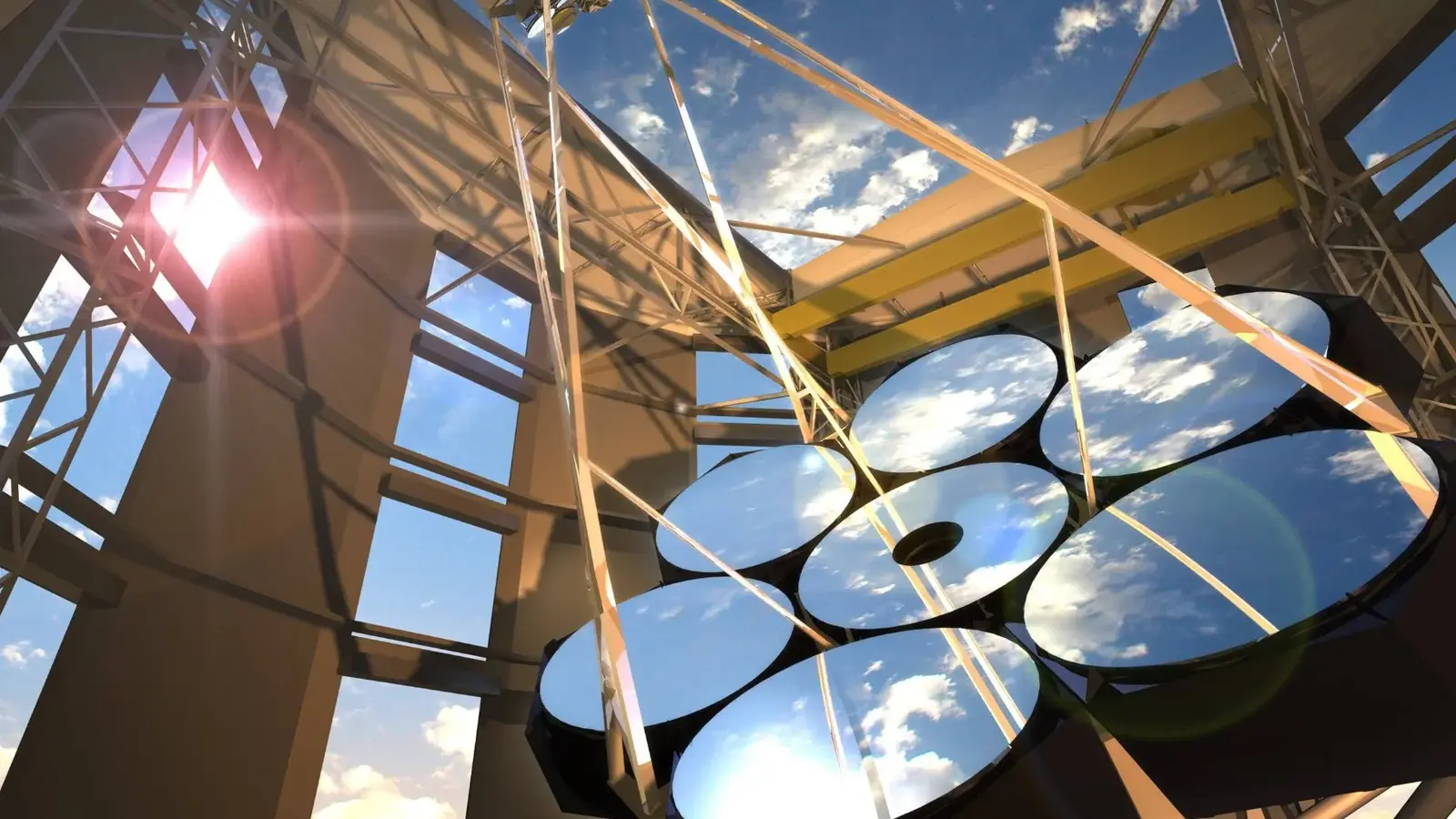
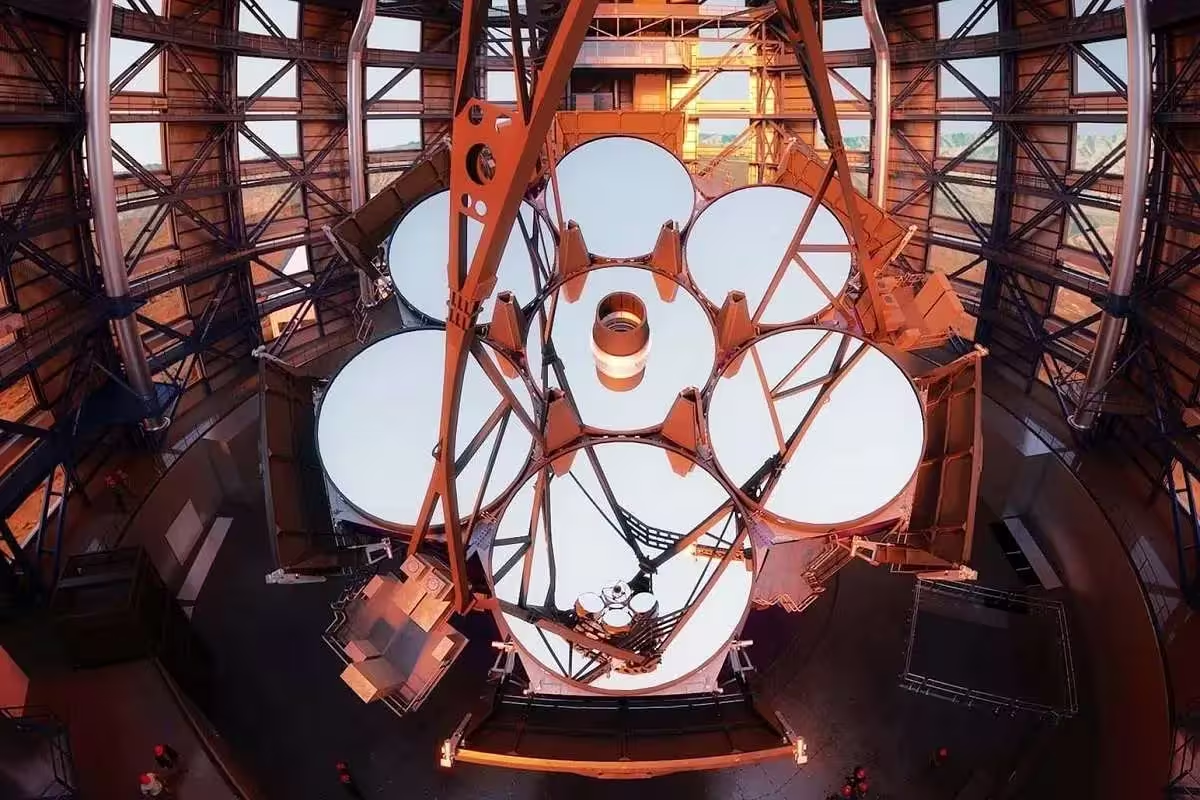
The Giant Magellan Telescope will be one of those ground-based giants. Built by a consortium of institutions across seven countries and sited in Chile's Atacama Desert, its primary aperture is 25.4 meters across and assembled from seven large circular segments. That geometry gives the telescope resolving power roughly ten times better than the Hubble Space Telescope and around four times that of the James Webb Space Telescope at comparable wavelengths.
Direct imaging of an Earthlike planet is not going to produce crisp, satellite-like photographs. Expect instead a few pixels, perhaps enough to detect brightness variations as the planet rotates and to separate planet light from the glare of its host star. Even that sparse information will let astronomers infer weather patterns, surface contrasts, and, crucially, atmospheric composition.

Ground observatories face a fundamental hurdle: Earth's atmosphere. The turbulence that makes stars twinkle also smears the tiny signal from a planet. Adaptive optics is the countermeasure. At the heart of the Giant Magellan Telescope's strategy is GMagAO-X, an advanced adaptive optics system loaded with more than 21,000 tiny actuators that flex the mirror surface thousands of times per second to cancel atmospheric distortion. A coronagraph works alongside to block the star's overwhelming light so the faint planetary reflection becomes visible.
Rebecca Bernstein, project scientist for the Giant Magellan Telescope and an astronomer at the Carnegie Institution, has stated that GMagAO-X will allow direct imaging and even tracking of small planets as they orbit their stars. That capability marks a dramatic shift: for the first time, astronomers expect to see Earth-sized worlds directly and follow their motion over time.
Measuring mass and chemistry with spectroscopy
Seeing is one thing, measuring is another. High-resolution spectroscopy will be essential to decode an exoplanet's physical properties. Instruments such as G-CLEF, designed for the Giant Magellan Telescope, will split the light from a target into its component colors with extreme precision. From these spectra scientists can determine a planet's mass through subtle gravitational effects on its star, detect gases in its atmosphere, and search for potential biosignatures such as oxygen or methane in certain relative abundances.
The European Extremely Large Telescope will sport an even larger primary mirror at 39.3 meters, and together these observatories will form a powerful one-two punch. But instrument suites differ. G-CLEF is planned as a unique high-resolution optical spectrograph early in the Giant Magellan Telescope's operation, giving it an advantage for measuring small-planet masses and searching for atmospheric oxygen. The ELT will bring complementary strengths at other wavelengths and with different instruments.
What early detections will look like and why they matter
Imagine a nearby sunlike star with a faint companion at one tenths of an arcsecond separation. With adaptive optics and a coronagraph, GMT might isolate the planet's light into a handful of pixels. Spectral analysis would follow, revealing absorption lines that indicate molecules in the atmosphere. Even limited data can test habitability: is there water vapor? Does the spectrum show oxygen in amounts inconsistent with nonbiological production? Are surface variations consistent with oceans and continents?

Answers to those questions will change how we build statistics for planetary occurrence. Rather than extrapolating from a biased sample of hot giants, astronomers will start filling in the population of small, temperate planets. With enough detections we can estimate how common temperate rocky worlds are, and whether Earth-like atmospheric chemistry is typical or rare.
Near-term context: JWST and survey telescopes
The Giant Magellan Telescope will not arrive alone. The James Webb Space Telescope is already probing atmospheres of larger exoplanets, and data reanalyses of survey missions have swollen candidate lists. On the survey side, the Vera C. Rubin Observatory will generate torrents of transient detections each night, from which telescopes like GMT can select promising targets for deeper study. The synergy between survey breadth and giant-telescope depth is the scientific model for the coming decade.
Expert Insight
Dr. Elena Morales, an observational astrophysicist at the University of Arizona, puts the upcoming capabilities in perspective. "Detecting oxygen or other potential biosignatures would be a watershed moment, but we must be cautious. Planetary atmospheres are shaped by geology, stellar activity, and history. Multiple lines of evidence will be necessary before we claim signs of life. What the new telescopes give us is the ability to assemble those lines of evidence instead of relying on single, ambiguous measurements."
This caution is not pessimism. It is a roadmap. Direct imaging plus high-resolution spectroscopy offers independent checks on atmospheric composition, surface properties, and planetary mass. Together these constrain models of habitability far better than any single technique.
Conclusion
The next decade will be decisive. PLATO will expand the roster of Earth-analogs, ARIEL will survey atmospheres, and ground giants like the Giant Magellan Telescope and the ELT will scrutinize select worlds with unmatched detail. We will move from detection to characterization and from statistical hints to direct measurements. Whether Earth proves to be a cosmic oddity or one of many habitable worlds, the instruments now under construction will let us find out with confidence.
Site preparation in the Atacama is underway, the primary mirror segments for the Giant Magellan Telescope have been fabricated, and final design reviews are expected in the coming years. When these observatories come online, the light they collect could finally answer the age-old question about our place in the cosmos.

“My work centers on sustainability, energy, and environmental science — examining how innovation can lead to a greener future.”

Discussion
Leave a Comment
Comments (3)
Looks overhyped? Maybe a bit, but the combo of PLATO, ARIEL and GMT is actually solid. Still, budgets and delays will kill timelines, probs.
Is this even feasible? adaptive optics with 21k actuators sounds insane, but how do we rule out bio false positives from abiotic O2?
wow didnt expect that, chills. the idea of seeing continents in a few pixels is wild. excited but also nervous about false hits