
It started as a bright pinprick in a survey image and, over three decades, refused to behave like anything astronomers expected. VT J1906+0849 is a radio source in the outer reaches of our galaxy that has brightened, faded, changed its spectrum and then brightened again, all without the telltale expansion that normally accompanies such dramatic radio displays.
Discovery and a timeline that stretches decades
Most astronomical fireworks have short lifetimes: milliseconds for pulsar blinks, days to months for novae, and years for some supernova afterglows. VT J1906+0849 does not fit that pattern. The object first surfaced in modern analyses when the Very Large Array Sky Survey recorded an unusually bright radio transient in 2017. At roughly 49,000 light-years from the Sun, sitting beyond the Norma-Cygnus spiral arm, the source registered about 70 millijanskies at radio wavelengths — extraordinarily bright given the distance.
That detection triggered a deep archival hunt. In images taken in 1996 by the NRAO VLA Sky Survey, there was nothing at the position. By 2005, a faint radio glow had emerged. Through multiple surveys between 2006 and 2013 the source climbed in brightness and, according to the assembled light curve, reached a peak near 200 millijanskies around 2014, before the 2017 VLASS epoch caught it fading.
The story did not end there. Follow-up targeted observations in 2019 and 2024 showed continued fading, suggesting a long-lived transient slowly dying out. Then late in 2025 the object brightened once more in new Very Large Array data, reversing what looked like a decline. This pattern — decades-long brightening, a peak, fading and then rebrightening — is unusual on galactic scales and raised the question: what engine can sustain such behavior for decades?
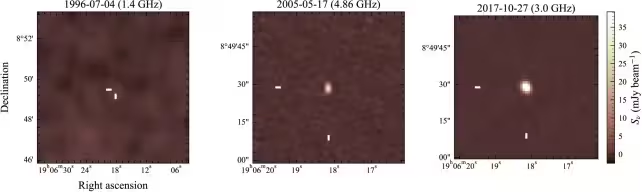
The location of VT J1906+0849 in radio observations from 1996 (left), 2005 (middle), and 2017 (right). The mysterious source is absent in the earliest image, but appears in later observations.
What the spectrum tells us
Radio astronomers do more than measure brightness. They map how that brightness shifts with frequency to infer physical conditions at the source. VT J1906+0849 displays a peaked radio spectrum: its flux density rises to a maximum at a certain frequency, then falls off at higher and lower frequencies. The peculiar piece is how that peak moves.
Measured peaks migrated from about 1.9 gigahertz in 2019 down to roughly 0.8 gigahertz in 2024, and then back up to approximately 2.2 gigahertz by 2026. A peak that shifts is not unheard of — expanding synchrotron-emitting clouds tend to shift their spectral peaks to lower frequencies as they grow and become optically thin. But when the team looked for evidence of spatial expansion, they found almost none. Over several years of interferometric imaging, VT J1906+0849 remained compact, even as its radio spectrum performed an unexpected dance.
These spectral moves point toward synchrotron radiation as the emission mechanism — energetic electrons spiraling through magnetic fields — but not in the simple textbook way of an expanding blob cooling and thinning out. The return to higher peak frequencies and the rebrightening imply active, ongoing processes: fresh particle acceleration, varying absorption along our line of sight, or intermittent injection of energy.
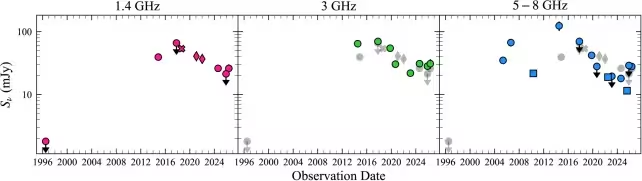
The changing radio brightness of VT J1906+0849 over several decades, measured at different frequencies. The source brightened dramatically, faded, and then began brightening again in late 2025.
A shortlist of contenders
Faced with a long-lived, spectrally erratic, compact radio source, researchers considered several explanations and whittled the field to a few that could plausibly match the data.
Explosive events like novae can produce bright synchrotron emission, but they generally reveal expansion signatures and evolve on much shorter timescales than decades. Pulsar wind nebulae produce broadband radio emission and can be long-lived, yet the spectral shifts seen here are far more chaotic than expected for a nebula energized by a steady pulsar wind.
That leaves accreting compact objects — black holes or neutron stars in binary systems that pull matter off a companion star. Accretion can power relativistic jets or produce dense disk winds. These outflows in turn can generate synchrotron emission and complicate the observed spectrum through absorption and changing geometry.
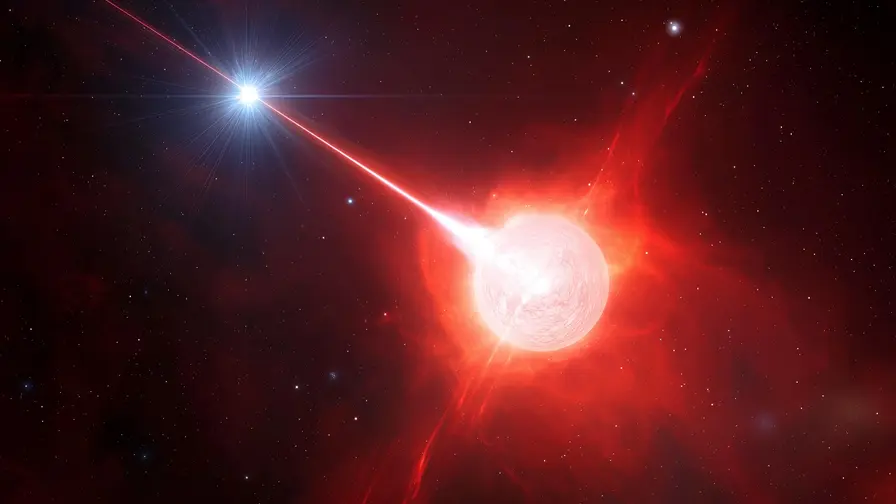
There is a Galactic precedent. SS 433 is an infamous case: a compact object accreting from a companion launches jets and a thick disk wind that both produce radio emission and obscure X-rays. In SS 433, strong outflows reach high speeds and the system’s complexity can mask expected signatures. The VT J1906+0849 team identified infrared evidence of gas moving at about 2,000 kilometers per second — consistent with a powerful outflow or wind. That clue makes a microquasar-like scenario plausible: a compact object continuously feeding a jet into a dense environment that both generates radio emission and prevents the emitting region from freely expanding.
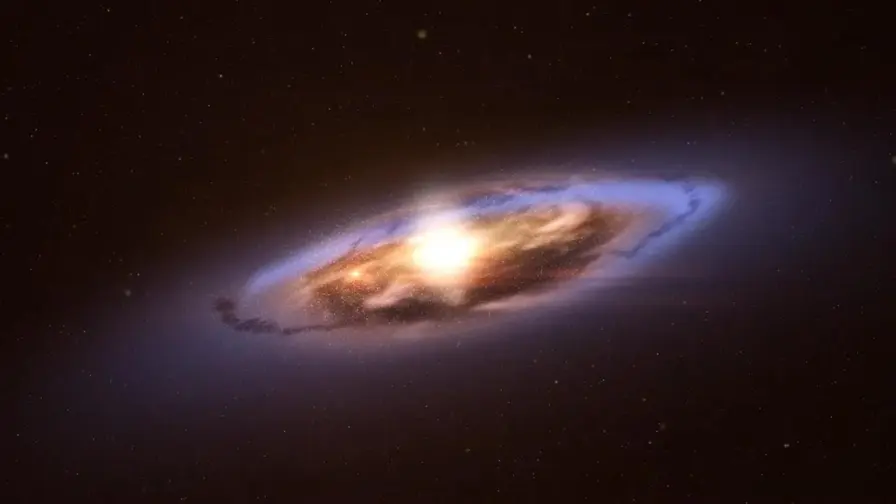
Yet there is an unsettling absence of expected high-energy photons. NASA’s Swift X-ray telescope recorded no clear X-ray counterpart to VT J1906+0849. If a black hole or neutron star were accreting vigorously, bright X-rays would usually betray the inflow. The Swift non-detection does not rule out accretion, however: dense winds or thick, edge-on disk structures can absorb X-rays and hide the central engine. That same material could reshape the radio spectrum and produce long-lived synchrotron emission at varying frequencies as conditions in the jet and wind change.
Expert Insight
"VT J1906+0849 is a reminder that the Galaxy still hides complex systems from our view," says Dr. Elena Ruiz, an astrophysicist specializing in compact binaries. "Long-term radio monitoring reveals behavior that short campaigns miss. The shifting spectral peak and the lack of spatial expansion point toward ongoing injection of energy rather than a one-off explosion. If a dense wind is obscuring X-rays, we need deeper, higher-resolution X-ray and infrared observations to pin down the central engine."
"Future very long baseline interferometry could test whether any tiny-scale motion or structure exists in the source, while multiwavelength campaigns would help separate jet contributions from wind absorption. This object should be on every monitoring list for the next several years."
Implications for galactic radio astronomy
VT J1906+0849 is more than a single oddball. It highlights how long-term, wide-field radio surveys can reveal a population of obscured accreting systems that are hard to identify at other wavelengths. Many binary accretors might be cloaked by dense winds or particular viewing angles, making them effectively invisible to X-ray searches yet conspicuous at radio frequencies where synchrotron processes dominate.
Finding and characterizing these hidden systems matters for several reasons. They inform population estimates of stellar-mass black holes and neutron stars in our galaxy, constrain models of jet formation and feedback on local environments, and provide laboratories for studying relativistic particle acceleration under conditions different from classical supernova remnants or pulsar wind nebulae.
Observationally, the case argues for coordinated, multi-decade strategies. Radio surveys like VLASS are only beginning to reveal these long-timescale transients. Facilities coming online or expanding in capability — such as MeerKAT, the Square Kilometre Array precursors, and eventually the SKA itself — will deepen surveys and catch more objects in different stages of their lives. Complementary infrared spectroscopy, deeper X-ray exposures and very long baseline imaging are essential follow-ups to break degeneracies in interpretation.
Conclusion
VT J1906+0849 resists tidy classification. Its decades-long variability, spectral shifts to both lower and higher radio frequencies, absence of clear expansion, and lack of detectable X-rays together tell a story of an active source operating behind a veil. A compact accretor launching jets into a dense, obscuring wind — a younger or more concealed cousin of SS 433 — fits the available evidence best, but it remains a hypothesis pending further data.
The broader lesson is clear: the Milky Way still has surprises, and only repeated, multiwavelength observations over long baselines will reveal the slow dances of its most elusive actors. VT J1906+0849 is one such dancer. We have its steps for now, but the music is not finished.
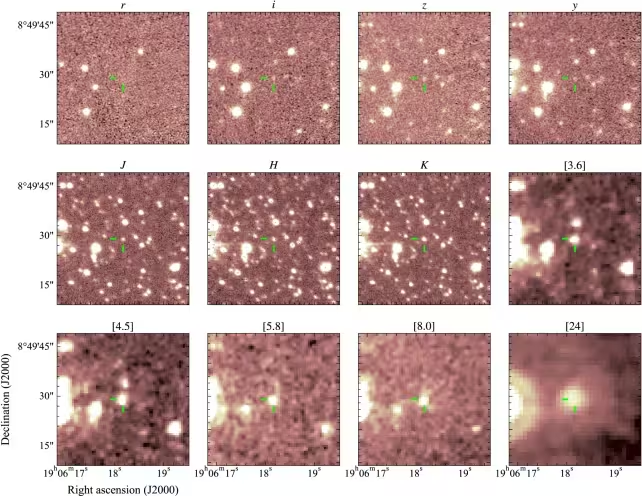
The location of VT J1906+0849 as seen at optical (top row), near-infrared (J, H, and K), and mid-infrared (remaining panels) wavelengths. These observations help astronomers investigate what might be producing the mysterious radio emission.

“My work centers on sustainability, energy, and environmental science — examining how innovation can lead to a greener future.”

Discussion
Leave a Comment
Comments (1)
Wow... a whole decades-long radio dance? Mind blown, this sounds like a hidden microquasar. Need more data!!