
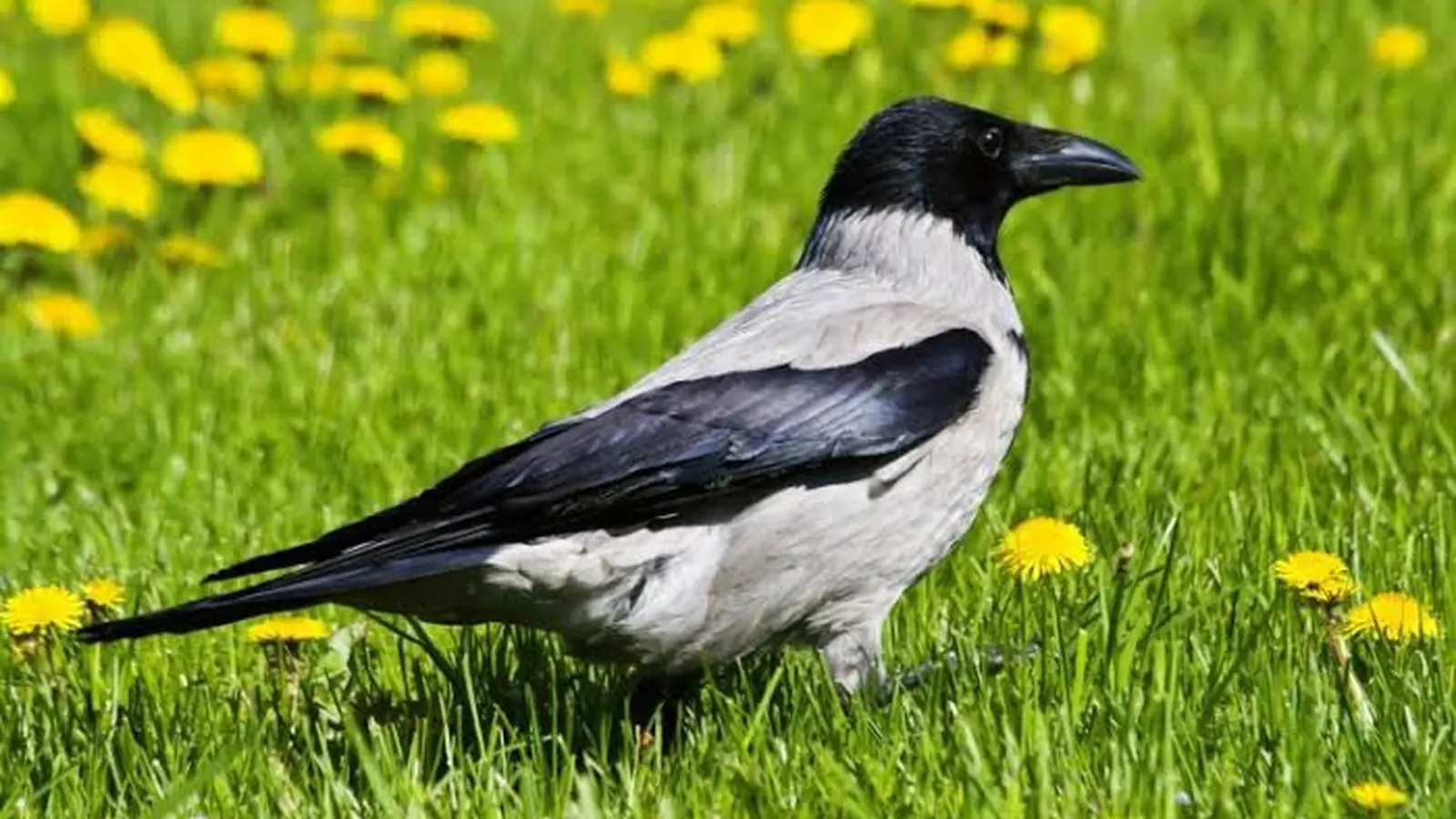
A flash on a screen. Hundreds of tiny white dots jitter. Two of them tilt one way and the rest scatter. A crow studies the scene and, with a single, precise peck, signals its choice. The whole decision unfolds in less than a quarter of a second.
Inside the lab test
Researchers at the University of Tübingen trained two carrion crows, Corvus corone, to report the dominant direction of moving dots on a touchscreen. The task sounds simple. It is not. Some dots drift left or right while most move randomly. The birds had to pick the prevailing direction and were rewarded with food when they chose correctly.
By varying the percentage of coherently moving dots, scientists tuned the difficulty. High-coherence trials were easy. Low-coherence trials demanded finer perceptual discrimination. The crows responded remarkably fast. On average their decision time was 235 milliseconds. That is under one-quarter of a second. It is also roughly half the response time reported for humans and macaques performing comparable tasks in earlier studies, although the authors caution that the crows were not tested side by side with primates in the same experiment.
Speed did not come at the expense of accuracy. When the motion signal was strong, the birds approached near-perfect performance. Even when coherence dropped to a mere 3 percent, their choices remained significantly better than chance, reaching correct responses about half the time. In other words, these crows could extract a faint motion signal from noisy clutter, and do so quickly.
Neural signatures and evolutionary echoes
To probe the brain mechanisms behind that rapid decision making, the team recorded activity from 248 neurons in a region called the nidopallium caudolaterale, or NCL. The NCL is often described as functionally analogous to the mammalian prefrontal cortex, the area involved in working memory, attention, and complex decisions.
Neurons in primate frontal cortex typically accumulate sensory evidence over time. When activity reaches a certain threshold, the animal commits to a choice. The new data suggest crows use a similar accumulation process. By analyzing spike patterns, the researchers could predict the bird’s eventual choice just 70 milliseconds after the dots appeared. That neural prediction preceded the crow’s behavioral peck by about 170 milliseconds.
Andreas Nieder, a professor of animal physiology at Tübingen and a coauthor on the study, notes that these results challenge a narrow view of what brain structure is required for complex cognition. "Our findings show that advanced information processing does not require a layered neocortex," he says. "Bird brains implement different architectures yet reach similar computational solutions."
That insight carries evolutionary weight. Birds and mammals diverged more than 310 million years ago. The fact that both lineages arrived at comparable decision-making dynamics suggests convergent evolution. Different hardware. Similar algorithms.

There are ecological reasons to expect fast visual decisions in birds. Flight through cluttered, three-dimensional space demands split-second judgments. Predator avoidance, prey capture, and rapid maneuvering all favor neural systems optimized for speed and sensorimotor coordination. Natural selection may have tuned avian circuits to extract and act on visual evidence with particular efficiency.

Still, several caveats matter. The current study involved only two crows. The comparisons to humans and monkeys rely on previously published data rather than direct, within-study controls. And decision speed can depend on many task details, from stimulus timing to the cost of errors. Researchers will need larger samples and matched cross-species experiments to map the full landscape of similarities and differences.
Expert Insight
Dr. Elena Márquez, a cognitive neuroscientist who studies comparative perception, reflects on the implications. "What I find compelling is the idea that different brains discover similar solutions. The nidopallium caudolaterale and the primate prefrontal cortex are not identical in form. Yet when the problem is the same, both systems appear to implement accumulation of evidence. That points to universal principles in neural computation."
She adds a practical note. "These findings should encourage experimental designs that match stimuli and reward structures across species. Only then can we separate genuine biological differences from artifacts of how tasks are set up."
Concluding thoughts
Published in Science, the study adds a new chapter to our understanding of avian cognition. It does not claim that crows are categorically smarter than humans. What it does show is that decision-making speed for a specific visual task can be astonishing in a bird with a brain that looks very different from ours.
Beyond headlines, the work points to deeper questions. Which circuit motifs are necessary to accumulate evidence? How do constraints such as metabolic cost and wiring geometry shape those motifs? Can engineers borrow design principles from birds to build faster, more efficient artificial systems?
Answers will require more experiments, with larger samples and direct cross-species comparisons. For now, the image of a crow, calm and rapid, parsing a noisy field of motion in under a blink, is both a reminder and an invitation. Evolution can produce many architectures. Some of them think fast.


“My work centers on sustainability, energy, and environmental science — examining how innovation can lead to a greener future.”

Discussion
Leave a Comment
Comments (1)
wow, a crow deciding in 235 ms?? insane. pecking the right way so fast, love the idea of convergent evolution. makes me wanna rethink 'bird brains' lol