
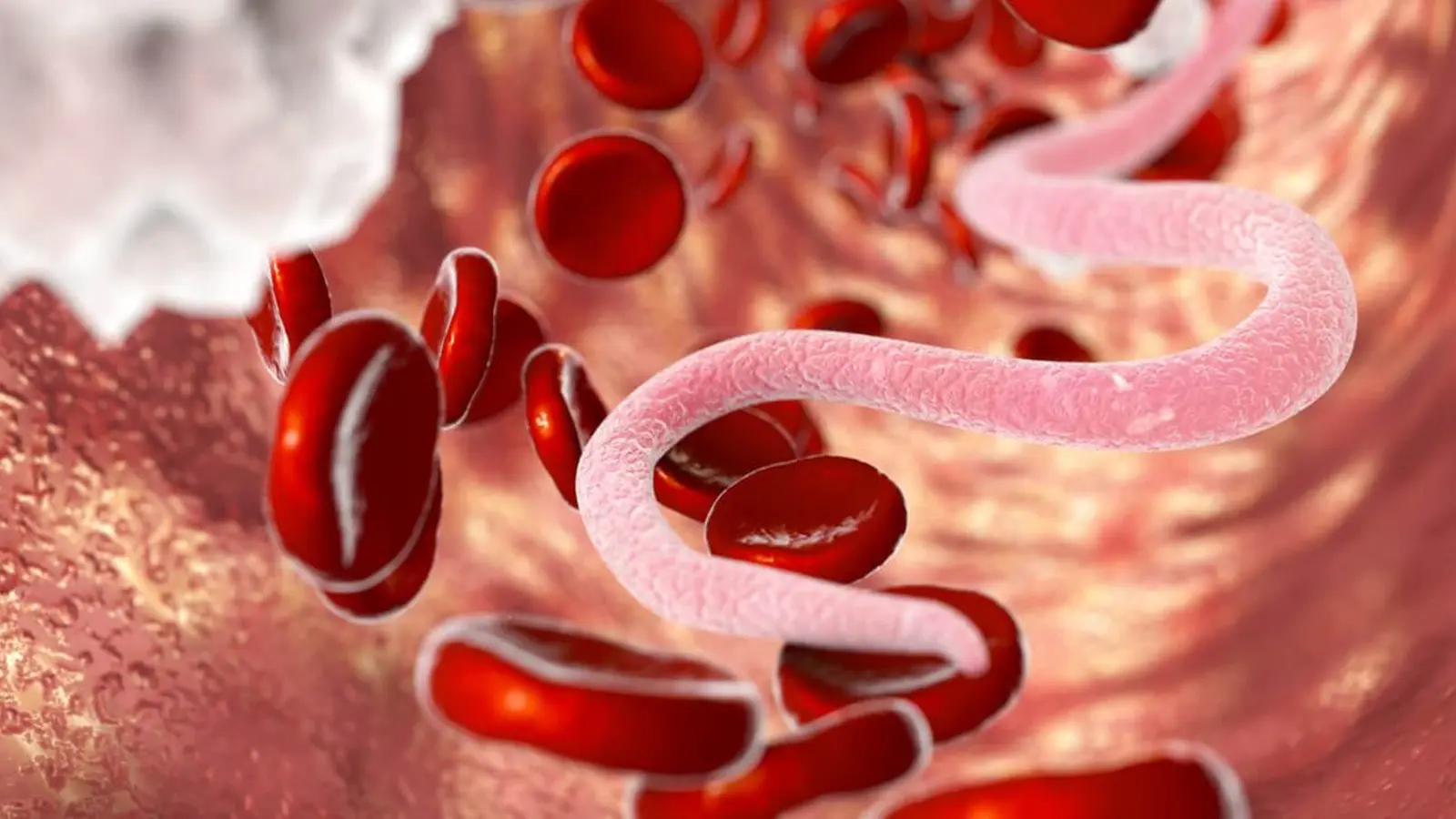
Imagine a tiny parasite in your gut quietly manufacturing medicine, day after day. Strange, unsettling, and oddly practical. That is the provocative image emerging from a new study showing that hookworms can be genetically altered to produce therapeutic proteins inside a host.
From parasite to production platform
Researchers working with the intestinal hookworm Ancylostoma ceylanicum used CRISPR/Cas9 gene editing to insert genetic instructions that prompt the worm to make an antibody against tetrodotoxin, the potent neurotoxin found in pufferfish. Why this parasite? Because it already survives, reproduces, and secretes molecules inside mammalian intestines. Scientists asked a simple, disruptive question: what if we repurpose that biology to deliver drugs continuously rather than relying on pills or injections?
The team faced a fundamental technical barrier first. Hookworms are protected by a tough external cuticle and early-stage embryos are compact and resilient. To get DNA into the animals, researchers turned to electroporation—brief electrical pulses that open transient pores in cell membranes. They introduced engineered DNA into hookworm eggs, including a CRISPR system and a gene coding for an antibody targeting tetrodotoxin. That antibody was chosen both for its clinical relevance and for national security interest; tetrodotoxin is so toxic and hard to counter that agencies such as DARPA have taken notice.
After genetic modification, the scientists infected hamsters with either engineered or unmodified hookworms to test whether the altered parasites would express the new gene inside a living host. Blood samples from animals hosting engineered worms contained detectable fragments of the produced antibody. In lab assays, that antibody preparation neutralized roughly 20 percent of tetrodotoxin’s activity. Not a cure; yet a clear signal that living parasites can express and release therapeutic proteins into circulation.

The science beneath the surface
Working with parasitic helminths is notoriously tricky. Their life cycles can be complex. Their cellular membranes and protective layers make genetic manipulation difficult. Achieving germline transmission—so the inserted genes persist across parasite generations—remains a critical next step. If engineered sequences can be passed to offspring, a small population of worms could, in principle, persist and continue producing therapeutic molecules for months or years.
There are other hard questions. How much antibody or drug can a handful of worms realistically secrete? The current experiment produced levels sufficient to partially neutralize toxin in vitro, but not enough to protect against a full lethal dose in a living organism. Immunogenicity is another concern: hosts might mount immune responses against the foreign protein or against the worms themselves, limiting effectiveness or causing adverse effects. Safety, containment, and ethics loom large.
Still, this work functions as an important proof of concept. It shows the principle: an intestinal parasite can be engineered to make and export a functional protein into a mammalian bloodstream. That opens a field of possibilities and a catalog of problems to solve.
Potential uses and limits
Where could such an approach be useful? One vision is of a low-maintenance “living pharmacy” that produces steady doses of biologics for chronic conditions—think anti-allergy antibodies, hormones, or metabolic regulators. A patient might harbor a controlled population of engineered organisms that reduce the need for frequent injections. The idea targets adherence problems in medicine: many treatments fail because people forget doses or lack access to care.
But practical deployment is distant. Scaling production inside a host, ensuring consistent dosing, reversing or removing the organism when needed, and preventing unintended spread are major engineering and regulatory hurdles. Public acceptance would be another barrier. Few will embrace the idea of deliberate parasitic colonization without ironclad safety data.
On the flip side, the methods developed to manipulate hookworms could benefit parasitology broadly. Improved tools for genetic access may reveal new targets for anti-parasitic drugs and vaccines. Understanding the basic biology of helminth-host interactions could also inform treatments for autoimmune diseases and allergies, where helminth-derived molecules sometimes modulate immune responses.
Expert Insight
"This study is an elegant demonstration of biological repurposing," says Dr. Rachel Moreno, a microbial engineer and science communicator. "It shows we can program a living organism to make useful molecules in situ, but the path from bench to bedside will require solving dose control, reversibility, and immune safety. The potential is real, yet the regulatory and societal questions are equally real."
The research appears in Nature Communications. The authors describe a careful, stepwise approach: establish genetic entry, validate expression, then quantify functional activity. Each stage produced encouraging results but also underscored how far the concept is from clinical application.

Whether engineered hookworms become therapeutic tools, research models, or a cautionary tale will depend on follow-up work. For now, the study expands the imagination of what a living therapeutic might be and challenges researchers to think beyond traditional drug delivery systems. Small worms. Big questions.

“My work centers on sustainability, energy, and environmental science — examining how innovation can lead to a greener future.”

Discussion
Leave a Comment
Comments (2)
This sounds sci-fi and risky. How do they stop the worms spreading? What if immune reactions make it worse, seems premature to hype
wow that made my skin crawl and brain buzz, weirdly clever tho. parasites as drug factories? if it works, also kinda terrifying... not ready for humans yet