
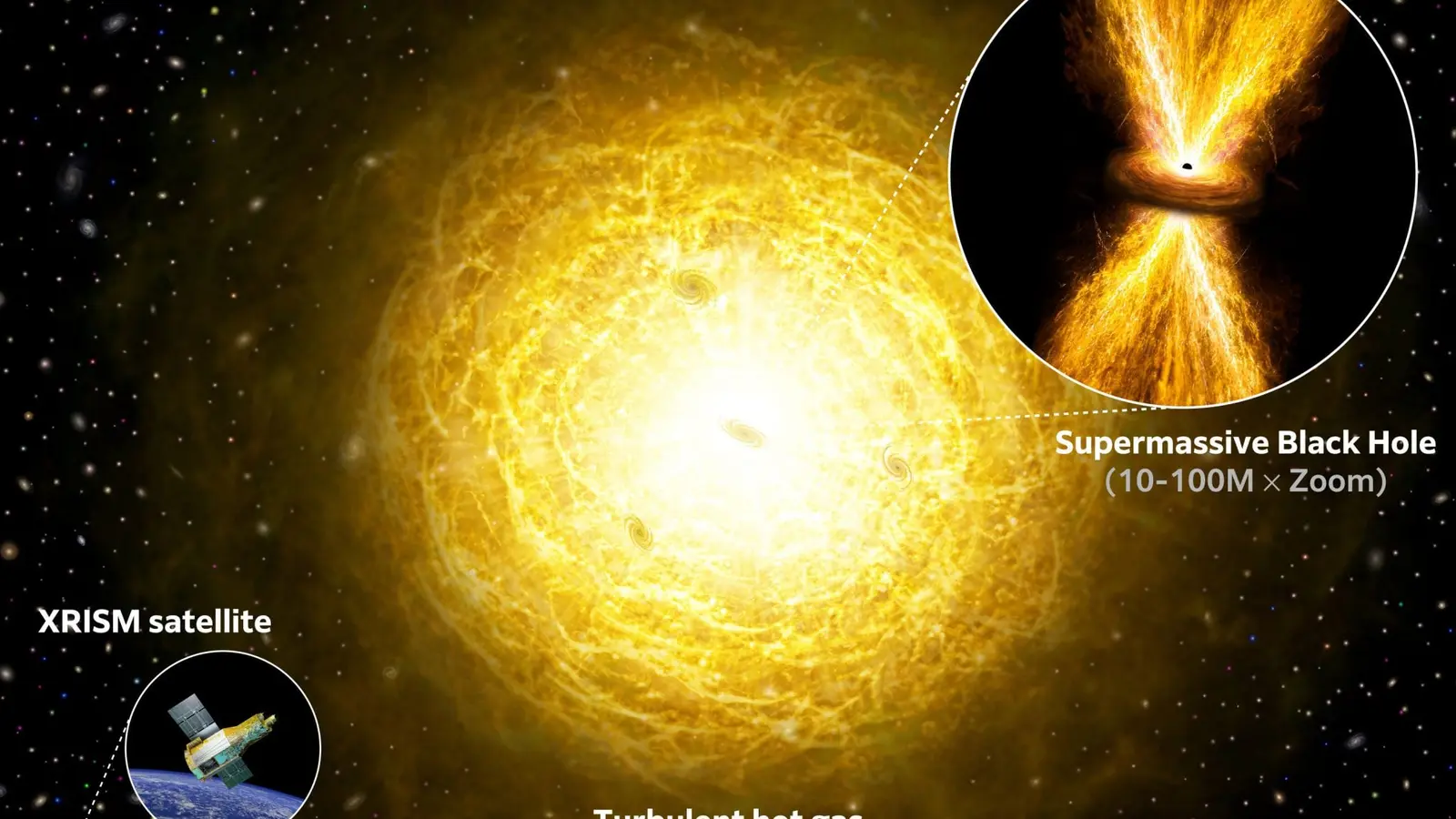
Imagine a single black hole stirring gas across a region half a million light-years wide. The scale is staggering. The mechanism is cleaner: powerful winds launched from the black hole push and churn the hot, X-ray-emitting plasma far beyond the galaxy that hosts the black hole.
New X-ray observations reveal that winds from a luminous quasar can deliver roughly 100 times more kinetic energy into their surroundings than astronomers had thought. That energy does not stall at the edge of a single galaxy. It floods into the larger galaxy group and excites turbulence on scales of several hundred thousand light-years. The implication is direct: black hole feedback is not just a local regulation mechanism for star formation inside a galaxy. It can reshape the thermal and dynamic state of the larger cosmic neighborhood.
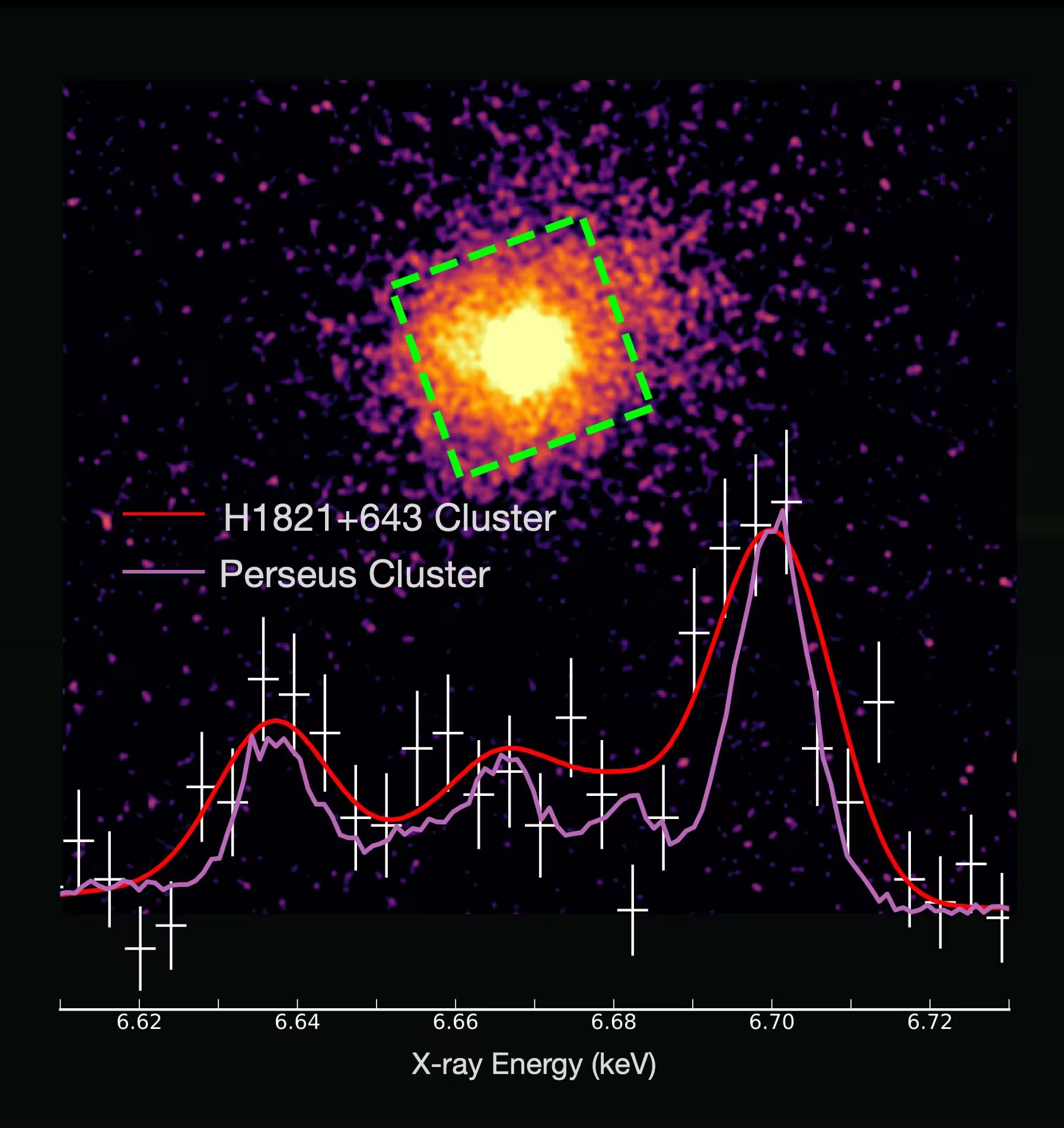
X-ray image of the H1821+643 galaxy group obtained with the Chandra X-ray Observatory. The green dashed square indicates the observed region, corresponding to a physical scale of approximately 900,000 light-years on each side. The lower panel shows the energy distribution of X-ray emission lines from iron ions (e.g., at 6.7 keV) in the central region (within a radius of about 300,000 light-years), with observational data (white) overlaid with the best-fit model (red). Compared with a typical galaxy cluster such as the Perseus cluster, the line broadening is significantly more pronounced, indicating highly turbulent and dynamically active hot gas over a wide spatial extent.
How XRISM traced the blast beyond one galaxy
The target was H1821+643, a bright quasar roughly 3.4 billion light-years away in Draco. Its central engine is a supermassive black hole that feeds rapidly and drives strong outflows. A team led by Satoshi Yamada at Tohoku University used XRISM, the Japanese X-ray astronomy satellite designed for high-resolution spectroscopy, to measure the motions of the hot gas around that black hole.
Spectroscopy is the key. Hot gas emits X-rays that carry signatures from ions such as iron. The shapes and widths of those emission lines tell a story: are the atoms sitting still, or are they being tossed around by turbulence? XRISM’s superior energy resolution made it possible to detect pronounced line broadening across a volume extending roughly 300,000 light-years from the quasar. That degree of broadening points to highly turbulent gas with substantial kinetic energy.
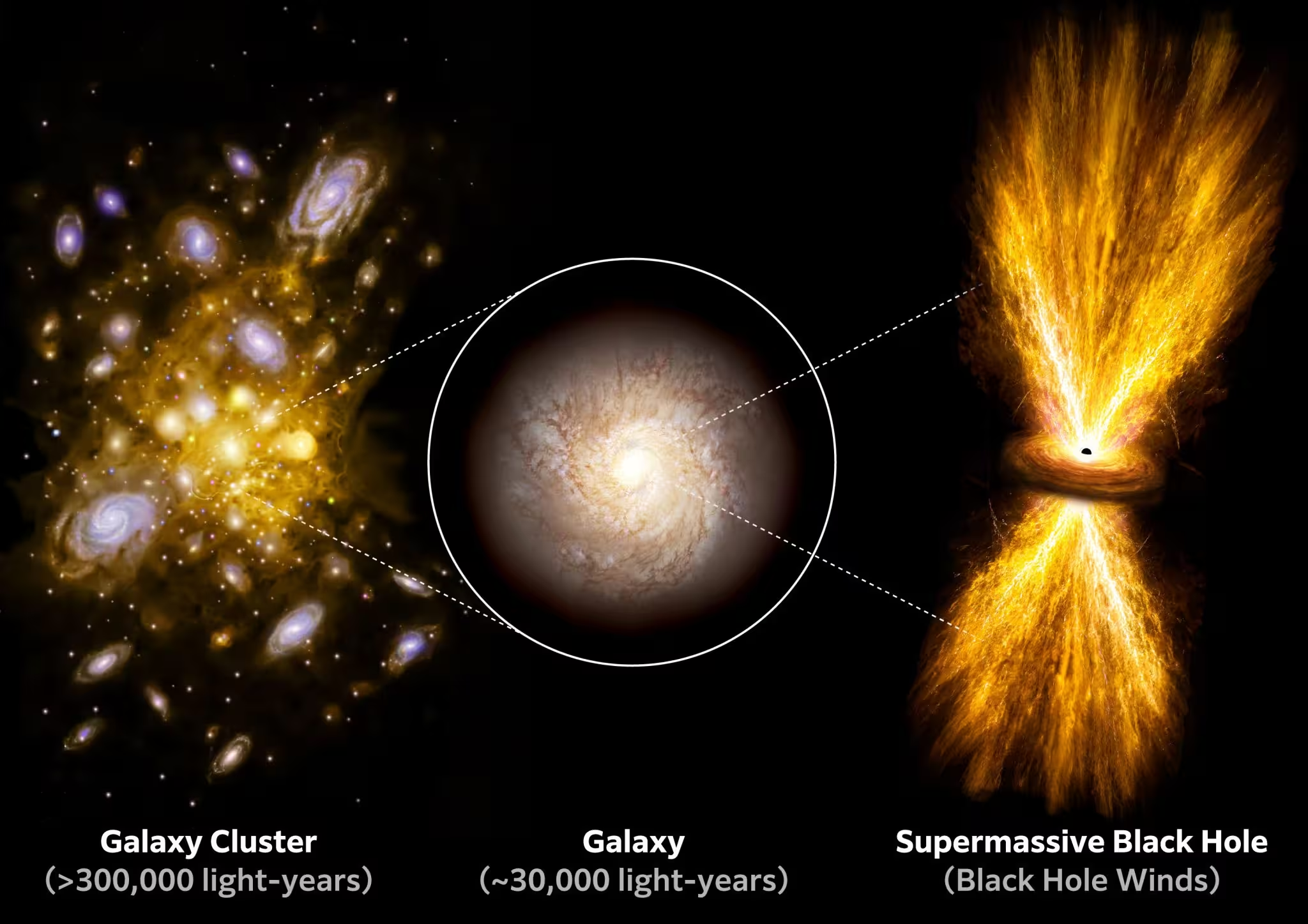
Schematic illustration of the hierarchical structure of the Universe, from a galaxy group (a collection of galaxies) to an individual galaxy and the supermassive black hole at its center. Although a black hole is more than 100 million times smaller than the radius of its host galaxy, it plays a crucial role in the galaxy’s central region.
What the numbers mean for cosmic feedback
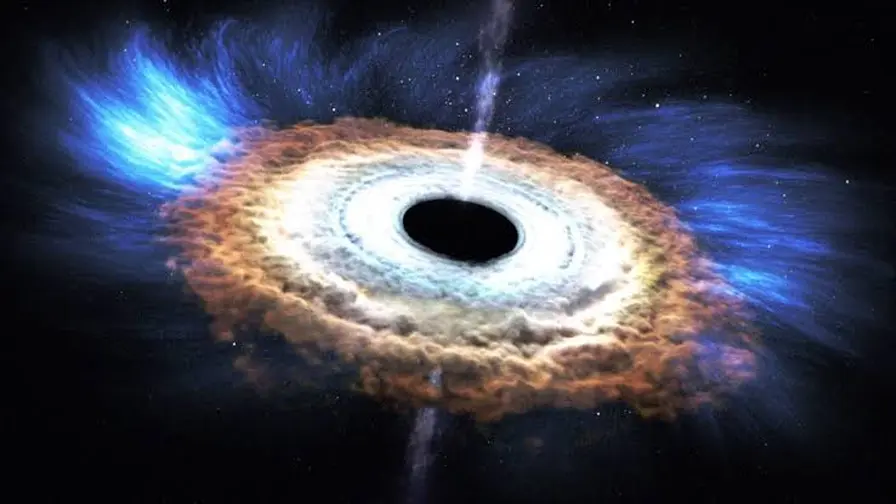
The analysis suggests the turbulent energy injected by the black hole is roughly two orders of magnitude greater than earlier figures. To put that in context, the energy is comparable to the combined output of several billion supernovae. That is an arresting comparison, because supernovae have long been considered one of the primary drivers of gas heating and metal mixing in galaxies and their haloes. Here, the black hole plays the dominant role at group scales.
Why does this matter? Because turbulence redistributes heat and heavy elements, and it can prevent gas from cooling and collapsing to form new stars. Feedback from supermassive black holes is a cornerstone of modern models for galaxy evolution, but until now most estimates confined the strongest effects to the host galaxy. These observations force a revision: quasar-driven winds can reach and energize the intragroup medium, influencing environments well beyond the stellar disk.
“Black holes are largely known for sucking matter in, but they also eject gas in the form of powerful winds,” says Satoshi Yamada of Tohoku University’s Frontier Institute for Interdisciplinary Sciences. “These winds were thought to be contained within the galaxy, but our study revealed that the force is immensely more powerful than previously understood.”
Expert Insight
Dr. Amina Torres, an astrophysicist unaffiliated with the study, notes: "This result reframes how we think about energy flow in galaxy groups. If a single active nucleus can stir gas on 300,000 light-year scales, then the cumulative effect of many such episodes over cosmic time becomes central to the thermal history of galaxy environments. Observatories like XRISM and Chandra allow us to quantify that churn for the first time."
Conclusion
The XRISM observations of H1821+643 show a supermassive black hole doing far more than the role of a hungry sink. It is a cosmic bellows, pumping energy into a volume that reaches the space between neighboring galaxies. For theorists and modelers, these data offer a stronger constraint on feedback prescriptions. For observers, they are an invitation: point high-resolution instruments at more quasars embedded in groups and clusters, and map how universal this phenomenon is.
Future campaigns combining XRISM-like spectroscopy with deep imaging from Chandra and radio observations of outflowing gas will refine the picture. We are seeing the outlines of a more connected universe, where the smallest, densest engines dramatically affect structure on the largest scales.

“The cosmos has always fascinated me. I write about space missions, astronomy, and the technologies pushing humanity beyond Earth.”

Discussion
Leave a Comment
Comments (2)
100x more kinetic energy? sounds huge, but is that robust or maybe a selection effect? curious, not totally convinced yet
wow didnt expect a black hole to stir half a million ly of gas, that's wild. XRISM seeing turbulence that far out... if true, models need a major rewrite, this changes stuff fast