
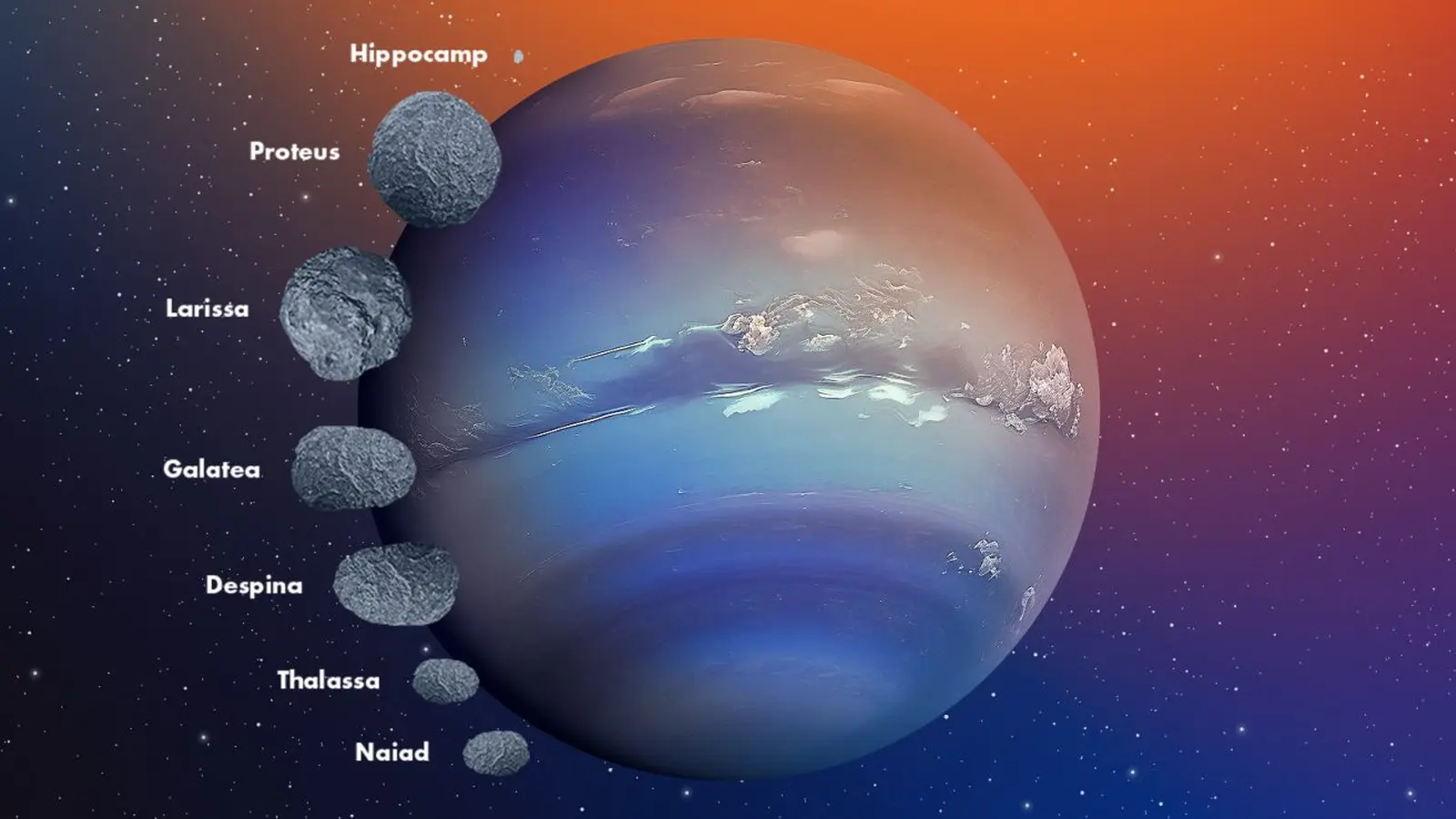
Imagine cracking open the buried heart of an icy world and finding clay where you expected pure frost. That is effectively what astronomers appear to have done around Neptune, using the James Webb Space Telescope like a forensic microscope on a planetary crime scene.
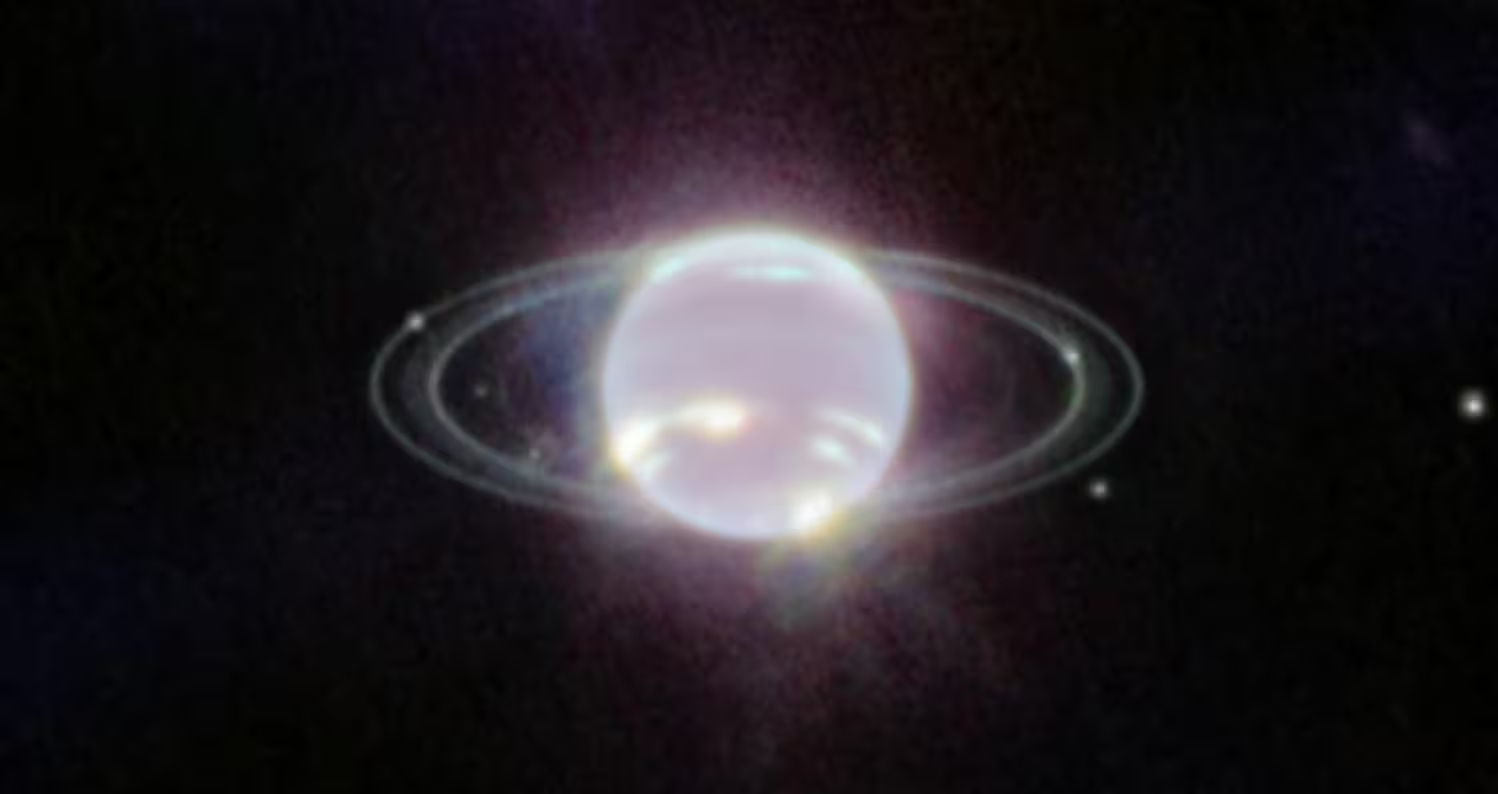
This image of the Neptune system, captured by the Near-Infrared Camera (NIRCam) on NASA’s James Webb Space Telescope in 2022, reveals stunning views of the planet’s rings- which have not been seen with this clarity in more than three decades- along with the planet’s inner moons.
Clues from spectra: unexpected minerals in small bodies
When Voyager 2 flew past Neptune in 1989 it added six previously unknown moons to our map of the planet. Five of them hug the planet just beyond its main rings and are tiny, dim, and stubbornly difficult to study from Earth. For decades they were little more than faint points in blurry images. Then Webb arrived, and with its near-infrared instruments scientists could finally split the light from those moons into precise spectral fingerprints.
The results were not what anyone expected. Larissa, Galatea, and the bright rings showed spectral features consistent with magnesium-rich phyllosilicates, a class of clay minerals that form only when liquid water alters rock. In the cold outer solar system, where surfaces are normally dominated by water ice, clay is a calling card of past internal heat and aqueous chemistry. That implies the source material came from deep inside a much larger, once-warm body.
Short sentence. Then another. The discovery rewrites part of Neptune’s history.
Ryleigh Davis, the lead author of the Science Advances paper and a former Caltech graduate student, put it plainly. The clays could not have formed on the current tiny moons. They had to originate in objects large enough to host internal heating and liquid water. Those interiors are not normally visible; they lie buried beneath kilometers of ice. Yet the spectra suggest those hidden layers were exposed and redistributed.
Adding to the mystery, the spectra for Larissa, Galatea, and the rings show little clear water-ice signature. That absence raises a tricky question: if the parent bodies contained abundant ice, where did it go? Some of it may be masked by darkening minerals. Some may have been thermally altered or sputtered away over time. The point remains: Webb is seeing mineralogies that demand an origin deep inside large icy worlds.
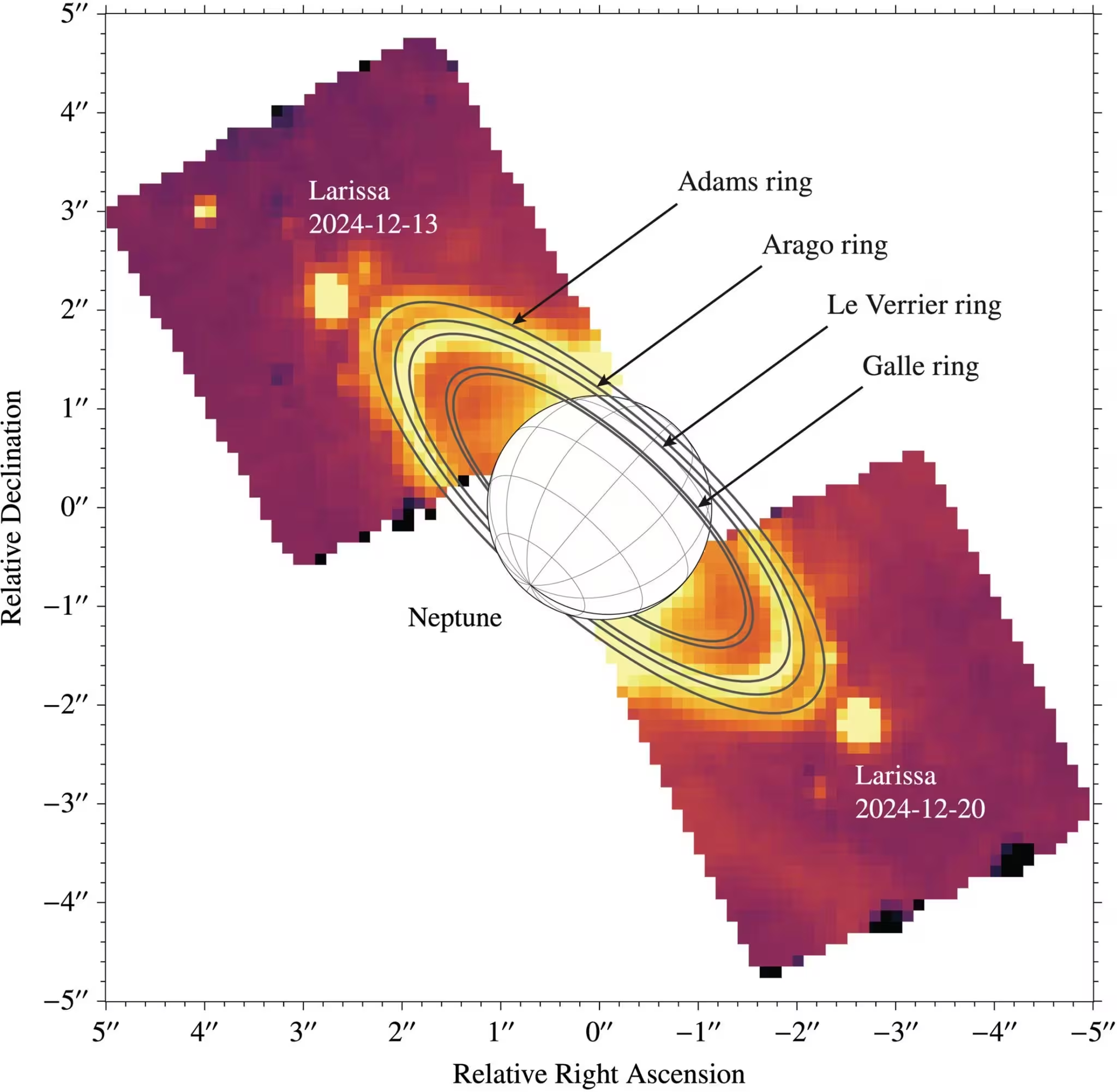
This JWST/ Near-Infrared Camera (NIRSpec) image of Neptune’s moon Larissa and rings was acquired on two dates when Larissa was on opposite sides of Neptune. The bright spots are Larissa, and the bright rings can be seen clearly. Neptune itself is positioned at the center, and the calculated positions of Neptune’s rings are overlaid in gray.
What could have turned moons inside out?
Two major scenarios can produce the kind of shattered, mixed material Webb is observing. The first is dynamic and dramatic: Triton, Neptune’s giant retrograde moon, did not form at Neptune. It was likely captured by Neptune’s gravity after forming elsewhere, perhaps in the Kuiper Belt. That capture, a violent gravitational dance, would have destabilized the planet’s existing satellites. Tidal forces and orbital chaos could have smashed a prior moon system into fragments and scattered debris across Neptune’s inner environment.
The second scenario posits a close encounter with a large Kuiper Belt object that itself was pulled apart by Neptune’s tides. Imagine a Pluto-sized body straying too near: tidal stresses rip it into pieces, and those fragments spread into a debris disk that later coagulated into the small moons and rings we see now.
Either way, the observational implication is the same. Material that once lay deep in a larger, differentiated body was excavated and now lives on the surface of much smaller satellites and in the rings. In other words, a catastrophic event effectively turned ancient icy moons inside out.
Proteus and the puzzle of diversity
Not every small moon shows identical chemistry. Proteus, the largest of the inner set examined, lacks the clear phyllosilicate signatures seen on Larissa and Galatea. That divergence suggests a complex reassembly process after the catastrophe. Proteus might have accreted from a different portion of the debris disk, one that contained fewer altered minerals. Alternatively, Proteus might have undergone later heating or shock processing that erased the clay signatures.
Across all three moons the team also detected an unidentified hydrated mineral. Its spectral pattern does not match anything in current laboratory libraries. That unresolved signature is a reminder that Webb is opening first-look windows into compositions we have not fully cataloged.
Scientific context and why this matters
We tend to think of the outer solar system as a frozen archive: cold ice, scattered rocks, and slow change. Webb’s findings buck that expectation. Phyllosilicates require aqueous alteration, which in turn implies internal heating and liquid water episodes — processes usually associated with larger, geologically active worlds. If Neptune’s inner moons are composed in part of material from such worlds, then the tiny satellites are preserved samples of interiors we cannot otherwise access.
That makes the inner Neptunian system an invaluable natural laboratory. Instead of inferring interior composition through models and remote density estimates, researchers can study actual fragments that carry the chemical fingerprints of deep planetary processes.
- Implication 1: A large moon system once existed around Neptune and was disrupted.
- Implication 2: Triton capture remains the leading mechanism to explain wholesale destruction.
- Implication 3: Small moons can preserve otherwise hidden mineralogy from larger parent bodies.
Mission details and methods
The observations come from Webb’s near-infrared instruments that separate light into fine spectral channels. Spectroscopy is how astronomers identify minerals at interplanetary distances: each mineral absorbs and reflects light at characteristic wavelengths. The Caltech-led program combined imaging and spectroscopy to map both spatial structure and chemical fingerprints of the rings and inner satellites.
Because these moons are small and faint, Webb’s sensitivity and spatial resolution were crucial. The team observed Larissa, Galatea, and Proteus at different orbital phases so they could isolate moon light from Neptune’s bright glare and from ring contributions. Careful data reduction and comparison to laboratory spectra allowed the identification of magnesium-rich phyllosilicates, while other features remain unassigned pending more laboratory work.
Expert Insight
Dr. Miriam Ortega, a planetary geochemist at a major university, who was not involved with the study, commented: “Finding phyllosilicates this far from the Sun changes the questions we ask about outer solar system evolution. It forces us to consider that aqueous alteration was more widespread, and that collisions or capture events exposed interior materials we otherwise cannot sample. Webb is giving us access to a class of planetary relics that serve as time capsules for early heating and chemistry.”
What this tells us about Neptune’s timeline
If Triton’s capture is the culprit, we can sketch a rough sequence. First, Neptune hosts a system of regular moons, likely icy and differentiated much like the satellites of Uranus. At some point an external giant — Triton — is captured. The capture injects angular momentum and energy into the system. The existing moons are destabilized and destroyed. Debris briefly forms a dense disk. Over time, some fraction of that material reaccretes into the small moons we observe today, while the rest escapes or falls into Neptune.
Modeling suggests that only a small percentage of fragmented material remains bound long enough to form new satellites. Davis noted an estimate that roughly one percent or so of the original mass might persist in the system after such upheaval. Yet even with low survival rates, the pieces that did stay hold priceless information.
Open questions and next steps
Several puzzles remain. Why is ice so muted in the spectra where clays appear? What is the unidentified hydrated mineral found across multiple moons? How exactly did debris dynamics, collisional grinding, and re-accretion operate in the aftermath of a capture or tidal disruption? Answering those questions will require more observations, laboratory spectral work, and dynamical simulations tailored to Neptune’s environment.
Future JWST observations could expand the sample to other small Neptunian satellites and to Nereid, a moon some researchers suspect might be the only largely intact survivor of the original system. Additional ground-based observations and improved spectral libraries for altered ices and hydrated minerals will also be essential.
Conclusion
Webb has turned Neptune’s inner system into a forensic record. The presence of clay minerals implies past episodes of internal heating and liquid water within much larger parent bodies, and the diversity among small moons points to a violent reshaping of the satellite population. Whether that reshaping was primarily the result of Triton’s capture or a different tidal disruption, the consequence is clear: Neptune’s small moons preserve fragments of ancient, once-hidden interiors. Those fragments offer a rare chance to study the deep chemistry of icy worlds without drilling or landing.
The next phase will be reconstruction. Combining Webb’s spectral clues with dynamical models, laboratory experiments, and further telescope campaigns should let scientists estimate the sizes of the original moons, reconstruct the violence of their demise, and refine our understanding of how outer solar system systems evolve after catastrophic encounters.

“The cosmos has always fascinated me. I write about space missions, astronomy, and the technologies pushing humanity beyond Earth.”

Discussion
Leave a Comment
Comments (4)
Makes sense tbh. Triton capture explains the chaos, though I'm still wondering how the ice got hidden or altered... also Larissa is a lovely name lol
Pretty balanced take. Webb's spectra are game changers, but lab work needed to ID that unknown hydrated mineral. Proteus being different is intriguing
Is this even true? Clays need long term water, right. So where did the heat come from? Triton capture, or an interloper? Sounds bold, need more data
Wow clay on Neptune's moons? Mind blown. Like finding a fossil in a freezer. If true, whole history gets rewritten... crazy but kinda awesome