
Imagine a cookbook full of ingredients and an oven that no longer produces the meals it used to. The recipe hasn’t vanished. The pantry remains stocked. Yet dinner is suddenly rare.
When the cosmic furnace slows
Astronomers have long known that the Universe was far more prolific at building stars billions of years ago than it is now. Star formation peaked in the distant past and has since declined sharply. Over roughly the last 4.5 billion years, the global rate at which new stars form has dropped to less than half of what it once was. That is a big change. It is also puzzling because one of the raw materials for stars, neutral atomic hydrogen, has not vanished at a matching pace.
Neutral atomic hydrogen, commonly labeled HI, is the diffuse, cold gas that fills galactic reservoirs. It emits a faint radio signal at a wavelength of 21 centimeters. Detecting that whisper across cosmic distances is difficult. Background noise is loud. Telescopes with great sensitivity can hear faint tones but usually only in narrow patches of sky. Wide surveys see more sky but miss the softest signals. This observational trade-off has left a hole in our picture of how HI evolved across the low- to intermediate-redshift Universe.
How two instruments bridged the gap
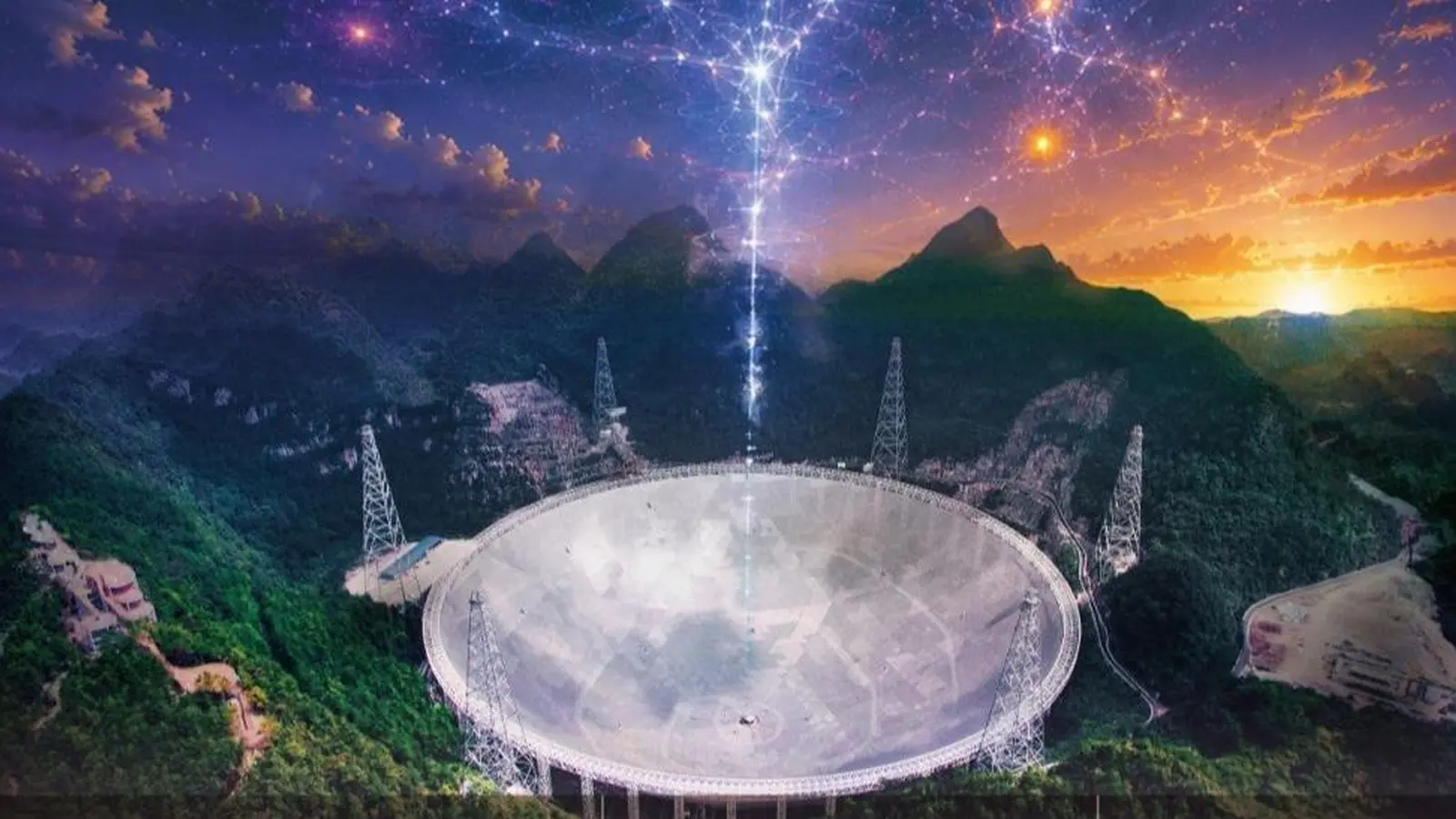
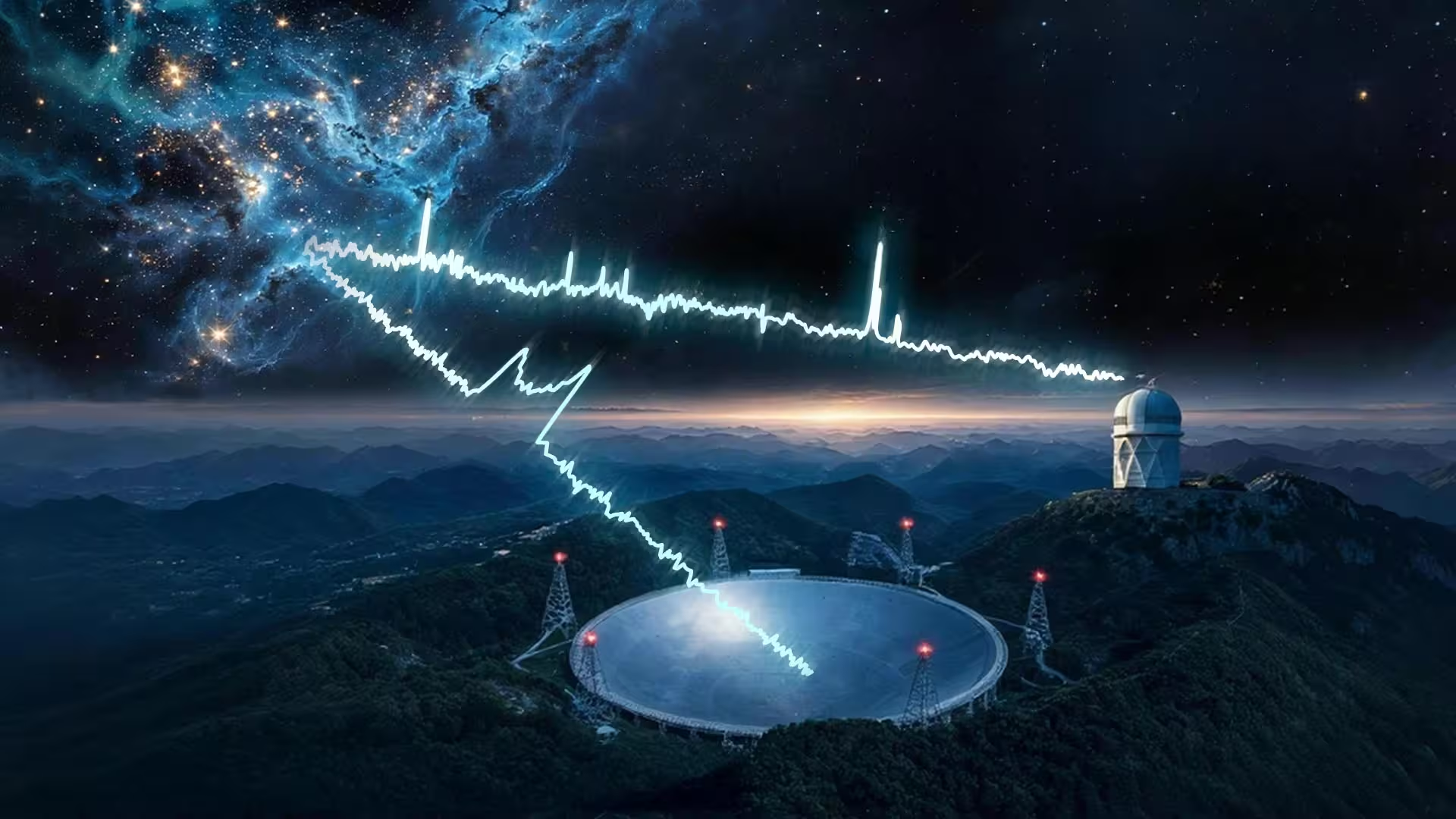
To close that gap, a team led by researchers at the Chinese Academy of Sciences combined observations from two complementary projects: the Five-hundred-meter Aperture Spherical radio Telescope, known as FAST, and the Dark Energy Spectroscopic Instrument, DESI. The strategy was straightforward in concept and demanding in practice. Use DESI to measure precise redshifts for millions of galaxies. Use FAST to listen for their 21-centimeter emissions. Stack many faint radio spectra, aligned by redshift, until the signal climbs above the noise.
Stacking the faint signals
Stacking is elegant. A single distant galaxy’s HI emission is typically too weak to detect. But millions of galaxies contribute tiny pieces of information. When those pieces are shifted into the same rest frame and added, the average HI profile emerges. The team applied this technique to roughly 2.5 million galaxies across nearly one-third of the sky. The combined dataset delivered the most precise measurement to date of how neutral atomic hydrogen density has changed during the last 4.5 billion years.

The headline was unexpected. About 4.5 billion years ago, the Universe formed stars at roughly 2.5 times the present rate. Yet the density of HI back then was only about 1.4 times higher than today. In plain terms: star formation fell much faster than the reservoir of neutral hydrogen.
Why less star formation without losing the fuel?
That mismatch forces a shift in the central question. It is no longer enough to ask whether galaxies simply ran out of gas. Instead we must ask why gas that still exists is failing to turn into stars. The answer appears to lie in how gas moves and transforms inside and around galaxies — the long-running baryon cycle that governs how material flows from the cosmic web into halos, cools, becomes molecular, and finally collapses into stars.
Stars do not form directly from diffuse HI. They require dense molecular clouds, mostly H2. HI acts as an intermediate stage, a kind of holding pattern between the large-scale supply and the small-scale sites of star birth. If the rates at which HI converts into molecular hydrogen decline, then star formation will lag even if HI remains abundant.
Why would that conversion slow? Several physical processes can contribute. The cosmic inflow of fresh gas from intergalactic filaments may have waned as structure formation matured. Heating processes — from supernova-driven winds, active galactic nuclei, or a warmer circumgalactic medium — can prevent gas from cooling and condensing. Environmental factors like interactions, stripping, or a drop in the dense-phase pressure can reduce the fraction of gas that becomes molecular. Any combination of these effects would leave HI reservoirs in place while choking off the supply of star-forming molecular gas.
Broader implications for galaxy evolution
These measurements do more than resolve a numerical discrepancy. They redirect theoretical work. Models that explain the late-time decline in star formation must now reproduce a situation where HI is relatively stable while molecular gas and star formation fall away. That constrains feedback efficiencies, the timing and amount of gas accretion, and the microphysics of cloud formation inside galaxies.
The new FAST plus DESI benchmark provides a reference point for simulations and other observational programs. For example, radio surveys planned with the Square Kilometre Array will probe HI across even larger volumes and to greater depths. Millimeter facilities such as ALMA and upcoming instruments will trace the molecular component directly, allowing researchers to test whether the fraction of H2 relative to HI indeed declines with time as this study suggests.

Expert Insight
"What surprised many of us was how gentle the drop in HI density appears compared with the dramatic fall in star formation," says Dr. Elena Marquez, an astrophysicist at the European Southern Observatory. "It tells a story in which galaxies hold on to their raw material but gradually lose the ability to process it into stars. Understanding the bottleneck — whether it is accretion, cooling, or feedback — is now the critical next step."
Dr. Marquez adds that combining multiwavelength data is essential. "You need optical redshifts, deep radio sensitivity, and molecular tracers together. Each observes a different chapter in the gas’s life. Only then can we read the full narrative of galaxy quenching."
Future prospects and technologies
The study showcases a practical path forward: pair enormous optical spectroscopic catalogs with deep radio observations and use statistical techniques to extract signals below individual detection thresholds. That same approach will scale up as surveys expand. DESI continues to map millions more galaxy redshifts. FAST will keep accumulating sensitive radio spectra. In parallel, instruments targeting CO and other molecular lines will reveal whether the predicted decline in molecular gas is real and widespread.
Improved simulations that include realistic treatments of inflows, feedback, and the multiphase interstellar medium will be judged against these observational anchors. If models cannot reproduce a large HI reservoir with declining H2 and star formation, then our understanding of the baryon cycle must change.
Conclusion
The Universe still stores much of the fuel needed to make stars, but it has become less efficient at converting that fuel into luminous stellar populations. The combined FAST and DESI analysis reframes the problem: the late-time slowdown in cosmic star formation is not primarily about running out of hydrogen. It is about the evolving flow and phase transitions of gas within galaxies. The data provide a new yardstick for theory and point the way toward the next observational campaigns that will test why the cosmic kitchen is no longer producing as many new stars.

“The cosmos has always fascinated me. I write about space missions, astronomy, and the technologies pushing humanity beyond Earth.”

Discussion
Leave a Comment
Comments (3)
Feels a bit overhyped, they stacked millions but averaging hides the messy details. Need more CO measurements pls. promising tho
is this even solid? HI barely dropped but star formation plunged, could stacking or selection bias be fooling us? curious, not convinced
wow, that hit different... Galaxies hoarding gas but not making stars?? kinda eerie. The stacking trick is brilliant, and a bit sad